Kurogane Type 95 Scout Car

Kurogane Type 95 Scout Car

CountryJapan
TypeReconnaissance car
PhotographYuri Pasholok
Topic

Album of 144 photos walk-around of a «Kurogane Type 95 Scout Car»

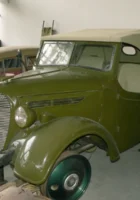
Photo gallery of a Kurogane Type 95 Scout Car, The Type 95 Kurogane (“Black Metal”) reconnaissance car was a Japanese scout car used during the war with China and World War II in the East. Between 1937 and 1945 approximately 4,800 were built. It was the only completely Japanese designed reconnaissance car ever used by the Japanese Army, which tended to use civilian cars. The Type 95 could accommodate only 3 persons – two in the front and one in the back. The two-cylinder air-cooled petrol engine was an advantage in cold climates encountered in China and it had 4-wheel drive. It was unarmed and unarmoured.

Source: Kurogane Type 95 Scout Car on Wikipedia

Continue reading

Views : 5274

Stormartillerivagn M-43

Stormartillerivagn M-43

CountrySweden
TypeAssault artillery wagon
PhotographTim Roberts
Topic

Album of 37 photos walk-around of a «Stormartillerivagn M-43»

Photo gallery of a Stormartillerivagn M-43, Stormartillerivagn m/43 (Sav m/43) (English: model 1943) was an assault gun based on Stridsvagn m/41 SII chassis, a Swedish development of a license-built Czech TNH medium tank. The Sav m/43 was first armed with a 75 mm gun, later they were rearmed with a 105 mm m/44 gun.

Source:: Stormartillerivagn M-43 on Wikipedia

Continue reading

Views : 3660

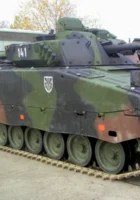
SPz2000

SPz2000

CountrySweden
TypeInfantry fighting vehicle
PhotographGunther Neumahr
Topic

Album of 56 photos walk-around of a «SPz2000»

Photo gallery of a SPz2000, The Stridsfordon 90 (Strf 90) (Eng. Combat Vehicle 90 (CV90)) is a family of Swedish tracked combat vehicles designed by FMV, Hägglunds and Bofors during the mid-1980s and early 1990s. The Swedish version of the main infantry fighting vehicle is fitted with a turret from Bofors that is equipped with a 40 mm autocannon, although export versions use 30 mm and 35 mm autocannons. Developed specifically for the Nordic sub-arctic climate, it has very good mobility in snow and wetlands while carrying and supporting eight (later versions were reduced to six) fully equipped soldiers. Other variants include Forward Observation, Command and Control, Anti-air, Armoured Recovery, Electronic Warfare and so forth. It is still produced and being developed further by BAE Systems Hägglunds AB.

Source:: SPz2000 on Wikipedia

Continue reading

Views : 2625

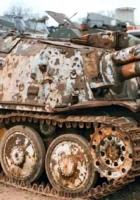
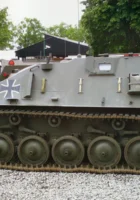
SPz kurz KrKW Hotchkiss

SPz kurz KrKW Hotchkiss

CountryGermany
TypeArmored vehicule

Photo gallery of a SPz kurz KrKW Hotchkiss, The SPz kurz KrKW (Hotchkiss) belonged to the initial supply the Bundeswehr with armored vehicles. The tank was based on the armored TT 6 French company Hotchkiss, the landing gear but was extended for a further five castors. From 1959 to 1967 1,600 cars were built under license at Magirus-Deutz in Mainz. The most famous version was the Spähpanzer, which was used to light reconnaissance troop in two vehicles.

Source: SPz kurz KrKW Hotchkiss on Wikipedia

Continue reading

Views : 3287

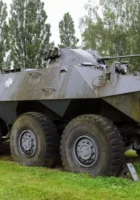
Spahpanzer 2

Spahpanzer 2

CountryWest Germany
TypeReconnaissance vehicle
Produced1975–1977
Built408

The Spähpanzer Luchs (English: Lynx) is a German 8×8 amphibious reconnaissance armoured fighting vehicle (Spähpanzer) in service since 1975 with the German Army, who used 408 in their armoured reconnaissance battalions. It was developed by Daimler-Benz between 1968 and 1975, replacing the M41 and the Schützenpanzer SPz 11-2 Kurz. The all-wheel drive Luchs made by Thyssen-Henschel (now: Rheinmetall) is well armoured, has an NBC protection system and is characterized by its low-noise running. The eight large low-pressure tyres have run-flat properties. At speeds up to about 50 km/h, all four axles can be steered. As a special feature, the vehicle is equipped with a rear-facing driver with his own driving position. Up to the first combat effectiveness upgrade in 1986, the Luchs was fully amphibious and could surmount water obstacles quickly and independently using propellers at the rear and the fold back trim vane at the front.

Source: Spahpanzer 2 on Wikipedia

Continue reading

Views : 3534

Royal Aircraft Factory BE2A

Royal Aircraft Factory BE2A

CountryUK
TypeBiplane aircraft
PhotographVladimir Yakubov
PlaceRAAF Museum, Point Cook, Australia
Topic

Album of 53 photos walk-around of a «Royal Aircraft Factory BE2A»

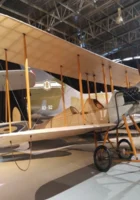
Photo gallery of a Royal Aircraft Factory BE2A, The Royal Aircraft Factory B.E.2 was a British single-engine tractor two-seat biplane which was in service with the Royal Flying Corps (RFC) from 1912 until the end of World War I. About 3,500 were built. Initially used as front-line reconnaissance aircraft and light bombers; variants of the type were also used as night fighters. Like many warplanes since, the B.E.2 was retained in front-line service long after it had become obsolete, for want of a suitable replacement. After its belated withdrawal it finally served as a trainer, communications aircraft and on anti-submarine coastal patrol duties.

Source: Royal Aircraft Factory BE2A on Wikipedia

Continue reading

Views : 2951

SKP M-42

SKP M-42

CountrySweden
TypeArmoured personnel carrier
PhotographThord Wedman
Topic

Album of 16 photos walk-around of a «SKP M-42»

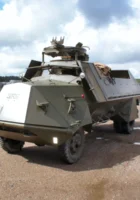
Photo gallery of a SKP M-42, Terrängbil m/42 KP (Tgbil m/42 SKP/VKP), meaning “Off-road vehicle 42” with a secondary designation of “Scania, Bodywork: Armoured” or “Volvo, Bodywork: Armoured”, was the Swedish army’s first armoured personnel carrier, developed as a stop-gap measure during World War II. In 1941, when tanks were organized into a unit of their own, it was clear there was a desperate need for a troop carrier able to both keep up with the tanks and provide protection against artillery shrapnel and small-arms fire. Due to the war there were no international suppliers to buy from, so the only option was to develop a domestic solution. AB Landsverk designed an APC consisting of a chassis from a regular army lorry equipped with an armoured shell.

Source: SKP M-42 on Wikipedia

Continue reading

Views : 2786

Tatra 813 Kolos

Tatra 813 Kolos

CountryCzechoslovakia
TypeHeavy Truck
Production period1967-1982
SuccessorTatra T815

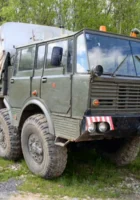
Photo gallery of a Tatra 813 Kolos, Tatra T813 was a truck produced in Czechoslovakia by the Tatra company. The first prototype already built in 1960 utilized existing Tatra T138 assemblies in 4×4 full-time all-wheel drive, which was also another first for Tatra. After the initial trials however the designers decided to develop and expand the concepts onto 8×8 all-wheel-drive all-terrain vehicle. The basis of the design thus became the modular chassis of T813. Successor is the Tatra T815 model.

Source: Tatra 813 Kolos on Wikipedia

Continue reading

Views : 4299

Sjvpbv 4024

MT-LB Sjvpbv 4024

CountrySweden
TypeMilitary ambulance
PhotographerThord Wedman
Topic

Album of 28 photos of a MT-LB Sjvpbv 4024

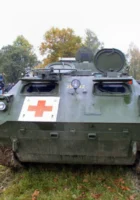
Photo galery of a MT-LB Sjvpbv 4024 , The MT-LB (Russian: Многоцелевой Тягач Легкий Бронированный, Mnogotselevoy Tyagach Logkiy Bronirovannyi / light multi-purpose armoured towing vehicle) is a Soviet multi-purpose fully amphibious auxiliary armoured tracked vehicle, which was first introduced in the late 1960s. Initially, the vehicle was known as the M 1970 in the west. Sweden :Sjvpbv 4024 (sjukvårdspansarbandvagn) – Military ambulance.

Source: MT-LB Sjvpbv 4024 on Wikipedia

Continue reading

Views : 3439

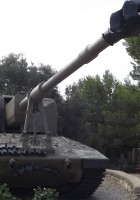
Merkava based Sholef

Merkava Howitzer Sholef

CountryIsrael
TypeSelf-propelled artillery
PhotographsSasha Lev
Topic

Album of 23 photos walk-around of a «Merkava Howitzer Sholef»

Photo gallery of a Merkava Howitzer Sholef, Two prototypes of Sholef (“Slammer”, Hebrew slang for “Gunslinger”) 155 mm self-propelled howitzer with automatic loading system were built by Soltam in 1984–1986. The 45-ton vehicle had a long 155 mm gun barrel giving a range of 45+ km. Using GPS, inertial navigation, and an internal fire control computer, it was also capable of direct fire while on the move. It never entered production. The Slammer is a heavily armored artillery gun mounted on a modified Merkava Mk 1 chassis. Many of these vehicles are Merkava Mk 1 that were retired after the Merkava Mk 2 and Merkava Mk 3 came into service. The Slammer has a long 52-caliber gun barrel that allows +10% range. Reload speed may be decreased to 1 for one minute every 10 minutes through use of an automatic loader. Ammunition racks are large. The Slammer is ready for autonomous operation (without an FDC) if the target’s location is known within 15 seconds of a halt, using GPS, inertial navigation, and an internal fire control computer. The Slammer 155 mm self-propelled howitzer is based on a modified Merkava MBT chassis fitted with a new welded steel turret, designed by Soltam Systems. Development commenced in the 1970s. The project was considered of high national priority and incorporated the newest technological developments. Instead the Israeli Defense Forces selected an upgraded version of American M109 howitzer.

Source: Merkava Howitzer Sholef on Wikipedia

Continue reading

Views : 4043