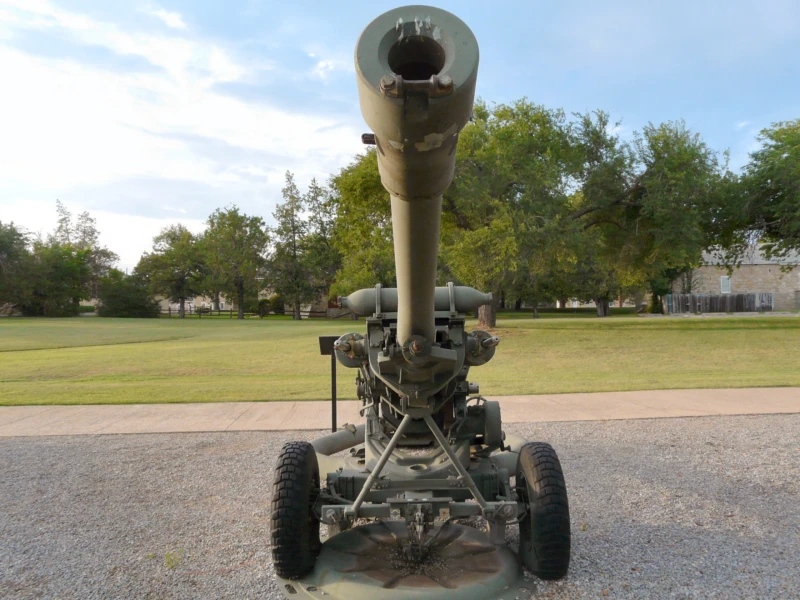
M119 howitzer | |
|---|---|
| Country | UK |
| Role | Towed howitzer |
| Produced | 1989 |
| Built | Unknow |
The M119 howitzer is the US designation for the L119 light gun, a lightweight British 105 mm howitzer also used by the United States Army. It can be easily airlifted by helicopter, or dropped by parachute. It does not need a recoil pit.
Source: M119 howitzer on Wikipedia
| M119 105mm Howitzer Walk Around | |
|---|---|
| Photographer | David Lueck |
| Localisation | Unknow |
| Photos | 43 |

See also:


The Air-Mobile Lightweight Field Artillery Workhorse
The M119 Howitzer is a lightweight 105 mm towed field artillery piece manufactured for the United States Army. Directly derived from the British Army’s acclaimed L118 Light Gun (designed by the Royal Ordnance Factory in the 1970s), the M119 was adopted by the US military in December 1989 to replace the aging M102 howitzer. Built to provide rapid, responsive fire support to light infantry, air assault, airborne, and mountain divisions, the M119 can be deployed quickly via sling-load under UH-60 Black Hawk or CH-47 Chinook helicopters, or air-dropped by parachute from C-130 Hercules aircraft. Through successive American upgrades—culminating in the digitized M119A3—the system integrates advanced digital fire control, GPS positioning, and inertial navigation, making it a cornerstone of rapid-reaction expeditionary artillery operations.
| Attribute | Technical Specification (M119A2 / M119A3 Standard) |
|---|---|
| Role | Lightweight Towed Field Artillery / Air-Mobile Fire Support |
| Crew | 5 to 7 Artillerymen (Section Chief, Gunner, Assistant Gunner, Cannoneers) |
| Caliber & Barrel Length | 105 mm (4.13 in) | 37-caliber barrel length (Ordnance L20 / M204) |
| Maximum Firing Range | 13,700 m (8.5 miles) with standard M1 HE | 19,500 m (12.1 miles) with rocket-assisted projectiles (M913 HERA) |
| Rate of Fire | 6 rounds per minute (maximum for 2 minutes) | 3 rounds per minute (sustained) |
| Combat Weight | 2,130 kg (4,700 lbs) for M119A2 | ~2,268 kg (5,000 lbs) for digitized M119A3 |
| Carriage Type | Tubular box-section bow trail with integrated 360-degree base firing platform (turntable) |
| Elevation / Traverse | Elevation: -5.6° (-100 mils) to +70° (+1244 mils) | Traverse: 11° left/right on carriage (360° via turntable) |
| Towing / Transport Options | Towed by M1097/M1152 HMMWVs or MTVR 4×4 trucks; sling-loadable under UH-60/CH-47; C-130/C-17 air-droppable |
| Production & Conversion Total | 1,000+ units produced across British Royal Ordnance and US Army Ordnance Depot production programs |
Design Engineering: Bow Trails, Turntables, and Digital Fire Control
- Curved Tubular Bow Trail Structure: Unlike traditional split-trail or box-trail carriages, the M119 features a distinctive single tubular steel “bow” trail. This open-arch shape allows the gun tube to elevate to extreme angles (+70 degrees) without hitting the carriage legs, permitting effective high-angle firing trajectories over mountainous terrain.
- 360-Degree Base Firing Turntable: Attached beneath the lower carriage is a circular steel firing platform. During battery emplacement, the turntable is lowered to rest directly on the ground. This allows a small gun crew to manually pivot the entire gun 360 degrees in seconds to counter emerging directional threats, bypassing carriage traverse limits.
- Low-Impulse Recoil Mechanism: The ordnance utilizes a hydro-pneumatic recoil system paired with a high-efficiency double-baffle muzzle brake. This combination absorbs the high energy of 100-series semi-fixed ammunition charges, keeping carriage weight low while maintaining steady ground anchor stability during rapid firing sequences.
- M119A3 Digital Fire Control System (DFCS): The modernized M119A3 variant replaced manual optical sights with an integrated digital fire control suite identical to the M777A2 155 mm howitzer. Incorporating GPS, inertial navigation, a digital gun display unit, and a laser inertial artillery pointing system (LINAPS), the M119A3 can execute “shoot-and-scoot” missions, opening fire within seconds of dropping off the transport vehicle.
Operational History: Desert Storm, Afghan Mountains, and Global Service
- US Army Adoption and Gulf War Deployment (1989–1991): Following its formal adoption in 1989, the M119 was deployed with the 82nd Airborne Division and 101st Airborne Division (Air Assault) during Operation Desert Storm, proving its mobility in high-tempo desert maneuvering warfare.
- The Fire Base Anchor of Operation Enduring Freedom (Afghanistan): In the high-altitude terrain of eastern Afghanistan, heavy self-propelled artillery was difficult to maneuver. The M119 became the primary fire-support weapon for the US Army’s 10th Mountain Division and 173rd Airborne Brigade, regularly transported by CH-47 Chinooks directly onto remote mountain ridge tops to protect isolated combat outposts (COPs).
- Transition to the Digitized M119A3 (2013–Present): Introduced in 2013, the M119A3 upgrade digitized light artillery operations. By eliminating the time needed for manual optical collimator surveys, gun batteries can fire their first round almost immediately upon landing, drastically lowering counter-battery radar exposure.
- International Combat Transfers: As part of military aid packages to Ukraine, dozens of M119A3 and L118/L119 light howitzers were transferred from US and British stocks. Ukrainian artillery units praised the howitzer for its rapid setup times, high rate of fire, high accuracy, and lightweight towing capability behind light utility trucks.
Views : 2700
You can see also :
 K9 Thunder – Photos & Videos
 M270 Multiple Launch Rocket System – Photos & Video
 10.5 cm leFH 16 – Photos & Videos
 M109 howitzer – Photos & Videos
 QF 25pdr Mark II Field Gun – Photos & Video
 US 105mm M2A2 Field Gun – Photos & Video
 M43 Howitzer Motor Carriage – Photos & Video
 M7B2 Priest – Walkround
 Soviet 122mm D-30 Howitzer – Walk Around
 M7 Priest – Walkround