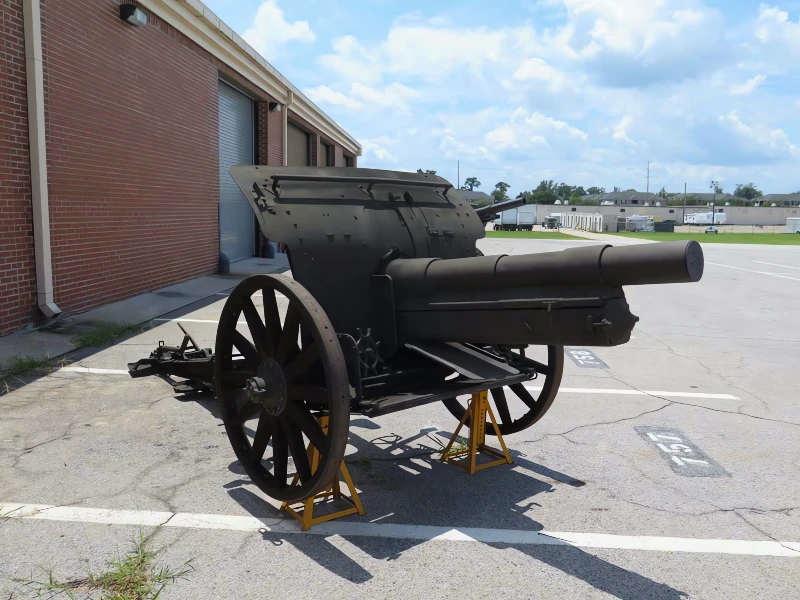
10.5 cm leFH 16 | |
|---|---|
| Country | German Empire – Nazi Germany |
| Role | Field howitzer |
| In service | 1916–45 |
| Built | Unknow |
The 10.5 cm leichte Feldhaubitze 16 (10.5 cm leFH 16) was a field howitzer used by Germany in World War I and World War II. The 10.5 cm leichte Feldhaubitze 16 was introduced in 1916 as a successor to 10.5 cm Feldhaubitze 98/09, featuring a longer barrel and hence longer range. It had the same carriage as the 7.7 cm FK 16.
Source: 10.5 cm leFH 16on Wikipedia
| German 10.5 cm leFH 16 Field Howitzer Walk Around | |
|---|---|
| Photographer | Vladimir Yakubov |
| Localisation | South Carolina Military Museum |
| Photos | 63 |

See also:


The Imperial German Workhorse Howitzer of the Western Front
The 10.5 cm leichte Feldhaubitze 16 (10.5 cm leFH 16) was a standard German light field howitzer introduced in 1916 by Rheinmetall to replace the earlier 10.5 cm leFH 98/09 during World War I. Engineered to meet the brutal demands of trench warfare, the leFH 16 featured a longer barrel, improved range, and a hydro-pneumatic recoil system designed to out-range Allied field artillery on the Western Front. Renowned for its reliability and devastating high-explosive capabilities, it served as the backbone of Imperial German field artillery batteries through the end of the Great War. Despite post-war treaty restrictions, hundreds of surplus howitzers were retained, modernized, and pressed back into active frontline and second-line service by the Reichswehr and the Wehrmacht during World War II.
| Attribute | Technical Specification (10.5 cm leFH 16 / Modernized leFH 16 n.A.) |
|---|---|
| Role | Light Field Howitzer / Direct & Indirect Infantry Support Artillery |
| Crew | 5 to 7 Artillerymen (Gun Commander, Gunner, Loader, Shell Handlers) |
| Caliber & Barrel Length | 105 mm (4.13 in) | 22-caliber barrel length (L/22, ~2.31 m barrel) |
| Maximum Firing Range | 9,225 m (10,088 yards / 5.7 miles) with standard high-explosive projectile |
| Rate of Fire | 4 to 5 rounds per minute (sustained) | Up to 8 rounds per minute (maximum) |
| Combat Weight | 1,525 kg (3,362 lbs) in firing position | 2,245 kg (4,949 lbs) transport weight with limber |
| Carriage Type | Box-trail carriage with integrated steel gun shield and spoked wooden/steel wheels |
| Elevation / Traverse | Elevation: -10° to +40° | Traverse: 4° total carriage traverse (2° left/right) |
| Towing / Transport Options | Horse-drawn 6-horse team with limber; later modified for motorized towing with rubberized wheels |
| Production Total | ~3,000+ units produced between 1916 and 1918 by Rheinmetall and Krupp |
Design Engineering: Barrel Elongation, Hydro-Pneumatic Recoil, and Separate-Loading Ammunition
- Extended L/22 Barrel Design: Developed as an urgent wartime upgrade to counter the French 75 mm and British 18-pounder quick-firing guns, the leFH 16 lengthened the barrel from 16.2 calibers (on the older leFH 98/09) to 22 calibers. This increased muzzle velocity to 395 m/s and extended maximum engagement range by nearly two kilometers.
- Hydro-Pneumatic Recoil System: Placed beneath the barrel inside the cradle, the hydro-pneumatic recoil mechanism absorbed the heavy shock of 105 mm firing. This allowed the gun to stay anchored in position between shots without requiring the crew to relevel the carriage after every round.
- Separate-Loading Variable Charges: The howitzer utilized separate-loading cased ammunition consisting of a high-explosive, shrapnel, or gas shell paired with a brass cartridge casing holding variable powder bags (Charges 1 through 5). This allowed battery commanders to adjust trajectory angles over high ridge lines and deep enemy trench lines.
- Box-Trail Carriage and Protective Shield: Built on a rigid steel box-trail carriage, the gun incorporated a curved steel shield to protect the crew from small-arms fire and shell splinters. A spade embedded at the end of the trail dug into the ground to anchor the weapon against recoil forces.
Operational History: Spring Offensives, Interwar Survival, and WWII Coast Defenses
- World War I Western Front Debuts (1916–1918): Introduced during the Battle of the Somme, the leFH 16 provided crucial rolling barrages for German infantry units. During the 1918 Spring Offensive (Kaiserschlacht), it served as the main mobile artillery piece supporting stormtrooper tactics.
- Interwar Reichswehr Inventory & Modernization: Following the Treaty of Versailles, the Weimar Republic was allowed to retain a limited quantity of leFH 16 howitzers. During the 1930s, many were modernized as the leFH 16 n.A. (neue Art), swapping the original barrel onto the carriage of the newer 10.5 cm leFH 18.
- World War II Second-Line and Coastal Service: As the Wehrmacht adopted the modern leFH 18, surviving leFH 16s were reassigned to reserve divisions, training units, and coastal defense fortifications along the Atlantic Wall in occupied France and the Channel Islands.
- Self-Propelled Conversions (Gw leFH 16): Following the Fall of France in 1940, German forces captured hundreds of French FCM 36 and Geschützwagen 39H(f) light tank chassis. German engineers mounted surplus leFH 16 howitzers onto these tracked hulls to create improvised self-propelled artillery pieces (Panzerjäger/Artillerie-Selbstfahrlafette) used in Normandy in 1944.
Views : 3088
You can see also :
 Howitzer 149-19 – Photos & Video
 15 cm sFH 13 – Walk Around
 M108 howitzer – Photos & Videos
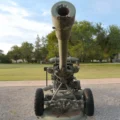 M119 howitzer – Photos & Videos
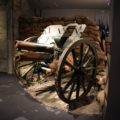 QF 4.5-inch howitzer – Photos & Video
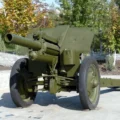 122mm M-30 – Photos & Video
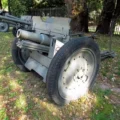 76 mm regimental gun M1927 – Photos & Video
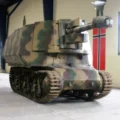 105mm leFH auf Hotchkiss 39H – Photos & Video
 LeFH18-40 – Walk Around
 M1918A1 155mm Howitzer – Walk Around
This is not a German 105cm lFH1916. This is a much rarer 10,5cm lFH Krupp 1916. The two howitzer types share almost nothing in common. Notice the barrel bands on the 10,5cm lFH Kp. 16 verses the typical lFH 16 and the lack of axel tree seats on the 10,5cm lFH Kp. 16 :
https://www.lovettartillery.com/MAT_10,5cm_lFH_Kp_Detail.html
https://www.lovettartillery.com/MAT_10,5cm_lFH_1916_Detail.htm
R/ Ralph Lovett: https://www.lovettartillery.com/