Pansarbandvagn 401

Pansarbandvagn 401

CountrySweden
TypeMulti-purpose armoured vehicle
PhotographThord Wedman
Topic

Album of 182 photos of a tank Pansarbandvagn 401

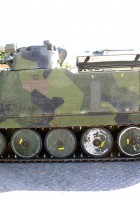
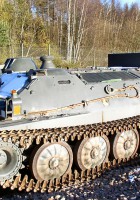
The MT-LB (Russian: Многоцелевой Тягач Легкий Бронированный, Mnogotselevoy Tyagach Logkiy Bronirovannyi / light multi-purpose armoured towing vehicle) is a Soviet multi-purpose fully amphibious auxiliary armoured tracked vehicle, which was first introduced in the late 1960s. Initially, the vehicle was known as the M 1970 in the west. Swedish MT-LB converted into Pbv 401 Pbv 401 (pansarbandvagn) – modified former East-German vehicle with 7.62 mm machine guns Ksp 95 and Ksp 58. Stripbv 4011 (stridsledningbandvagn) – battalion-level command post. Bgbv 4012 (bärgningsbandvagn) – Swedish designator for the MTP-LB. Rlpbv 4014/T (radiolänkbandvagn) – signals vehicle. Stripbv 4021 (stridsledningbandvagn) – company-level command post. Sjvpbv 4024 (sjukvårdspansarbandvagn) – Military ambulance. Lvrbpbv 4016 (luftvärnsrobotbandvagn) – unconfirmed designator for vehicles, equipped with RBS 70. Pvrbbv 452 (pansarvärnrobotbandvagn) – with RBS 56 BILL 1 Anti-tank guided weapon.

Source: Pansarbandvagn 401 on Wikipedia

Continue reading

Views : 4151

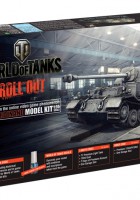
FERDINAND ITALERI 36501

Italeri

Ref 36501
SerieWorld of Tanks
Scale1/35
Topic

FERDINAND

THE BOX CONTAIN: 1 MODEL KIT – 1 LIQUID CEMENT – 1 TANK GUIDE – WORLD oF TANKS DECALS – 3 INVITE CODES – 1 BONUS CODE

Official German designation: Sturmgeschutz (StuG) 8.8cm Pak43/2 (Ferdinand/Elefant) The StuG 8.8cm was based on the unsuccessful Porsche Tiger chassis fitted with a heavily armoured superstructure in the front and a mounted 8,8cm Pak 43/2 L/71 gun. A total of 90 vehicles were produced; they first saw combat in the Battle of Kursk (Operation Citadel). It was built in 1943 under the name Ferdinand, after its designer Ferdinand Porsche, but was soon renamed. After the Battle of Kursk, the remaining 48 vehicles were pulled out of service and given an overhaul. This included a ball-mount machine gun in the front along with a commander’s cupola. The name Elefant was soon decided upon. The vehicle was received with mixed feelings. It provided good protection with its thick armour but was severely unreliable in its mechanics due to the use of non-standard parts. Nevertheless, the Ferdinand/Elefant might well have been the most successful tank destroyer employed during the war, with a kills to losses ratio of approximately 10:1.

Source: Italeri

Continue reading

Views : 2152

PBV 302

Pansarbandvagn 302

CountrySweden
TypeArmoured personnel carrier
PhotographThord Wedman
Topic

Album of 155 photos of a tank Pansarbandvagn 302

Pansarbandvagn 302 (Pbv 302) is a Swedish high-mobility armoured personnel carrier that was developed to meet the operational requirements of the Swedish Army. It was designed and manufactured by Hägglund and Söner in Örnsköldsvik (now Hägglunds Vehicle AB). The design was commissioned in 1961 as a replacement for the Pbv 301. Production ran from 1966 until 1971. The vehicle has been upgraded and continues in limited service even though the CV 90 series is now the standard infantry fighting vehicle in Sweden, used both at home and by Swedish forces abroad.

Source: Pansarbandvagn 302 on Wikipedia

Continue reading

Views : 5537

Pansarbandvagn 301

Pansarbandvagn 301

CountrySweden
TypeArmoured personnel carrier
PhotographThord Wedman
TopicAlbum of 38 photos of a tank Pansarbandvagn 301

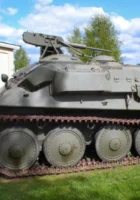
Pansarbandvagn 301 (pbv 301), was a Swedish armoured personnel carrier used by the Swedish Army. It was a typical “battle taxi”, armed with a 20 mm Bofors gun from the scrapped J21-fighters and with room for transporting 8 fully armed soldiers. The pbv 301 was an interim solution, built on the chassis from the obsolete Stridsvagn m/41, introduced in 1961 and removed from service in the late 1960s and early 1970s when the replacement pbv 302 came into use. The pbv 301 replaced the open-topped KP-bil armoured car as the armoured troop transport in the Swedish Army.

Source: Pansarbandvagn 301 on Wikipedia

Continue reading

Views : 3477

Douglas F4D-1 (F-6A) Skyray

Douglas F4D Skyray

CountryUSA
TypeSupersonic fighter/interceptor
PhotographerVladimir Yakubov
Topic

Album of 121 photos walk-around of a «Douglas F4D-1 (F-6A) Skyray»

Photo gallery of a Douglas F4D-1 (F-6A) Skyray, The Douglas F4D Skyray (later redesignated F-6 Skyray) was an American carrier-based supersonic fighter/interceptor built by the Douglas Aircraft Company. Although it was in service for a relatively short time and never entered combat, it was notable for being the first carrier-launched aircraft to hold the world’s absolute speed record, at 752.943 mph,[1] and was the first United States Navy and United States Marine Corps fighter that could exceed Mach 1 in level flight. It was the last fighter produced by the Douglas Aircraft Company before it merged with McDonnell Aircraft and became McDonnell Douglas. The F5D Skylancer was an advanced development of the F4D Skyray that did not go into service.

Source: Douglas F4D Skyray on Wikipedia

Continue reading

Views : 4830

Northrop F-5E Tiger II
Northrop F-5
CountryUSA
RoleLight Fighter
First flight30 July 1959<
Built2200+

The Northrop F-5A/B Freedom Fighter and the F-5E/F Tiger II are part of a supersonic light fighter family, initially designed in the late 1950s by Northrop Corporation. Being smaller and simpler than contemporaries such as the McDonnell Douglas F-4 Phantom II, the F-5 cost less to both procure and operate, making it a popular export aircraft. The F-5 started life as a privately funded light fighter program by Northrop in the 1950s. The design team wrapped a small, highly aerodynamic fighter around two compact and high-thrust General Electric J85 engines, focusing on performance and low cost of maintenance. Though primarily designed for the day air superiority role, the aircraft is also a capable ground-attack platform. The F-5A entered service in the early 1960s. During the Cold War, over 800 were produced through 1972 for U.S. allies. Though the USAF had no acknowledged need for a light fighter, it did procure roughly 1,200 Northrop T-38 Talon trainer aircraft, which were directly based on the F-5A.

Source: Northrop F-5E Tiger II on Wikipedia

Continue reading

Views : 19423

Panzerhaubitze 2000

Panzerhaubitze 2000

CountryGermany
TypeSelf-propelled howitzer
Produced1998-present
WarsWar in Afghanistan, Russian invasion of Ukraine

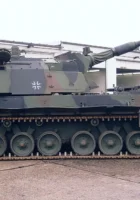
The Panzerhaubitze 2000 (“armoured howitzer 2000”), abbreviated PzH 2000, is a German 155 mm self-propelled howitzer developed by Krauss-Maffei Wegmann (KMW) and Rheinmetall for the German Army. The PzH 2000 is one of the most powerful conventional artillery systems deployed in the 2010s. It is particularly notable for a very high rate of fire; in burst mode it can fire three rounds in 9 seconds, ten rounds in 56 seconds, and can—depending on barrel heating—fire between 10 and 13 rounds per minute continuously.[1] The PzH 2000 has automatic support for up to 5 rounds of Multiple Rounds Simultaneous Impact (MRSI). The replenishment of shells is automated. Two operators can load 60 shells and propelling charges in less than 12 minutes. PzH 2000 has also been selected by the armies of Italy, Netherlands, Greece, Lithuania and Croatia, and more orders are probable as many NATO forces replace their M109 howitzers.

Source: Panzerhaubitze 2000 on Wikipedia

Continue reading

Views : 10095

Ba-3

BA-3

CountryURSS
TypeHeavy armored car
PhotographVladimir Yakubov
Topic

Album of 102 photos of a tank BA-3

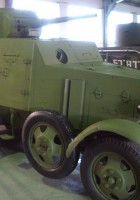
The BA-3 (Russian: Broneavtomobil 3) was a heavy armored car developed in the Soviet Union in 1933, followed by a slightly changed model BA-6 in 1936. Both were based mostly on BA-I, the most important development being the new turret, same as in the T-26 m 1933 and BT-5 tanks, and also equipped with the 45 mm main gun. Around 180 BA-3 cars were built at the Izhorskij and Vyksunskij factories, until production ended in 1935. BA-6 followed with 386 cars produced between 1936 and 1938 in Izhorskij factory. Most of BA-3 production was based on the Ford-Timken chassis, a 6×4 modification of the US Ford AA 4×2 truck, but the last batch was built on Russian version of the same chassis – GAZ-AAA, continued to be used in BA-6. The biggest limitation of the BA-3 was the mobility, limited to roads or very hard ground, the result of unnecessarily large weight. The innovation that slightly improved mobility were the auxiliary (“Overall”) tracks that could be fitted onto the rear tandem wheels, converting the car to half-track.

Source: BA-3 on Wikipedia

Continue reading

Views : 5128

Bachem Ba 349 Natter

Bachem Ba 349 Natter

CountryGermany
TypeRocket-powered interceptor
PhotographerVladimir Yakubov
Topic

Album of 65 photos walk-around of a «Bachem Ba 349 Natter»

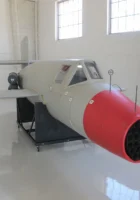
Photo gallery of a Bachem Ba 349 Natter, The Bachem Ba 349 Natter (English: Colubrid, grass-snake) was a World War II German point-defence rocket-powered interceptor, which was to be used in a very similar way to a manned surface-to-air missile. After a vertical take-off, which eliminated the need for airfields, most of the flight to the Allied bombers was to be controlled by an autopilot. The primary role of the relatively untrained pilot was to aim the aircraft at its target bomber and fire its armament of rockets. The pilot and the fuselage containing the rocket-motor would then land using separate parachutes, while the nose section was disposable. The only manned vertical take-off flight on 1 March 1945 ended in the death of the test pilot, Lothar Sieber.

Source: Bachem Ba 349 Natter on Wikipedia

Continue reading

Views : 5558

Douglas TF-10B Skyknight

Douglas TF-10B Skyknight

CountryUSA
TypeFighter aircraft
First flight23 March 1948
Built265

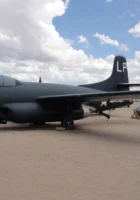
Photo gallery of a Douglas TF-10B Skyknight, The Douglas F3D Skyknight (later designated F-10 Skyknight) was a United States twin-engined, mid-wing jet fighter aircraft manufactured by the Douglas Aircraft Company in El Segundo, California. The F3D was designed as a carrier-based all-weather night fighter and saw service with the United States Navy and United States Marine Corps. The mission of the F3D was to search out and destroy enemy aircraft at night.

Source: Douglas TF-10B Skyknight on Wikipedia

Continue reading

Views : 9754