
FV107 Scimitar | |
|---|---|
| Country | UK |
| Role | Reconnaissance vehicle |
| Manufacturer | Alvis / BAE Systems Land & Armaments |
| Built | 500+ |
The FV107 Scimitar is an armoured reconnaissance vehicle (sometimes classed as a light tank) used by the British Army. It was manufactured by Alvis in Coventry. It is very similar to the FV101 Scorpion, but mounts a high velocity 30 mm L21 RARDEN cannon instead of a 76 mm gun. It was issued to Royal Armoured Corps armoured regiments in the reconnaissance role. Each regiment originally had a close reconnaissance squadron of five troops, each containing eight FV107 Scimitars.
Source: FV107 Scimitar Wikipedia
| Scimitar FV107 Walk Around | |
|---|---|
| Photographer | Vladimir Yakubov |
| Localisation | Ontario Regiment Museum |
| Photos | 83 |

See also:


The Swift, All-Terrain Armoured Reconnaissance Tracked Vehicle
The FV107 Scimitar is a British light armoured reconnaissance vehicle and a primary variant of the Combat Vehicle Reconnaissance (Tracked)—or CVR(T)—family designed by Alvis Vehicles of Coventry. Operational with the British Army from 1971 through its formal retirement in 2023, the Scimitar was built to perform high-speed battlefield armed reconnaissance, screen friendly flanks, and probe enemy lines. Exceptional ground mobility, an ultra-low ground pressure hull, and a dual-feed 30 mm L21 RARDEN autocannon allowed the Scimitar to cross swampy, heavily rutted terrain inaccessible to main battle tanks. Over its five decades of service—spanning the Falklands War, the Gulf War, the Balkans, Iraq, and Afghanistan—it proved to be one of the most versatile and dependable tracked combat vehicles in modern military history.
| Attribute | Technical Specification (FV107 Scimitar / CVR(T) Standard) |
|---|---|
| Role | Armoured Reconnaissance Vehicle / Light Scout Tank (CVR(T)) |
| Crew | 3 (Commander, Gunner, Driver) |
| Primary Armament | 1 × 30 mm L21 RARDEN autocannon (165 rounds carried in 3-round clips) |
| Secondary Armament | 1 × 7.62 mm L37A1 (or L94A1 chain gun) coaxial machine gun (3,000 rounds carried) |
| Powerplant | Jaguar 4.2L 6-cylinder petrol (original, ~190 hp) | Cummins BTA 5.9L turbocharged diesel (LEP upgrade, 190 hp) |
| Maximum Road Speed | 80.5 km/h (50 mph) top speed | Exceptional power-to-weight ratio (~24 hp/tonne) |
| Combat Weight | ~7,800 kg (17,200 lbs / 7.8 tonnes) baseline | ~12,000 kg (12 tonnes) for Scimitar Mk 2 with add-on armour |
| Dimensions | Length: 4.9 m (16 ft 1 in) | Width: 2.24 m (7 ft 4 in) | Height: 2.1 m (6 ft 11 in) |
| Hull Armor & Construction | E-type aluminum-zinc-magnesium alloy (Armour plate) with optional Plasan bar/slat composite add-on armor |
| Production Total | 3,000+ total CVR(T) family hulls built across British Alvis production lines and overseas export contracts |
Design Engineering: Aluminum Airframe Alloys, RARDEN Autocannons, and Low Ground Pressure
- Lightweight Aluminum Alloy Hull: The Scimitar’s structural hull was constructed entirely out of specially developed military-grade aluminum-zinc-magnesium alloy armor plate. This kept the baseline combat weight under 8 tonnes—enabling air transport inside C-130 Hercules cargo aircraft—while resisting medium-caliber shell splinters and heavy machine-gun fire.
- 30 mm L21 RARDEN Autocannon: Designed specifically for light armored vehicles, the long-recoil 30 mm RARDEN cannon fires high-velocity Armour-Piercing Discarding Sabot (APDS) and High Explosive (HE) rounds. The gun is hand-fed using compact three-round clips, eliminating heavy external belt-feed mechanisms while preventing spent cartridge gases from entering the cramped combat turret.
- Ultra-Low Ground Pressure Footprint: Featuring lightweight aluminum road wheels and rubber-bushed tracks, the Scimitar exerted less ground pressure than an adult human footprint (approx. 5 lbs/sq in). This allowed the vehicle to float across soft boglands, snowfields, and deep mud that would instantly bog down heavy main battle tanks.
- Scimitar Mk 2 Modernization: Under the Life Extension Programme (LEP) developed for the Afghan theater, the **Scimitar Mk 2** variant introduced a redesigned hull structure built on a Spartan APC chassis. It integrated a fuel-efficient Cummins diesel engine, improved blast-protected seats, air conditioning, modern thermal night-fighting sights, and heavy composite bar/slat armor suites against RPG threats.
Operational History: Falklands Combat, Desert Storm Sweeps, and Afghanistan Patrols
- The Falklands War Victory (1982): Operating with the Blues and Royals, two Scimitars and two Scorpios provided crucial armored direct-fire support to Royal Marines and Paratroopers during battles for Mount Tumbledown and Wireless Ridge. Their low ground pressure allowed them to traverse saturated Falklands peat bogs that halted all other mechanical vehicles.
- Gulf War Armoured Sweeps (1991 – Operation Granby): Deployed alongside the 1st Armoured Division, Scimitar troops screened the advance of heavy Challenger 1 tanks across the open Iraqi desert. Their high speed, low silhouetted profile, and thermal sights allowed them to outmaneuver enemy reconnaissance forces and relay target data back to artillery batteries.
- Peacekeeping in the Balkans & Operation Telic (Iraq): Throughout UN and NATO peacekeeping missions in Bosnia and Kosovo, as well as during the 2003 invasion of Iraq, Scimitars served as primary convoy escorts, urban reconnaissance platforms, and route-clearance security vehicles.
- Retirement and International Legacy: After over 50 years of distinguished service as the British Army’s principal light armored scout, the FV107 Scimitar fleet was officially phased out in late 2023 in favor of the modern Ajax tracked armored vehicle program, leaving behind a legacy as one of the world’s most effective reconnaissance designs.
Views : 4047
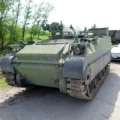
Nice photos, but I hate to be really picky, but it’s not a Scimitar. This version shown is actually a Sabre, which was put together using the hull from a Scorpion, which were decommisioned due to a fume toxicity problem from the 76mm gun. They then added the turret from the Fox CVR(W) armoured car. The main differences from the Scimitar were a slightly different stowage bin configuration, and the fitting of a 7.62mm Hughes chain gun instead of the L7 GPMG as a turret mounted co-axial machine gun. When the CVR(T) dieselisation programme was introduced, the Sabre, for some reason, was not included. They remained with the 4.2 Lt Jaguar engine and were mainly sold off by the MOD. Hope this hel[ps