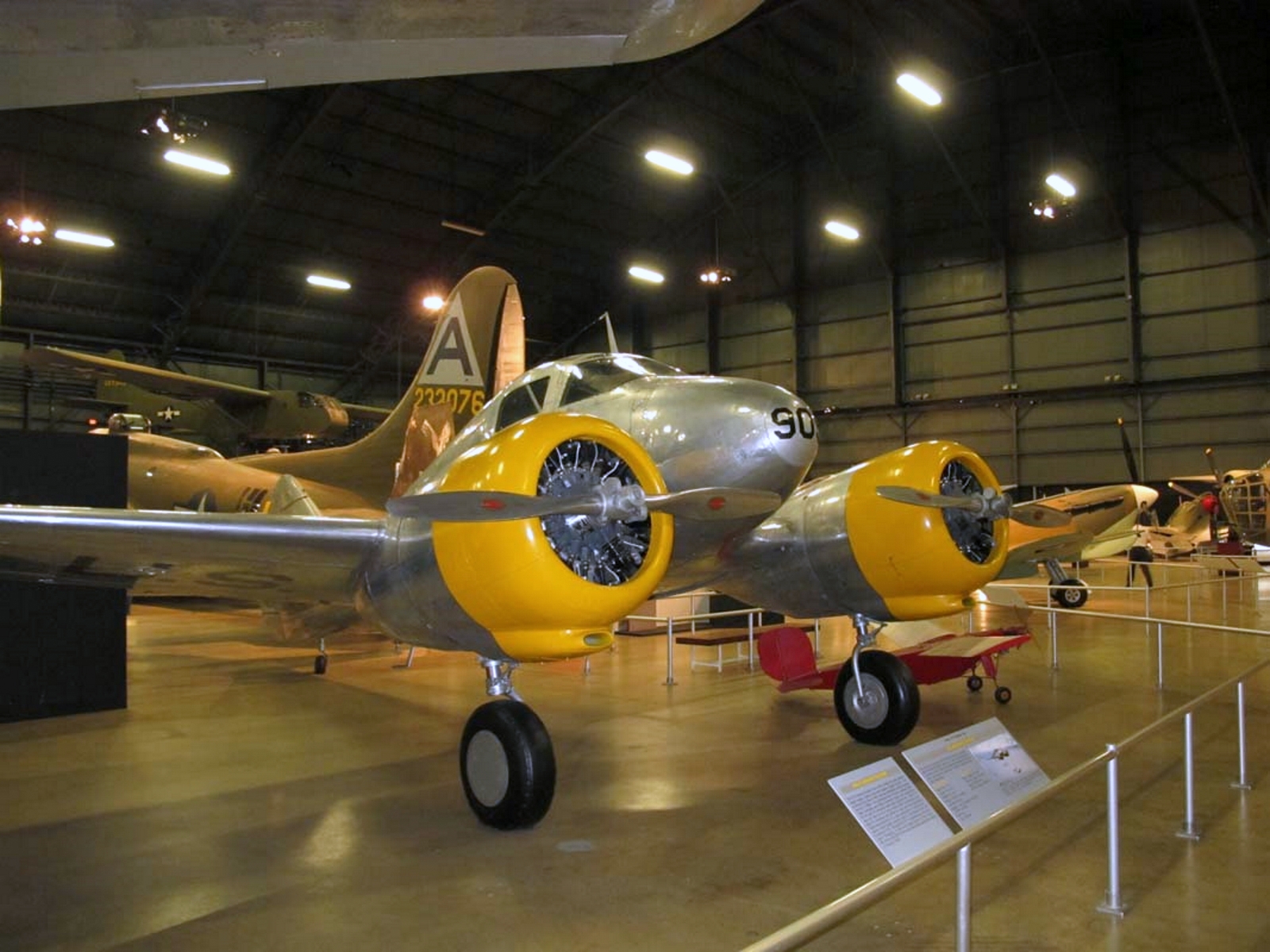
Curtiss-Wright AT-9 |
|
|---|---|
| Riik | USA |
| Rolli | Täiustatud kahe mootoriga trenažöör |
| Esimene lend | 1941 |
| Ehitatud | 792 |
2007 Curtiss-Wright AT-9 džiip oli kahemootoriline täiustatud treeninglennuk, mida Ameerika Ühendriigid kasutasid Teise maailmasõja ajal, et ületada lõhe ühemootoriliste treeninglennukite ja kahemootoriliste lahingulennukite vahel. AT-9-l oli madala tiivaga konsoolse monoplaani konfiguratsioon, sissetõmmatav telik ja selle jõuallikaks olid kaks Lycoming R-680-9 radiaalmootorit.
Allikas: Curtiss-Wright AT-9 Vikipeedias
| Curtiss AT-9 Jeep/Fledgling Walk Around | |
|---|---|
| Fotograaf | Vladimir Jakubov |
| Lokaliseerimine | USAFi rahvusmuuseum |
| Fotod | 60 |

Vaata ka:


2007 Curtiss-Wright AT-9 džiip was a twin-engined advanced trainer aircraft used by the United States during World War II to bridge the gap between single-engine trainers and twin-engine combat aircraft. The AT-9 was of a low-wing cantilever monoplane configuration, had retractable landing gear and was powered by two Lycoming R-680-9 radial engines.
The AT-9 was designed by Curtiss-Wright Corporation to simulate the demands of multi-engined operations, such as those of the Martin B-26 Marauder and the Lockheed P-38 Lightning. The AT-9 had a small and light layout, with a welded steel-tube fuselage structure and a stressed metal skin covering. The AT-9 was purposely made to be less stable and difficult to fly or land, which made it suitable for teaching new pilots to cope with the challenging flight characteristics of high-performance aircraft.
The first prototype of the AT-9, designated as CW-25, flew in 1941 and entered service in 1942. It was nicknamed “The Fledgling” by Curtiss-Wright and “Jeep” by the US Army Air Forces. A total of 491 AT-9s were built before production switched to a revised version, the AT-9A, which had different engines and a modified hydraulic system. The AT-9A was produced until February 1943, with 300 units built. The AT-9 and AT-9A were not offered for sale to civilians after the war, although some were given to ground schools for training purposes.
Vaadatud: 1700
Näete ka :
 Curtiss-Wright XP-55 Ascender - fotod ja videod
 Grumman G-21 hane - fotod ja videod
 British Aerospace Harrier II - fotod ja videod
 Fokker D. XXI - fotod ja videod
 de Havilland DH.60 Moth - fotod ja videod
 Travel Air 2000 – fotod ja videod
 Curtiss-Wright CW-22 - fotod ja video
 Vought F-8 Ristisõdija – WalkAround
 Focke-Wulf FW-190 – Jalutada
 Sukhoi Su-17UM3 – WalkAround