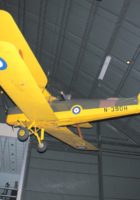
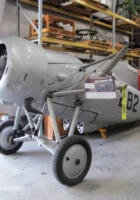
Fairchild PT-19A Cornell

Fairchild PT-19A Cornell

LandUsa
TypMilitär-Trainerflugzeug
FotoRandy Ray
SuchenTravis Air Force Base Museum
BeschreibungAlbum von 59 Fotos Rundgang einer «Fairchild PT-19A Cornell»

Fotogalerie eines Fairchild PT-19A Cornell, The Fairchild PT-19 (company designation Fairchild M62) is an American Fairchild Aircraft monoplane primary trainer aircraft that served with the United States Army Air Forces, RAF and RCAF during World War II. It was a contemporary of the Kaydet biplane trainer and was used by the USAAF during Primary Flying Training as the introductory pre-solo phase trainer for introducing new pilots to flying before passing them on to the more agile Kaydet. As with other USAAF trainers of the period, the PT-19 had multiple designations based on the powerplant installed.

Quelle: Fairchild PT-19A Cornell auf Wiki

Weiterlesen

Aufrufe : 2516

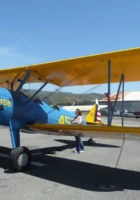
Stearman PT-13D Kaydet

Stearman PT-13D Kaydet

LandUsa
TypMilitär-Trainerflugzeug

Fotogalerie eines Stearman PT-13D Kaydet, The Stearman (Boeing) Model 75 is a biplane used as a military trainer aircraft, of which at least 10,626 were built in the United States during the 1930s and 1940s. Stearman Aircraft became a subsidiary of Boeing in 1934. Widely known as the Stearman, Boeing Stearman or Kaydet, it served as a primary trainer for the United States Army Air Forces, the United States Navy (as the NS & N2S), and with the Royal Canadian Air Force as the Kaydet throughout World War II. After the conflict was over, thousands of surplus aircraft were sold on the civilian market. In the immediate postwar years they became popular as crop dusters, sports planes, and for aerobatic and wing walking use in air shows.

Quelle: Stearman PT-13D Kaydet auf Wiki

Weiterlesen

Aufrufe : 4942

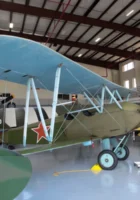
Polikarpow Po-2

Polikarpow Po-2

LandSowjetunion
TypAllzweck-Doppeldecker
FotoWladimir Nikolajewitsch Jakubow
SuchenFantasy of Flight, Polk City
BeschreibungAlbum von 83 Fotos walk-around von einem »Polikarpov Po-2»

Fotogalerie eines Polikarpow Po-2, The Polikarpov Po-2 (also U-2) served as a general-purpose Soviet biplane, nicknamed Kukuruznik (Russian: Кукурузник, from Russian “kukuruza” (кукуруза) for maize; thus, “maize duster” or “crop duster”), NATO reporting name “Mule”. The reliable, uncomplicated concept of the Po-2’s design made it an ideal training aircraft, as well as doubling as a low-cost ground attack, aerial reconnaissance, psychological warfare and liaison aircraft during war, proved to be one of the most versatile light combat types to be built in the Soviet Union. As of 1978 it remained in production for a longer period of time than any other Soviet-era aircraft. It is one of the most produced aircraft, and may be the most produced biplane with production possibly as high as 30,000 Po-2s built between 1928 and 1959.However, production figures for Polikarpov U-2 and Po-2 bombers and trainers combined are between 20,000 and 30,000. with production ending as early as 1952.

Quelle: Polikarpov Po-2 auf Wiki

Weiterlesen

Views : 8669

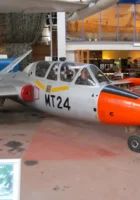
Fouga Magister

Fouga Magister C.M.170

LandFrankreich
TypZweisitziger Jettrainer
Erstflug23. Juli 1952
Gebaut929

das Fouga CM.170 Magister is a 1950s French two-seat jet trainer. The related CM.175 Zéphyr was a carrier-capable version for the French Navy. In 1948, development commenced at Fouga on a new primary trainer aircraft design that harnessed newly developed jet propulsion technology. The initial design was evaluated by the French Air Force (Armée de l’Air, AdA) and, in response to its determination that the aircraft lacked sufficient power for its requirements, was enlarged and adopted a pair of Turbomeca Marboré turbojet engines. First flying on 23 July 1952, the first production order for the type was received on 13 January 1954. In addition, the related CM.175 Zéphyr was a carrier-capable version developed and produced for the French Navy.

Quelle: Fouga Magister C.M.170 auf Wiki

Weiterlesen

Aufrufe : 5612

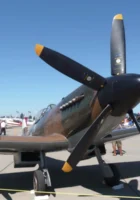
Supermarine Spitfire MK. Xiv

Supermarine Spitfire MK. Xiv

LandGroßbritannien
RolleKampfflugzeuge
Erstflug27. November 1941
Produziert1942–48

das Supermarine Spitfire Das britische Einsitzer-Jagdflugzeug wurde von der Royal Air Force und vielen anderen alliierten Ländern vor, während und nach dem Zweiten Weltkrieg eingesetzt. Die Spitfire wurde in vielen Varianten mit mehreren Flügelkonfigurationen gebaut und in größerer Stückzahl produziert als jedes andere britische Flugzeug. Es war auch der einzige britische Kämpfer, der während des Krieges in ständiger Produktion war. Die Spitfire ist nach wie vor beliebt bei Enthusiasten, mit etwa 54 Spitfires, die flugfähig sind, während viele weitere statische Exponate in Luftfahrtmuseen auf der ganzen Welt sind.

Quelle: Supermarine Spitfire MK. XIV auf Wiki

Weiterlesen

Views : 11768

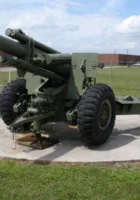
US 155mm M1A1 Haubitze

US 155mm M1A1 Haubitze

LandUsa
TypHaubitze
FotoRandy J Ray
SuchenMilitärmuseum Motts
BeschreibungAlbum von 49 Fotos walk-around von einem "US 155mm M1A1 Haubitze"

Fotogalerie eines US 155mm M1A1 Haubitze, The M114 155 mm howitzer was a towed howitzer developed and used by the United States Army. It was first produced in 1942 as a medium artillery piece under the designation of 155 mm Howitzer M1. It saw service with the US Army during World War II, the Korean War, and the Vietnam War, before being replaced by the M198 howitzer.

Quelle: US 155mm M1A1 Haubitze auf Wiki

Weiterlesen

Aufrufe : 4401

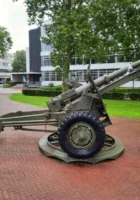
QF Mk.III

QF 25pdr Mark II Feldkanone

LandGroßbritannien
TypHaubitze
Im Dienst1940–heute

Fotogalerie eines QF 25pdr Mark II Feldkanone, The Ordnance QF 25-pounder, or more simply 25-pounder or 25-pdr, was the major British field gun and howitzer during World War II. It was introduced into service just before the war started, combining high-angle and direct-fire, relatively high rates of fire, and a reasonably lethal shell in a highly mobile piece. It remained the British Army’s primary artillery field piece well into the 1960s, with smaller numbers serving in training units until the 1980s. Many Commonwealth of Nations countries used theirs in active or reserve service until about the 1970s and ammunition for the weapon is currently being produced by Pakistan Ordnance Fac. Die Mark II: Der Mark I-Wagen war das Standardgeschütz während des Zweiten Weltkriegs. Sie wurden in Australien und Kanada gebaut, aber hauptsächlich in Großbritannien. Die Lieferungen (aus britischer Produktion) begannen Anfang 1940 und wurden erstmals im Mai 1940 bei einem kanadischen Regiment in Großbritannien in Dienst gestellt. In Frankreich ging keine Ordnance 25-pr Mk 2 auf Wagen 25-pr Mark 1 verloren. Diese Waffe feuerte alle Ladungen, 1 – 3 und Super. Im Jahr 1942 wurde eine Mündungsbremse an der Waffe angebracht, um die Instabilität zu beseitigen, die beim Abfeuern der 20-Pfund-AP-Granate mit Charge Super bei direktem Feuer in niedrigen Höhenwinkeln verursacht wurde. Um das Gleichgewicht der Waffe auf den Zapfen zu erhalten, wurde auch ein Gegengewicht angebracht, direkt vor dem Verschlussring. Die Bezeichnung der modifizierten Waffe wurde nicht geändert. Schließlich wurden alle Geschütze, die in Europa dienten, so umgebaut.

Quelle: QF 25pdr Mark II Field Gun auf Wiki
Weiterlesen

Ansichten : 4319

US 105mm M2A2 Feldkanone

US 105mm M2A2 Feldkanone

LandUsa
TypHaubitze
FotoWladimir Nikolajewitsch Jakubow
SuchenMusée de l'Armee, Paris
BeschreibungAlbum von 66 Fotos Rundgang mit einer «US 105mm M2A2 Field Gun»

Fotogalerie eines US 105mm M2A2 Feldkanone, The 105 mm M2A1 (M101A1) howitzer was a howitzer developed and used by the United States. It was the standard U.S. light field howitzer in World War II and saw action in both the European and Pacific theaters. Entering production in 1941, it quickly gained a reputation for accuracy and a powerful punch. The M101A1 fired 105-millimetre (4.1 in) high explosive (HE) semi-fixed ammunition and had a range of 11,270 metres (12,330 yd), making it suitable for supporting infantry. M2A2 : modifizierter Schild

Quelle: US 105mm M2A2 Feldgeschütz im Wiki

Weiterlesen

Ansichten : 3540

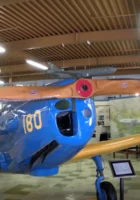
de Havilland DH.82 Tiger Motte

de Havilland DH.82 Tiger Moth

LandGroßbritannien
RolleTrainer
Erste Fliege26. Oktober 1931
Gebaut8868

das de Havilland DH.82 Tiger Motte ist ein Doppeldecker aus den 1930er Jahren, der von Geoffrey de Havilland entworfen wurde und von der Royal Air Force (RAF) und anderen als Haupttrainer betrieben wurde. Die Tiger Moth blieb bei der RAF im Einsatz, bis sie 1952 durch die de Havilland Chipmunk ersetzt wurde, als viele der überschüssigen Flugzeuge in den zivilen Betrieb gingen. Viele andere Nationen nutzten die Tigermoth sowohl in militärischen als auch in zivilen Anwendungen, und sie ist in vielen Ländern nach wie vor als Freizeitflugzeug weit verbreitet. Es wird immer noch gelegentlich als primäres Trainingsflugzeug eingesetzt, vor allem für Piloten, die Erfahrungen sammeln möchten, bevor sie zu anderen Heckradflugzeugen übergehen. Viele sind heute bei verschiedenen Unternehmen beschäftigt, die Probeunterrichtserfahrungen anbieten. Der 1975 gegründete De Havilland Moth Club ist heute ein Eigentümerverein, der einen gemeinsamen Verein und technische Unterstützung anbietet.

Quelle: de Havilland DH.82 Tiger Moth auf Wiki

Weiterlesen

Views : 6422

Dewoitine D.26

Dewoitine D.26

LandFrankreich – Schweiz
TypSchulungsflugzeug
FotoWladimir Nikolajewitsch Jakubow
SuchenFantasy of Flight, Polk City
BeschreibungAlbum von 80 Fotos walk-around von einem »Dewoitine D.26»

Fotogalerie eines Dewoitine D.26, The Dewoitine D.26 was a military trainer developed in France for the Swiss Air Force in parallel with the D.27 fighter. The D.26 airframe was similar to that of the D.27. Differences included: The engine cowling was omitted on the D.26; The D.26 radial engine was smaller and produced less power; The D.26 was not equipped with provision for armament.

Quelle: Dewoitine D.26 auf Wiki

Weiterlesen

Aufrufe : 2808