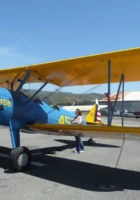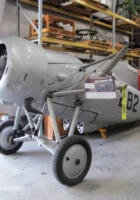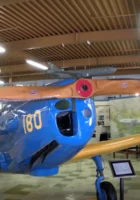
Fairchild PT-19A Cornell

Fairchild PT-19A Cornell

LandUsa
TypeMilitaire trainervliegtuigen
FotoRandy Ray
ZoekTravis Luchtmachtbasis Museum
BeschrijvingAlbum van 59 foto's walk-around van een «Fairchild PT-19A Cornell»

Fotogalerij van een Fairchild PT-19A Cornell, The Fairchild PT-19 (company designation Fairchild M62) is an American Fairchild Aircraft monoplane primary trainer aircraft that served with the United States Army Air Forces, RAF and RCAF during World War II. It was a contemporary of the Kaydet biplane trainer and was used by the USAAF during Primary Flying Training as the introductory pre-solo phase trainer for introducing new pilots to flying before passing them on to the more agile Kaydet. As with other USAAF trainers of the period, the PT-19 had multiple designations based on the powerplant installed.

Bron: Fairchild PT-19A Cornell op Wiki

Lees verder

Views : 2516

Stearman PT-13D Kaydet

Stearman PT-13D Kaydet

LandUsa
TypeMilitaire trainervliegtuigen

Fotogalerij van een Stearman PT-13D Kaydet, The Stearman (Boeing) Model 75 is a biplane used as a military trainer aircraft, of which at least 10,626 were built in the United States during the 1930s and 1940s. Stearman Aircraft became a subsidiary of Boeing in 1934. Widely known as the Stearman, Boeing Stearman or Kaydet, it served as a primary trainer for the United States Army Air Forces, the United States Navy (as the NS & N2S), and with the Royal Canadian Air Force as the Kaydet throughout World War II. After the conflict was over, thousands of surplus aircraft were sold on the civilian market. In the immediate postwar years they became popular as crop dusters, sports planes, and for aerobatic and wing walking use in air shows.

Bron: Stearman PT-13D Kaydet op Wiki

Lees verder

Views : 4942

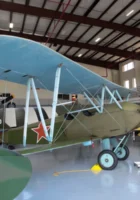
Polikarpov Po-2

Polikarpov Po-2

LandSovjet-Unie
TypeTweedekker voor algemeen gebruik
FotoVladimir Yakubov
ZoekFantasie van vlucht, Polk City
BeschrijvingAlbum van 83 foto's walk-around van een «Polikarpov Po-2»

Fotogalerij van een Polikarpov Po-2, The Polikarpov Po-2 (also U-2) served as a general-purpose Soviet biplane, nicknamed Kukuruznik (Russian: Кукурузник, from Russian “kukuruza” (кукуруза) for maize; thus, “maize duster” or “crop duster”), NATO reporting name “Mule”. The reliable, uncomplicated concept of the Po-2’s design made it an ideal training aircraft, as well as doubling as a low-cost ground attack, aerial reconnaissance, psychological warfare and liaison aircraft during war, proved to be one of the most versatile light combat types to be built in the Soviet Union. As of 1978 it remained in production for a longer period of time than any other Soviet-era aircraft. It is one of the most produced aircraft, and may be the most produced biplane with production possibly as high as 30,000 Po-2s built between 1928 and 1959.However, production figures for Polikarpov U-2 and Po-2 bombers and trainers combined are between 20,000 and 30,000. with production ending as early as 1952.

Bron: Polikarpov Po-2 op Wiki

Lees verder

Views : 8669

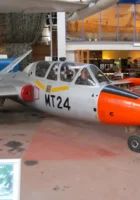
Fouga Magister

Fouga Magister C.M.170

LandFrankrijk
TypeJettrainer met twee zitplaatsen
Eerste vlucht23 juli 1952
Gebouwd929

De Fouga CM.170 Magister is a 1950s French two-seat jet trainer. The related CM.175 Zéphyr was a carrier-capable version for the French Navy. In 1948, development commenced at Fouga on a new primary trainer aircraft design that harnessed newly developed jet propulsion technology. The initial design was evaluated by the French Air Force (Armée de l’Air, AdA) and, in response to its determination that the aircraft lacked sufficient power for its requirements, was enlarged and adopted a pair of Turbomeca Marboré turbojet engines. First flying on 23 July 1952, the first production order for the type was received on 13 January 1954. In addition, the related CM.175 Zéphyr was a carrier-capable version developed and produced for the French Navy.

Bron: Fouga Magister C.M.170 op Wiki

Lees verder

Aantal keren bekeken: 5612

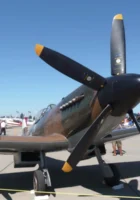
Supermarine Spitfire MK. Xiv

Supermarine Spitfire MK. Xiv

LandUk
RoleGevechtsvliegtuigen
Eerste vlucht27 november 1941
Geproduceerd1942–48

De Supermarine Spitfire Is een Brits eenzits gevechtsvliegtuig dat werd gebruikt door de Royal Air Force en vele andere geallieerde landen voor, tijdens en na de Tweede Wereldoorlog. De Spitfire werd gebouwd in vele varianten, met behulp van verschillende vleugelconfiguraties, en werd in grotere aantallen geproduceerd dan alle andere Britse vliegtuigen. Het was ook de enige Britse vechter die gedurende de hele oorlog in continue productie was. De Spitfire blijft populair onder liefhebbers, met ongeveer 54 Spitfires die luchtwaardig zijn, terwijl nog veel meer statische tentoonstellingen zijn in luchtvaartmusea over de hele wereld.

Bron: Supermarine Spitfire MK. XIV op Wiki

Lees verder

Views : 11767

US 155mm M1A1 Houwitser

US 155mm M1A1 Houwitser

LandUsa
TypeHouwitser
FotoRandy J Ray
ZoekMotts Militair Museum
BeschrijvingAlbum van 49 foto's walk-around van een «US 155mm M1A1 Howitzer»

Fotogalerij van een US 155mm M1A1 Houwitser, The M114 155 mm howitzer was a towed howitzer developed and used by the United States Army. It was first produced in 1942 as a medium artillery piece under the designation of 155 mm Howitzer M1. It saw service with the US Army during World War II, the Korean War, and the Vietnam War, before being replaced by the M198 howitzer.

Bron: US 155mm M1A1 Houwitser op Wiki

Lees verder

Views : 4401

QF Mk.III

QF 25pdr Mark II Veldpistool

LandUk
TypeHouwitser
In gebruik1940-heden

Fotogalerij van een QF 25pdr Mark II Veldpistool, The Ordnance QF 25-pounder, or more simply 25-pounder or 25-pdr, was the major British field gun and howitzer during World War II. It was introduced into service just before the war started, combining high-angle and direct-fire, relatively high rates of fire, and a reasonably lethal shell in a highly mobile piece. It remained the British Army’s primary artillery field piece well into the 1960s, with smaller numbers serving in training units until the 1980s. Many Commonwealth of Nations countries used theirs in active or reserve service until about the 1970s and ammunition for the weapon is currently being produced by Pakistan Ordnance Fac. Het Merk II: gemonteerd op de Mark I-koets was het standaardkanon tijdens de Tweede Wereldoorlog. Ze werden gebouwd in Australië en Canada, maar vooral in het Verenigd Koninkrijk. De leveringen (van Britse productie) begonnen begin 1940 en kwamen voor het eerst in dienst bij een Canadees regiment dat in mei 1940 in het VK was gestationeerd. Er zijn geen Ordnance 25-pr Mk 2 op Carriage 25-pr Mark 1 verloren gegaan in Frankrijk. Dit pistool vuurde alle ladingen af, 1 – 3 en Super. In 1942 werd een mondingsrem op het kanon gemonteerd om de instabiliteit te elimineren die werd veroorzaakt bij het afvuren van de 20 lb AP-granaat met Charge Super bij direct vuur onder lage elevatiehoeken. Om het evenwicht van het pistool op de tappen te bewaren, werd ook een contragewichtgewicht gemonteerd, net voor de stuitring. De aanduiding van het gewijzigde kanon werd niet gewijzigd. Uiteindelijk werden alle kanonnen die in Europa dienden zo omgebouwd.

Bron: QF 25pdr Mark II Field Gun op Wiki

Lees verder

Bekeken : 4319

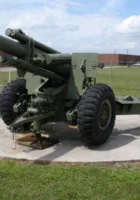
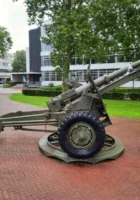
US 105mm M2A2 veldkanon

US 105mm M2A2 veldkanon

LandUsa
TypeHouwitser
FotoVladimir Yakubov
ZoekMusée de l'Armee, Parijs
BeschrijvingAlbum van 66 foto's walk-around van een «US 105mm M2A2 Field Gun»

Fotogalerij van een US 105mm M2A2 veldkanon, The 105 mm M2A1 (M101A1) howitzer was a howitzer developed and used by the United States. It was the standard U.S. light field howitzer in World War II and saw action in both the European and Pacific theaters. Entering production in 1941, it quickly gained a reputation for accuracy and a powerful punch. The M101A1 fired 105-millimetre (4.1 in) high explosive (HE) semi-fixed ammunition and had a range of 11,270 metres (12,330 yd), making it suitable for supporting infantry. M2A2 : gemodificeerd schild

Bron: US 105mm M2A2 veldkanon op Wiki

Lees verder

Bekeken : 3540

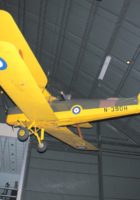
de Havilland DH.82 Tijgermot

de Havilland DH.82 Tiger Moth

LandUk
RoleTrainer
Eerste vlieg26 oktober 1931
Gebouwd8868

De de Havilland DH.82 Tijgermot is een tweedekker uit de jaren 1930 ontworpen door Geoffrey de Havilland en werd geëxploiteerd door de Royal Air Force (RAF) en anderen als primaire trainer. De Tiger Moth bleef in dienst bij de RAF tot hij in 1952 werd vervangen door de De Havilland Chipmunk, toen veel van de overtollige vliegtuigen in gebruik werden genomen. Veel andere landen gebruikten de Tiger Moth in zowel militaire als civiele toepassingen, en het blijft in veel landen wijdverspreid als recreatievliegtuig. Het wordt nog steeds af en toe gebruikt als een primair trainingsvliegtuig, vooral voor die piloten die ervaring willen opdoen voordat ze overstappen op andere staartwielvliegtuigen. Velen zijn nu in dienst van verschillende bedrijven die proefleservaringen aanbieden. De in 1975 opgerichte club De Havilland Moth is nu een vereniging van eigenaren die een onderlinge club en technische ondersteuning biedt.

Bron: de Havilland DH.82 Tijgermot op Wiki

Lees verder

Views : 6422

Dewoitine D.26

Dewoitine D.26

LandFrankrijk – Zwitsers
TypeDe vliegtuigen van de trainer
FotoVladimir Yakubov
ZoekFantasie van vlucht, Polk City
BeschrijvingAlbum van 80 foto's walk-around van een «Dewoitine D.26»

Fotogalerij van een Dewoitine D.26, The Dewoitine D.26 was a military trainer developed in France for the Swiss Air Force in parallel with the D.27 fighter. The D.26 airframe was similar to that of the D.27. Differences included: The engine cowling was omitted on the D.26; The D.26 radial engine was smaller and produced less power; The D.26 was not equipped with provision for armament.

Bron: Dewoitine D.26 op Wiki

Lees verder

Bekeken : 2808