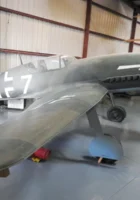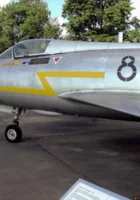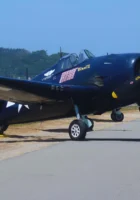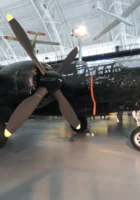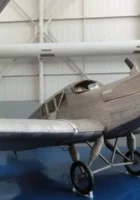
Dornier Do.335

Dornier Do.335

CountryNazi Germany
RoleFighter-bomber
First flight26 October 1943
Built37

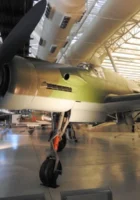
The Dornier Do 335 Pfeil (“Arrow”) was a World War II heavy fighter built by the Dornier company. The two-seater trainer version was also called Ameisenbär (“anteater”). The Pfeil’s performance was much better than other twin-engine designs due to its unique “push-pull” layout and the much lower aerodynamic drag of the in-line alignment of the two engines. It was Germany’s fastest piston-engined aircraft of World War II. The Luftwaffe was desperate to get the design into operational use, but delays in engine deliveries meant that only a handful were delivered before the war ended.

Source: Dornier Do.335 on Wikipedia

Continue reading

Views : 6817

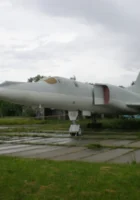
Tupolev Tu-22MO

Tupolev Tu-22M

CountrySoviet Union
RoleStrategic bomber/Maritime strike
First flight30 August 1969
Built497

The Tupolev Tu-22M (Russian: Туполев Ту-22М; NATO reporting name: Backfire) is a supersonic, variable-sweep wing, long-range strategic and maritime strike bomber developed by the Tupolev Design Bureau. According to some sources, the bomber was believed to be designated Tu-26 at one time. During the Cold War, the Tu-22M was operated by the Soviet Air Force (VVS) in a strategic bombing role, and by the Soviet Naval Aviation (Aviacija Vojenno-Morskogo Flota, AVMF) in a long-range maritime anti-shipping role.[2] Significant numbers remain in service with the Russian Air Force, and as of 2014 more than 100 Tu-22Ms are in use.

Source: Tupolev Tu-22M on Wikipedia

Continue reading

Views : 4840

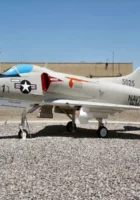
Douglas A-4F Skyhawk

Douglas A-4 Skyhawk

CountryUSA
RoleAttack aircraft, fighter, aggressor aircraft
First flight22 June 1954
Built2960

The Douglas A-4 Skyhawk is a single seat subsonic carrier-capable attack aircraft developed for the United States Navy and United States Marine Corps in the early 1950s. The delta winged, single turbojet engined Skyhawk was designed and produced by Douglas Aircraft Company, and later by McDonnell Douglas. It was originally designated A4D under the U.S. Navy’s pre-1962 designation system. The Skyhawk is a relatively lightweight aircraft with a maximum takeoff weight of 24,500 pounds (11,100 kg) and has a top speed of more than 670 miles per hour (1,080 km/h). The aircraft’s five hardpoints support a variety of missiles, bombs and other munitions. It was capable of carrying a bomb load equivalent to that of a World War II-era Boeing B-17 bomber, and could deliver nuclear weapons using a low-altitude bombing system and a “loft” delivery technique. The A-4 was originally powered by the Wright J65 turbojet engine; from the A-4E onwards, the Pratt & Whitney J52 was used. Skyhawks played key roles in the Vietnam War, the Yom Kippur War, and the Falklands War. Sixty years after the aircraft’s first flight in 1954, some of the 2,960 produced (through February 1979) remain in service with several air arms around the world.

Source: Douglas A-4 Skyhawk on Wikipedia

Continue reading

Views : 19164

Heinkel He 100 D-1

Heinkel He 100

CountryNazi Germany
RoleFighter
First flight22 January 1938
Built25

The Heinkel He 100 was a German pre-World War II fighter aircraft design from Heinkel. Although it proved to be one of the fastest fighter aircraft in the world at the time of its development, the design was not ordered into series production. Approximately 19 prototypes and pre-production examples were built. None are known to have survived the war. The reason for the He 100 failing to reach production status is mostly unknown. Officially, the Luftwaffe rejected the He 100 to concentrate single-seat fighter development on the Messerschmitt Bf 109. Following the adoption of the Bf 109 and Messerschmitt Bf 110 as the Luftwaffe’s standard fighter types, the Ministry of Aviation (the Reichsluftfahrtministerium or RLM) announced a “rationalization” policy that placed fighter development at Messerschmitt and bomber development at Heinkel.

Source: Heinkel He 100 on Wikipedia

Continue reading

Views : 5654

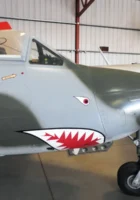
De Havilland Vampire FB.6

de Havilland Vampire

CountryUK
RoleFighter aircraft
First flight20 September 1943
Built3268

The de Havilland Vampire is a British jet fighter developed and manufactured by the de Havilland Aircraft Company. Work on the aircraft began during the Second World War as a largely experimental aircraft suitable for combat that harnessed the groundbreaking innovation of jet propulsion; it was quickly decided to opt for a single-engine, twin-boom aircraft equipped with the Halford H.1 turbojet engine (later the de Havilland Goblin). Originally ordered as an experimental aircraft only, the decision to mass-produce the aircraft as an interceptor for the Royal Air Force (RAF) was finalised in May 1944.

Source: de Havilland Vampire on Wikipedia

Continue reading

Views : 5436

Dassault Mystere IVA

Dassault Mystere

CountryFrance
RoleFighter-bomber
First flight23 February 1951
Built171

The Dassault MD.452 Mystère is a 1950s French fighter-bomber. After the success of the Ouragan, Dassault was working on a more advanced machine based on it, which would take to the air in early 1951 as the MD.452 Mystère I. The first prototype Mystère I was essentially an Ouragan with a 30-degree swept wing and modified tail surfaces. Two further prototypes followed, powered by the Rolls-Royce Tay 250 centrifugal-flow turbojet, an improved version of the Rolls-Royce Nene, built under license by Hispano-Suiza, and rated at 28.0 kN (6,300 lbf) thrust.

Source: Grumman F6F Hellcat on Wikipedia

Continue reading

Views : 3137

Grumman F6F Hellcat

Grumman F6F Hellcat

CountryUSA
RoleFighter aircraft
First flight26 June 1942
Built12275

The Grumman F6F Hellcat is an American carrier-based fighter aircraft of World War II. Designed to replace the earlier F4F Wildcat and to counter the Japanese Mitsubishi A6M Zero, it was the United States Navy’s dominant fighter in the second half of the Pacific War. The Hellcat competed with the faster Vought F4U Corsair for that role and prevailed, as the Corsair had significant issues with carrier landings. The Corsair instead was primarily deployed to great effect in land-based use by the U.S. Marine Corps.

Source: Grumman F6F Hellcat on Wikipedia

Continue reading

Views : 10975

Northrop P-61C Black Widow

Northrop P-61 Black Widow

CountryUSA
RoleNight fighter
First flight26 May 1942
Built706

The Northrop P-61 Black Widow, named for the American spider, was the first operational U.S. warplane designed as a night fighter, and the first aircraft designed to use radar. The P-61 had a crew of three: pilot, gunner, and radar operator. It was armed with four 20 mm (.79 in) Hispano M2 forward-firing cannons mounted in the lower fuselage, and four .50 in (12.7 mm) M2 Browning machine guns mounted in a remote-controlled dorsal gun turret. It was an all-metal, twin-engine, twin-boom design developed during World War II. The first test flight was made on May 26, 1942, with the first production aircraft rolling off the assembly line in October 1943. The last aircraft was retired from government service in 1954.

Source: Northrop P-61 Black Widow on Wikipedia

Continue reading

Views : 11130

Junkers F.13

Junkers F.13

CountryGermany
RoleSmall passenger transport
First flight25 June 1919
Built322

The Junkers F.13 (also known as the F 13) was the world’s first all-metal transport aircraft, developed in Germany at the end of World War I. It was an advanced cantilever-wing monoplane, with enclosed accommodation for four passengers. Over 300 were sold. It was in production for thirteen years and in commercial service for almost twenty.

Source: Junkers F.13 on Wikipedia

Continue reading

Views : 4533

Mirage 2000D

Dassault Mirage 2000D

CountryFrance
RoleTactical bomber
First flight3 February 1986
Built86

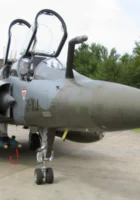
The Dassault Mirage 2000N is a variant of the Mirage 2000 designed for nuclear strike. It forms the core of the French air-based tactical nuclear deterrent. The Mirage 2000D is its conventional attack counterpart. Dassault has also developed the Mirage 2000D, which is a development of the Mirage 2000N designed for long-range precision strikes with conventional weapons. This aircraft is exactly the same as the Mirage 2000N, but introduces support for conventional attack missiles such as the Apache and Scalp missiles, as well as the AASM weapons. The first aircraft, converted from the Mirage 2000N prototype, flew on 19 February 1991, and the French Air Force ordered a total of 86 aircraft.

Source: Dassault Mirage 2000D on Wikipedia

Continue reading

Views : 7998