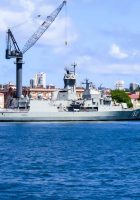
HMAS Anzac (FFH 150)

HMAS Anzac (FFH 150)

CountryAustralia
RoleAnzac-class frigate
Launched16 September 1994
StatusActive as of 2016

HMAS Anzac (FFH 150) is the lead ship of the Anzac-class frigates in use with the Royal Australian Navy (RAN) and the Royal New Zealand Navy (RNZN). Entering Australian service in 1996, the frigate operated as part of the INTERFET peacekeeping taskforce in 1999. In 2003, she was involved in the Battle of Al Faw, and became the first RAN ship to fire in anger since the Vietnam War. The ship is operational as of 2016.

Source: HMAS Anzac (FFH 150) on Wikipedia

Continue reading

Views : 2167

URAL-375

Ural-375

Country Soviet Union
Role Truck
Produced 1961-1964 1964-1983
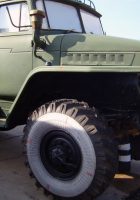
The Ural-375 is a general purpose 4.5 ton 6×6 truck, produced at the Ural Automotive Plant in the Russian SFSR since 1961. The Ural 375 replaced the ZIL-157 as the standard Soviet Army truck in 1979. It was itself replaced by the Ural-4320. The Soviets found the trucks an ideal platform for the BM-21 Grad rocket launcher. Other modes for the Ural-375D included troop carrier, supply carrier, etc.
Source: Ural-375 on Wikipedia
Continue reading

Views : 5624

155mm BR-2 Gun Mod.1935

152mm BR-2 Gun Mod.1935

CountrySoviet Union
RoleHeavy gun
Produced1937-1940
Built37+

The 152 mm gun M1935 (Br-2) (Russian: 152-мм пушка обр. 1935 г. (Бр-2)) was a Soviet 152.4 mm heavy gun, produced in limited numbers by the Barrikady Plant in Stalingrad in the late 1930s. The most unusual feature of the gun was its tracked carriage, shared by a number of Soviet heavy artillery systems of the interwar period. Despite a number of drawbacks, most notably limited mobility and short service life of the barrel, the weapon was employed throughout the German-Soviet War; an upgraded variant with wheeled carriage, Br-2M, remained in service at least until the 1970s.

Source: 152mm BR-2 Gun Mod.1935 on Wikipedia

Continue reading

Views : 2626

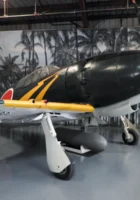
Mitsubishi J2M Raiden

Mitsubishi J2M Raiden

CountryJapan
RoleFighter aircraft
Produced1942–1945
Built671

The Mitsubishi J2M Raiden was a single-engined land-based fighter aircraft used by the Imperial Japanese Navy Air Service in World War II. The Allied reporting name was “Jack”. The J2M was designed by Jiro Horikoshi, creator of the A6M Zero, to meet the 14-Shi (14th year of the Showa reign, or 1939) official specification. It was to be a strictly local-defense interceptor, intended to counter the threat of high-altitude bomber raids, and thus relied on speed, climb performance, and armament at the expense of manoeuvrability. The J2M was a sleek, but stubby craft with its oversized Mitsubishi Kasei engine buried behind a long cowling, cooled by an intake fan and connected to the propeller with an extension shaft.

Source: Mitsubishi J2M Raiden on Wikipedia

Continue reading

Views : 3450

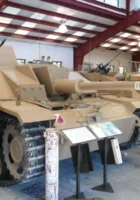
SdKfz 142-1 StuG III

StuG III Ausf. G

CountryNazi Germany
RoleAssault gun
ProducedDecember 1942 – April 1945
Built~8423
The final and by far the most common of the StuG series. Upper superstructure was widened: welded boxes on either sides were abandoned. This new superstructure design increased its height to 2160 mm. The back wall of the fighting compartment got straightened, and the ventilation fan on top of the superstructure was relocated to the back of the fighting compartment. From March 1943, the driver’s periscope was abandoned. In February 1943, Alkett was joined by MIAG as a second manufacturer. From May 1943, side hull spaced armour plates (Schürzen) were fitted to G models for added armour protection, particularly against Russian anti-tank rifles, but were also useful against hollow-charge ammunition. Side plates were retro-fitted to some Ausf. F/8 models, as they were to be fitted to all front line StuGs and other tanks by June 1943 in preparation for the battle of Kursk. Mountings for the Schürzen proved inadequately strong, as many were lost in the field. From March 1944, an improved mounting was introduced; as a result, side skirts are seen more often with late model Ausf G. From May 1943, 80 mm thick plates were used for frontal armour instead of two plates of 50 mm + 30 mm. However, a backlog of StuGs with completed 50 mm armour existed. For those, a 30 mm additional armour plate still had to be welded or bolted on, until October 1943.
Source: StuG III Ausf. G on Wikipedia
Continue reading

Views : 11932

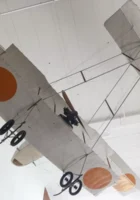
Farman HF.20 biplane

Farman HF.20

CountryFrance
RoleReconnaissance aircraft
PeriodFirst World War

The Farman HF.20 and its derivatives were a family of reconnaissance aircraft produced in France shortly before and during the First World War. It was a refined version of the Farman MF.11 “Shorthorn” that did away with the type’s distinctive landing skids, and incorporated design features from Henri Farman’s designs. It entered service with the French, Belgian and Serbian armies in 1913 (two aircraft conducted reconnaissance during the Siege of Shkodër in the First Balkan War and one crashed), and with the British RFC and RNAS shortly after the outbreak of war. The type was also licence-built in the UK by Airco and Grahame-White. The HF.20 was seriously underpowered, and a variety of engines were trialled in the hope of correcting this, none with much success. The problem was eventually solved only when an engine of twice the power of the original powerplant was fitted to the HF.27 variant, by which time the aircraft was already obsolete. Nevertheless, the performance of the HF.20 made it adequate for use on secondary fronts.

Source: Farman HF.20 on Wikipedia

Continue reading

Views : 2241

Ford 5-AT-B Tri-Motor

Ford AT-5 Tri-motor

Country USA
Role Transport aircraft
Introduction 1926
Built 199
The Ford Trimotor (also called the “Tri-Motor”, and nicknamed “The Tin Goose”) is an American three-engined transport aircraft. Production started in 1925 by the companies of Henry Ford and ended on June 7, 1933. A total of 199 Ford Trimotors were made. It was designed for the civil aviation market, but also saw service with military units.
Source: Ford AT-5 Tri-motor on Wikipedia
Continue reading

Views : 3539

SdKfz 135 Marder I

SdKfz 135 Marder I

CountryNazi Germany
RoleTank destroyer
In Service1942–1944
Built170

The Marder I “Marten” (Sd.Kfz. 135) was a German World War II tank destroyer, armed with the 75 mm anti-tank gun. Most Marder Is were built on the base of the Tracteur Blindé 37L (Lorraine), a French artillery tractor/armoured personnel carrier of which the Germans had acquired more than three hundred after the Fall of France in 1940.

Source: SdKfz 135 Marder I on Wikipedia

Continue reading

Views : 6252

Sikorsky JRS-1

Sikorsky JRS-1

CountryUSA
RoleFlying boat airliner
Introduction1934
Built53
The Sikorsky S-43 was a twin-engine amphibious aircraft manufactured in United States during the 1930s by the American firm Sikorsky Aircraft. The S-43 first flew in 1935, and was a smaller version of the Sikorsky S-42 “Clipper”. It accommodated between 18 and 25 passengers, with a separate two-crew forward cockpit. The S-43 was known as the “Baby Clipper” in airline service. On April 14, 1936, an S-43 with a 500 kilograms (1,100 lb) payload, piloted by Boris Sergievsky, set an altitude record for amphibious aircraft when it reached an altitude of 27,950 feet above Stamford, Connecticut. Also aboard was designer Igor Sikorsky. In total, approximately 53 S-43s were built, including examples of the twin-tailed S-43B
Source: Sikorsky JRS-1 on Wikipedia
Continue reading

Views : 2347

Marder Hotchkiss

Marder Hotchkiss

CountryNazi Germany
RoleTank destroyer
PeriodWorld War II

The Marder I “Marten” (Sd.Kfz. 135) was a German World War II tank destroyer, armed with the 75 mm anti-tank gun. Most Marder Is were built on the base of the Tracteur Blindé 37L (Lorraine), a French artillery tractor/armoured personnel carrier of which the Germans had acquired more than three hundred after the Fall of France in 1940. Between July and August 1942, 170 Marder I’s were built on the Lorraine chassis. Later, several other French and Polish tanks were used as the conversion base for the Marder I, including the Hotchkiss H39 and FCM 36. These conversions were also completed at Baustokommando Becker, though fewer of these were built.

Source: Marder Hotchkiss on Wikipedia

Continue reading

Views : 4793