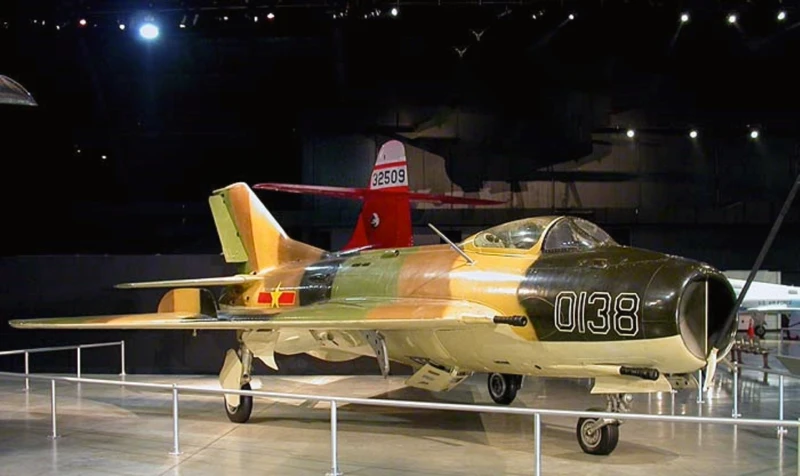
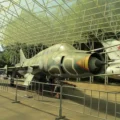
The Mikoyan-Gurevich MiG-19 (Russian: Микоян и Гуревич МиГ-19; NATO reporting name: Farmer) is a Soviet second generation, single-seat, twin jet-engined fighter aircraft. It was the first Soviet production aircraft capable of supersonic speeds in level flight. A comparable U.S. “Century Series” fighter was the North American F-100 Super Sabre, although the MiG-19 would primarily oppose the more modern McDonnell Douglas F-4 Phantom II and Republic F-105 Thunderchief over North Vietnam.
The First Supersonic Vanguard of the Cold War Skies
The Mikoyan-Gurevich MiG-19 (NATO reporting name: Farmer) represents a major milestone in Soviet aviation history as the Soviet Union’s first mass-produced fighter aircraft capable of breaking the sound barrier in level flight. Developed in the early 1950s by the legendary Mikoyan-Gurevich OKB design bureau, the MiG-19 was engineered to counter high-altitude American strategic bombers and secure air superiority during the tensest years of the Cold War. Positioned historically between the subsonic, gun-armed jet fighters of the Korean War era (like the MiG-15 and MiG-17) and the Mach 2, missile-centric Mach-era (dominated by the MiG-21), the MiG-19 was a notoriously unforgiving “hot rod” to fly. Despite a relatively short frontline service life in the Soviet Air Force, its sheer speed, brutal cannon firepower, and exceptional dogfighting agility made it a dangerous adversary in proxy conflicts across Vietnam, the Middle East, and Asia.
2,172 units built in the USSR (plus ~4,500 Chinese license-built Shenyang J-6 / F-6 variants)
Design Engineering: Twin Turbojets, 55-Degree Sweep, and Severe Handling Quirks
A Pure Supersonic Aerodynamic Planform: To cross the threshold into level-flight supersonic speeds, Soviet designers abandoned the conservative wing sweep angles of the MiG-17 (45 degrees) in favor of a radical, thin-profile wing swept back at a sharp 55-degree angle. This configuration drastically reduced wave drag near Mach 1 but required wing fences to prevent spanwise airflow from causing low-speed stalling during landing approaches.
The Compact Twin RD-9B Engines: The MiG-19 was built around two small, highly efficient Tumansky RD-9B axial-flow turbojet engines packed tightly side-by-side inside the rear fuselage. This twin-engine layout provided a massive thrust-to-weight ratio for its era, granting the MiG-19 incredible acceleration and climb rates. However, placing the fuel tanks directly above the hot engine bays created severe thermal stress, occasionally causing internal fires on early models until heavy heat shielding was added.
Sledgehammer Cannon Firepower: Unlike Western designs transitioning rapidly to early, unreliable air-to-air missiles, the MiG-19 relied heavily on three massive 30 mm NR-30 autocannons. Firing heavy 400-gram high-explosive shells at 900 rounds per minute, a single brief burst from a MiG-19 could literally slice an enemy fighter or bomber in half.
All-Moving Tailplane (Stabilator): Early MiG-19 test flights revealed severe elevator control loss during transsonic flight due to shockwave formation. To solve this “compressibility” issue, engineers introduced an all-moving tailplane (stabilator) on the MiG-19S variant. Operated by hydraulics, this allowed the pilot to maintain full pitch control even when flying faster than the speed of sound.
Operational History: Cold War Interceptions and the Skies over Vietnam
Defending Soviet Airspace against Incursions: During the late 1950s and early 1960s, MiG-19 interceptors were tasked with intercepting Western intelligence and reconnaissance flights probing Soviet borders. On July 1, 1960, a Soviet MiG-19 shot down an American RB-47H reconnaissance aircraft over the Barents Sea, demonstrating the jet’s deadly high-altitude intercept capability.
Clashes in the Vietnam War (The J-6 / MiG-19 in Combat): The MiG-19 saw intense combat during the Vietnam War, primarily flown by the Vietnam People’s Air Force (VPAF) in the form of Chinese-built Shenyang J-6s. While less sophisticated than American F-4 Phantoms, the MiG-19’s high thrust-to-weight ratio and exceptional low-speed turn radius made it a lethal dogfighter in close-quarters air combat where early air-to-air missiles routinely failed.
Middle Eastern Conflicts (Arab-Israeli Wars): Flying for the air forces of Egypt and Syria, MiG-19s engaged Israeli Mirage IIIC fighters in the 1967 Six-Day War and subsequent War of Attrition. While the MiG-19 was maneuverable, poor ground-controlled radar vectoring and pilot training disparities often placed Arab units at a tactical disadvantage against Israeli jets.
The Immortal Legacy of the Shenyang J-6: Because the Soviet Union phased out the MiG-19 quickly in favor of the Mach 2 MiG-21, China took over its development under license as the **Shenyang J-6**. China produced thousands of units, exporting them globally as the F-6 to countries like Pakistan, North Korea, and Tanzania. The Pakistani Air Force famously upgraded their F-6s with modern AIM-9 Sidewinder missiles, flying them with great success during the 1971 Indo-Pakistani War.


 Sikorsky S-43 – Photos & VIdeos
 Grumman G-44 Widgeon – Photos & Videos
 Douglas B-23 Dragon – Photos & Videos
 Beechcraft Model 17 – Photos & Videos
 Lockheed YO-3 – Photos & Video
 Mig-21PF – Photos & Video
 Mig-27K – Photos & Video
 MiG-15bis – Photos & Video
 Vought F-8 Crusader – WalkAround
 Sukhoi Su-17UM3 – WalkAround