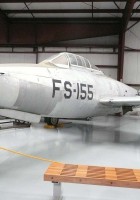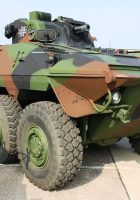
Luch Spahpanzer 2

Spahpanzer 2

PaísAlemania Occidental
TipoVehículo de reconocimiento
Producido1975–1977
Construido408

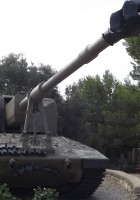
el Spähpanzer Luchs (English: Lynx) is a German 8×8 amphibious reconnaissance armoured fighting vehicle (Spähpanzer) in service since 1975 with the German Army, who used 408 in their armoured reconnaissance battalions. It was developed by Daimler-Benz between 1968 and 1975, replacing the M41 and the Schützenpanzer SPz 11-2 Kurz. The all-wheel drive Luchs made by Thyssen-Henschel (now: Rheinmetall) is well armoured, has an NBC protection system and is characterized by its low-noise running. The eight large low-pressure tyres have run-flat properties. At speeds up to about 50 km/h, all four axles can be steered. As a special feature, the vehicle is equipped with a rear-facing driver with his own driving position. Up to the first combat effectiveness upgrade in 1986, the Luchs was fully amphibious and could surmount water obstacles quickly and independently using propellers at the rear and the fold back trim vane at the front.

Fuente: Spahpanzer 2 en Wikipedia

Continuar leyendo

Vistas : 2710

Fábrica real de aviones BE2A

Fábrica real de aviones BE2A

PaísUk
TipoAviones biplanos
FotografíaVladimir Yakubov
lugarMuseo RAAF, Point Cook, Australia
Tema

Álbum de 53 fotos de un «Royal Aircraft Factory BE2A»

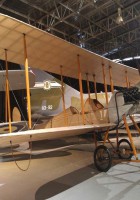
Galería de fotos de un Fábrica real de aviones BE2A, The Royal Aircraft Factory B.E.2 was a British single-engine tractor two-seat biplane which was in service with the Royal Flying Corps (RFC) from 1912 until the end of World War I. About 3,500 were built. Initially used as front-line reconnaissance aircraft and light bombers; variants of the type were also used as night fighters. Like many warplanes since, the B.E.2 was retained in front-line service long after it had become obsolete, for want of a suitable replacement. After its belated withdrawal it finally served as a trainer, communications aircraft and on anti-submarine coastal patrol duties.

Fuente: Royal Aircraft Factory BE2A en Wikipedia

Continuar leyendo

Vistas : 2489

SKP M-42

SKP M-42

PaísSuecia
TipoPortaaviones blindado
FotografíaThord Wedman
Tema

Álbum de 16 fotos walk-around de un «SKP M-42»

Galería de fotos de un SKP M-42, Terrängbil m/42 KP (Tgbil m/42 SKP/VKP), meaning “Off-road vehicle 42” with a secondary designation of “Scania, Bodywork: Armoured” or “Volvo, Bodywork: Armoured”, was the Swedish army’s first armoured personnel carrier, developed as a stop-gap measure during World War II. In 1941, when tanks were organized into a unit of their own, it was clear there was a desperate need for a troop carrier able to both keep up with the tanks and provide protection against artillery shrapnel and small-arms fire. Due to the war there were no international suppliers to buy from, so the only option was to develop a domestic solution. AB Landsverk designed an APC consisting of a chassis from a regular army lorry equipped with an armoured shell.

Fuente: SKP M-42 en Wikipedia

Continuar leyendo

Vistas : 2250

Tatra 813 GRAD

Tatra 813 Kolos

PaísChecoslovaquia
TipoCamión pesado
Periodo de producción1967-1982
SucesorTatra T815

Galería de fotos de un Tatra 813 Kolos, Tatra T813 was a truck produced in Czechoslovakia by the Tatra company. The first prototype already built in 1960 utilized existing Tatra T138 assemblies in 4×4 full-time all-wheel drive, which was also another first for Tatra. After the initial trials however the designers decided to develop and expand the concepts onto 8×8 all-wheel-drive all-terrain vehicle. The basis of the design thus became the modular chassis of T813. Successor is the Tatra T815 model.

Fuente: Tatra 813 Kolos en Wikipedia

Continuar leyendo

Vistas : 3533

MT-LB Sjvpbv 4024

MT-LB Sjvpbv 4024

PaísSuecia
TipoAmbulancia militar
FotógrafoThord Wedman
Tema

Álbum de 28 fotos de un MT-LB Sjvpbv 4024

Galería de fotos de un MT-LB Sjvpbv 4024 , The MT-LB (Russian: Многоцелевой Тягач Легкий Бронированный, Mnogotselevoy Tyagach Logkiy Bronirovannyi / light multi-purpose armoured towing vehicle) is a Soviet multi-purpose fully amphibious auxiliary armoured tracked vehicle, which was first introduced in the late 1960s. Initially, the vehicle was known as the M 1970 in the west. Suecia :Sjvpbv 4024 (sjukvårdspansarbandvagn) – Ambulancia militar.

Fuente: MT-LB Sjvpbv 4024 en Wikipedia

Continuar leyendo

Vistas : 2915

Sholef basado en Merkava

Obús Merkava Sholef

PaísIsrael
TipoArtillería autopropulsada
FotografíasSasha Lev
Tema

Álbum de 23 fotos walk-around de un «Merkava Obús Sholef»

Galería de fotos de un Obús Merkava Sholef, Two prototypes of Sholef (“Slammer”, Hebrew slang for “Gunslinger”) 155 mm self-propelled howitzer with automatic loading system were built by Soltam in 1984–1986. The 45-ton vehicle had a long 155 mm gun barrel giving a range of 45+ km. Using GPS, inertial navigation, and an internal fire control computer, it was also capable of direct fire while on the move. It never entered production. The Slammer is a heavily armored artillery gun mounted on a modified Merkava Mk 1 chassis. Many of these vehicles are Merkava Mk 1 that were retired after the Merkava Mk 2 and Merkava Mk 3 came into service. The Slammer has a long 52-caliber gun barrel that allows +10% range. Reload speed may be decreased to 1 for one minute every 10 minutes through use of an automatic loader. Ammunition racks are large. The Slammer is ready for autonomous operation (without an FDC) if the target’s location is known within 15 seconds of a halt, using GPS, inertial navigation, and an internal fire control computer. The Slammer 155 mm self-propelled howitzer is based on a modified Merkava MBT chassis fitted with a new welded steel turret, designed by Soltam Systems. Development commenced in the 1970s. The project was considered of high national priority and incorporated the newest technological developments. Instead the Israeli Defense Forces selected an upgraded version of American M109 howitzer.

Fuente: Merkava Obús Sholef en Wikipedia

Continuar leyendo

Vistas : 3430

Sexton autopropulsado pistola

Sexton autopropulsado pistola

PaísCanadá
TipoArtillería autopropulsada
En servicio1943–1956
Construido2150

El SP de 25 pdr, rastreado, sacristán fue un vehículo de artillería autopropulsado de la Segunda Guerra Mundial. Se basó en versiones construidas en Canadá del chasis de tanque estadounidense M3 Lee y M4 Sherman, que entró en producción en Canadá como Ram y Grizzly. Cuando la producción de Sherman en los Estados Unidos se expandió y el suministro ya no era un problema, en 1943 se decidió cambiar las líneas de producción canadienses para producir el Sexton para dar al ejército británico un cañón de artillería móvil utilizando su obús Ordnance QF de 25 libras, que podía disparar un proyectil HE de 87,6 mm (3,45 pulgadas) y 11,5 kg (25 lb) o un proyectil perforante. Encontró uso en el ejército canadiense y británico, así como en muchos otros Imperios británicos y fuerzas asociadas. Justo después de la guerra, varios Grizzly y Sextons fueron vendidos a Portugal, que los utilizó en la década de 1980.

Fuente: Sexton autopropulsado pistola en Wikipedia

Continuar leyendo

Vistas : 3367

Sable F-86F norteamericano

Sable F-86 norteamericano

PaísE.e.u.u
PapelAviones de combate
Primer vuelo1 de octubre de 1947
Construido9860

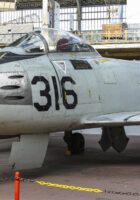
el Sable F-86 norteamericano, a veces llamado Sabrejet, era un avión de combate transónico. Producido por North American Aviation, el Sabre es más conocido como el primer caza de ala barrido de los Estados Unidos que podría contrarrestar el MiG-15 soviético de alas similares en combates aéreos de alta velocidad sobre los cielos de la Guerra de Corea (1950-1953). Considerado uno de los mejores y más importantes aviones de combate en esa guerra, el F-86 también está altamente calificado en comparación con los cazas de otras épocas. Aunque fue desarrollado a finales de la década de 1940 y estaba desactualizado a finales de los años 50, el Sabre demostró ser versátil y adaptable, y continuó como un caza de primera línea en numerosas fuerzas aéreas hasta que los últimos ejemplos operativos activos fueron retirados por la Fuerza Aérea Boliviana en 1994.

Fuente: Sable F-86 norteamericano en Wikipedia

Continuar leyendo

Views : 8896

Steyr 680M

Steyr 680M

PaísAustria
TipoCamión
FotografíaGunther Neumahr
Periodo de producción1960-1984
Tema

Álbum de 19 fotos de un «Steyr 680M»

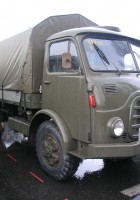
Galería de fotos de un Steyr 680M, The Steyr 680M was a truck of the brand Steyr. It was produced from 1960 to about 1984 of the former Steyr Daimer Puch AG in Austria and in its branch in Greece. The vehicle is powered by a liquid-cooled , six-cylinder four-stroke – diesel engine series WD-609 (Vorkammereinspritzer) or WD-610 (direct injection) with 88 kW (120 hp), and from 1979 to the from the Steyr 91 derived, and 142 PS ( 104 kW) payable WD-612 operated. The design speed is 80 km / h, the range is 450 km. Overall, it can be loaded in the two-axle version with up to 4,500 kg, the maximum permissible total weight is 10,100 kg. The three-axle version 680M3 makes the largely identical engine through turbocharging 110 kW (150 hp) or the series of motors WD612 125 kW (170 hp). The payload is 5.5 tons and the maximum permissible total weight of 12 tons. The five-speed transmission of 680ers is not synchronized , it must therefore with declutching are switched and double domes. When off-road driving means of switchable are front-wheel drive , the reduction gear and the rear axle is available. Partly also vehicles were equipped with a mechanical winch fitted. In the 1990s, the Steyr 680M was combat performance increased. He was charged with double exterior mirrors, reinforced flatbed, new brakes, new roof and the dashboard of the truck Steyr 12M18 equipped.

Fuente: Steyr 680M en Wikipedia

Continuar leyendo

Vistas : 4365

República F-84 Thunderjet

República F-84 Thunderjet

PaísE.e.u.u
PapelCazabombarderos
Primer vuelo28 de febrero de 1946
Construido7524

Galería de fotos de un República F-84 Thunderjet, The Republic F-84 Thunderjet was an American turbojet fighter-bomber aircraft. Originating as a 1944 United States Army Air Forces (USAAF) proposal for a “day fighter”, the F-84 first flew in 1946. Although it entered service in 1947, the Thunderjet was plagued by so many structural and engine problems that a 1948 U.S. Air Force review declared it unable to execute any aspect of its intended mission and considered canceling the program. The aircraft was not considered fully operational until the 1949 F-84D model and the design matured only with the definitive F-84G introduced in 1951. In 1954, the straight-wing Thunderjet was joined by the swept-wing F-84F Thunderstreak fighter and RF-84F Thunderflash photo reconnaissance aircraft.

Fuente: Republic F-84 Thunderjet en Wikipedia

Continuar leyendo

Views : 7300