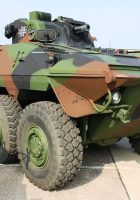
Luch Spahpanzer 2

Spahpanzer 2

PaysAllemagne de l’Ouest
TypeVéhicule de reconnaissance
Produit1975–1977
Construit408

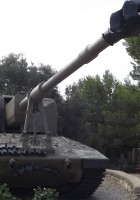
Lla Spähpanzer Luchs (English: Lynx) is a German 8×8 amphibious reconnaissance armoured fighting vehicle (Spähpanzer) in service since 1975 with the German Army, who used 408 in their armoured reconnaissance battalions. It was developed by Daimler-Benz between 1968 and 1975, replacing the M41 and the Schützenpanzer SPz 11-2 Kurz. The all-wheel drive Luchs made by Thyssen-Henschel (now: Rheinmetall) is well armoured, has an NBC protection system and is characterized by its low-noise running. The eight large low-pressure tyres have run-flat properties. At speeds up to about 50 km/h, all four axles can be steered. As a special feature, the vehicle is equipped with a rear-facing driver with his own driving position. Up to the first combat effectiveness upgrade in 1986, the Luchs was fully amphibious and could surmount water obstacles quickly and independently using propellers at the rear and the fold back trim vane at the front.

Source: Spahpanzer 2 sur Wikipédia

Lire l’article

Vues : 2710

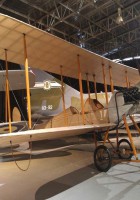
Royal Aircraft Factory BE2A

Royal Aircraft Factory BE2A

PaysRoyaume-uni
TypeBiplan
PhotoVladimir Yakubov
lieuRAAF Museum, Point Cook, Australie
Sujet

Album de 53 photos de promenade d’un « Royal Aircraft Factory BE2A »

Galerie de photos d’un Royal Aircraft Factory BE2A, The Royal Aircraft Factory B.E.2 was a British single-engine tractor two-seat biplane which was in service with the Royal Flying Corps (RFC) from 1912 until the end of World War I. About 3,500 were built. Initially used as front-line reconnaissance aircraft and light bombers; variants of the type were also used as night fighters. Like many warplanes since, the B.E.2 was retained in front-line service long after it had become obsolete, for want of a suitable replacement. After its belated withdrawal it finally served as a trainer, communications aircraft and on anti-submarine coastal patrol duties.

Source: Royal Aircraft Factory BE2A sur Wikipedia

Lire l’article

Vues : 2489

SKP M-42

SKP M-42

PaysSuède
TypeVéhicule blindé de transport de troupes
PhotoThord Wedman
Sujet

Album de 16 photos balade d’un « SKP M-42 »

Galerie de photos d’un SKP M-42, Terrängbil m/42 KP (Tgbil m/42 SKP/VKP), meaning « Véhicule hors route 42 » avec une désignation secondaire de « Scania, Carrosserie : blindée » Ou « Volvo, Carrosserie : blindée », était l’armée suédoise’s first armoured personnel carrier, developed as a stop-gap measure during World War II. In 1941, when tanks were organized into a unit of their own, it was clear there was a desperate need for a troop carrier able to both keep up with the tanks and provide protection against artillery shrapnel and small-arms fire. Due to the war there were no international suppliers to buy from, so the only option was to develop a domestic solution. AB Landsverk designed an APC consisting of a chassis from a regular army lorry equipped with an armoured shell.

Source: SKP M-42 sur Wikipedia

Lire l’article

Vues : 2250

Tatra 813 GRAD

Tatra 813 Kolos

PaysTchécoslovaquie
TypeCamion lourd
Période de production1967-1982
SuccesseurTatra T815

Galerie de photos d’un Tatra 813 Kolos, Tatra T813 was a truck produced in Czechoslovakia by the Tatra company. The first prototype already built in 1960 utilized existing Tatra T138 assemblies in 4×4 full-time all-wheel drive, which was also another first for Tatra. After the initial trials however the designers decided to develop and expand the concepts onto 8×8 all-wheel-drive all-terrain vehicle. The basis of the design thus became the modular chassis of T813. Successor is the Tatra T815 model.

Source: Tatra 813 Kolos sur Wikipedia

Lire l’article

Vues : 3533

MT-LB Sjvpbv 4024

MT-LB Sjvpbv 4024

PaysSuède
TypeAmbulance militaire
PhotographeThord Wedman
Sujet

Album de 28 photos d’un MT-LB Sjvpbv 4024

Photo galery d’un MT-LB Sjvpbv 4024 , The MT-LB (Russian: Многоцелевой Тягач Легкий Бронированный, Mnogotselevoy Tyagach Logkiy Bronirovannyi / light multi-purpose armoured towing vehicle) is a Soviet multi-purpose fully amphibious auxiliary armoured tracked vehicle, which was first introduced in the late 1960s. Initially, the vehicle was known as the M 1970 in the west. Suède :Sjvpbv 4024 (sjukvårdspansarbandvagn) – Ambulance militaire.

Source: MT-LB Sjvpbv 4024 sur Wikipedia

Lire l’article

Vues : 2915

Basé à Merkava Sholef

Merkava Obusier Sholef

PaysIsraël
TypeArtillerie automotrice
PhotographiesSasha Lev
Sujet

Album de 23 photos walk-around d’un « Merkava Howitzer Sholef »

Galerie de photos d’un Merkava Obusier Sholef, Two prototypes of Sholef (« prison », argot hébreu pour « Gunslinger ( Gunslinger ) ») 155 mm self-propelled howitzer with automatic loading system were built by Soltam in 1984–1986. The 45-ton vehicle had a long 155 mm gun barrel giving a range of 45+ km. Using GPS, inertial navigation, and an internal fire control computer, it was also capable of direct fire while on the move. It never entered production. The Slammer is a heavily armored artillery gun mounted on a modified Merkava Mk 1 chassis. Many of these vehicles are Merkava Mk 1 that were retired after the Merkava Mk 2 and Merkava Mk 3 came into service. The Slammer has a long 52-caliber gun barrel that allows +10% range. Reload speed may be decreased to 1 for one minute every 10 minutes through use of an automatic loader. Ammunition racks are large. The Slammer is ready for autonomous operation (without an FDC) if the targets location is known within 15 seconds of a halt, using GPS, inertial navigation, and an internal fire control computer. The Slammer 155 mm self-propelled howitzer is based on a modified Merkava MBT chassis fitted with a new welded steel turret, designed by Soltam Systems. Development commenced in the 1970s. The project was considered of high national priority and incorporated the newest technological developments. Instead the Israeli Defense Forces selected an upgraded version of American M109 howitzer.

Source: Merkava Howitzer Sholef sur Wikipedia

Lire l’article

Vues : 3430

Pistolet automoteur Sexton

Pistolet automoteur Sexton

PaysCanada
TypeArtillerie automotrice
En service1943–1956
Construit2150

Le SP 25pdr, suivi, Sacristain était un véhicule d’artillerie automoteur de la Seconde Guerre mondiale. Il était basé sur des versions construites au Canada des châssis de chars américains M3 Lee et M4 Sherman, qui sont entrés en production au Canada sous le nom de Ram and Grizzly. Lorsque la production de Sherman aux États-Unis a augmenté et que l’approvisionnement n’était plus un problème, en 1943, il a été décidé de changer les chaînes de production canadiennes pour produire le Sexton afin de donner à l’armée britannique un canon d’artillerie mobile utilisant leur obusier Ordnance QF 25 pounder, qui pouvait tirer un obus HE de 87,6 mm (3,45 po) de 11,5 kg (25 lb) ou un obus perforant. Il a été utilisé dans l’armée canadienne et britannique, ainsi que dans de nombreux autres forces de l’Empire britannique et des forces associées. Juste après la guerre, un certain nombre de Grizzly et de Sextons ont été vendus au Portugal, qui les a utilisés dans les années 1980.

Source: Pistolet automoteur Sexton sur Wikipedia

Lire l’article

Vues : 3367

North American F-86F Sabre

North American F-86 Sabre

PaysUsa
RôleChasseur
Premier vol1er octobre 1947
Construit9860

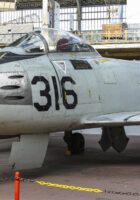
Lla North American F-86 Sabre, parfois appelé le Sabrejet, était un avion de chasse transonique à réaction. Produit par North American Aviation, le Sabre est surtout connu sous le nom de United States’ premier chasseur à aile balayée capable de contrer le MiG-15 soviétique aux ailes similaires dans des combats aériens à grande vitesse au-dessus du ciel de la guerre de Corée (1950-1953). Considéré comme l’un des meilleurs et des plus importants avions de chasse de cette guerre, le F-86 est également très bien noté par rapport aux chasseurs d’autres époques. Bien qu’il ait été développé à la fin des années 1940 et qu’il soit désuet à la fin de l' ’Dans les années 50, le Sabre s’est avéré polyvalent et adaptable, et a continué en tant que chasseur de première ligne dans de nombreuses forces aériennes jusqu’à ce que les derniers exemplaires opérationnels actifs soient retirés par l’armée de l’air bolivienne en 1994.

Source: North American F-86 Sabre sur Wikipédia

Lire l’article

Views : 8896

Steyr 680M

Steyr 680M

PaysAutriche
TypeCamion
PhotoGunther Neumahr
Période de production1960-1984
Sujet

Album de 19 photos de promenade d’un « Steyr 680M »

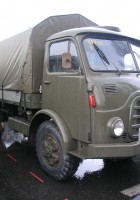
Galerie de photos d’un Steyr 680M, The Steyr 680M was a truck of the brand Steyr. It was produced from 1960 to about 1984 of the former Steyr Daimer Puch AG in Austria and in its branch in Greece. The vehicle is powered by a liquid-cooled , six-cylinder four-stroke – diesel engine series WD-609 (Vorkammereinspritzer) or WD-610 (direct injection) with 88 kW (120 hp), and from 1979 to the from the Steyr 91 derived, and 142 PS ( 104 kW) payable WD-612 operated. The design speed is 80 km / h, the range is 450 km. Overall, it can be loaded in the two-axle version with up to 4,500 kg, the maximum permissible total weight is 10,100 kg. The three-axle version 680M3 makes the largely identical engine through turbocharging 110 kW (150 hp) or the series of motors WD612 125 kW (170 hp). The payload is 5.5 tons and the maximum permissible total weight of 12 tons. The five-speed transmission of 680ers is not synchronized , it must therefore with declutching are switched and double domes. When off-road driving means of switchable are front-wheel drive , the reduction gear and the rear axle is available. Partly also vehicles were equipped with a mechanical winch fitted. In the 1990s, the Steyr 680M was combat performance increased. He was charged with double exterior mirrors, reinforced flatbed, new brakes, new roof and the dashboard of the truck Steyr 12M18 equipped.

Source: Steyr 680M sur Wikipedia

Lire l’article

Views : 4365

République F-84 Thunderjet

République F-84 Thunderjet

PaysUsa
RôleChasseur-bombardier
Premier volLe 28 février 1946
Construit7524

Galerie de photos d’un République F-84 Thunderjet, The Republic F-84 Thunderjet was an American turbojet fighter-bomber aircraft. Originating as a 1944 United States Army Air Forces (USAAF) proposal for a « combattant de jour », le F-84 a volé pour la première fois en 1946. Bien qu’il soit entré en service en 1947, le Thunderjet a été en proie à tant de problèmes structurels et moteurs qu’un examen de l’US Air Force de 1948 a déclaré qu’il ne pouvait exécuter aucun aspect de sa mission prévue et a envisagé d’annuler le programme. L’avion n’a pas été considéré comme pleinement opérationnel jusqu’à ce que le modèle F-84D de 1949 et la conception n’a mûri qu’avec le F-84G définitif introduit en 1951. En 1954, le Thunderjet à voilure droite a été rejoint par le chasseur F-84F Thunderstreak à ailes balayées et l’avion de reconnaissance photo RF-84F Thunderflash.

Source: Republic F-84 Thunderjet sur Wikipedia

Lire l’article

Vues : 7300