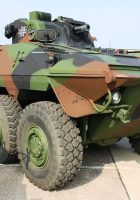
Luch Spahpanzer 2

Spahpanzer 2 Annoncer

LandVesttyskland
TypeRekognosceringskøretøj
Produceret1975–1977
Bygget408

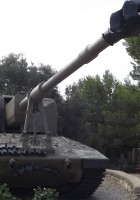
Den Spähpanzer Luchs (English: Lynx) is a German 8×8 amphibious reconnaissance armoured fighting vehicle (Spähpanzer) in service since 1975 with the German Army, who used 408 in their armoured reconnaissance battalions. It was developed by Daimler-Benz between 1968 and 1975, replacing the M41 and the Schützenpanzer SPz 11-2 Kurz. The all-wheel drive Luchs made by Thyssen-Henschel (now: Rheinmetall) is well armoured, has an NBC protection system and is characterized by its low-noise running. The eight large low-pressure tyres have run-flat properties. At speeds up to about 50 km/h, all four axles can be steered. As a special feature, the vehicle is equipped with a rear-facing driver with his own driving position. Up to the first combat effectiveness upgrade in 1986, the Luchs was fully amphibious and could surmount water obstacles quickly and independently using propellers at the rear and the fold back trim vane at the front.

Kilde: Spahpanzer 2 på Wikipedia

Fortsæt med at læse

Set antal gange : 2710

Royal Aircraft Factory BE2A

Royal Aircraft Factory BE2A

LandUk
TypeBiplan fly
FotografiVladimir Yakubov
StedRAAF Museum, Point Cook, Australien
Emne

Album af 53 fotos walk-around af en «Royal Aircraft Factory BE2A»

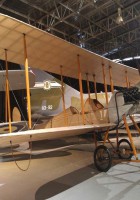
Fotogalleri af en Royal Aircraft Factory BE2A, The Royal Aircraft Factory B.E.2 was a British single-engine tractor two-seat biplane which was in service with the Royal Flying Corps (RFC) from 1912 until the end of World War I. About 3,500 were built. Initially used as front-line reconnaissance aircraft and light bombers; variants of the type were also used as night fighters. Like many warplanes since, the B.E.2 was retained in front-line service long after it had become obsolete, for want of a suitable replacement. After its belated withdrawal it finally served as a trainer, communications aircraft and on anti-submarine coastal patrol duties.

Kilde: Royal Aircraft Factory BE2A på Wikipedia

Fortsæt med at læse

Views : 2489

SKP M-42

SKP M-42

LandSverige
TypePansret mandskabsvogn
FotografiThord Wedman
Emne

Album med 16 fotos walk-around af en «SKP M-42»

Fotogalleri af en SKP M-42, Terrängbil m/42 KP (Tgbil m/42 SKP/VKP), meaning “Off-road vehicle 42” with a secondary designation of “Scania, Bodywork: Armoured” or “Volvo, Bodywork: Armoured”, was the Swedish army’s first armoured personnel carrier, developed as a stop-gap measure during World War II. In 1941, when tanks were organized into a unit of their own, it was clear there was a desperate need for a troop carrier able to both keep up with the tanks and provide protection against artillery shrapnel and small-arms fire. Due to the war there were no international suppliers to buy from, so the only option was to develop a domestic solution. AB Landsverk designed an APC consisting of a chassis from a regular army lorry equipped with an armoured shell.

Kilde: SKP M-42 på Wikipedia

Fortsæt med at læse

Views : 2250

Tatra 813 GRAD

Tatra 813 Kolos

LandTjekkoslovakiet
TypeTung lastbil
Produktionsperiode1967-1982
EfterfølgerTatra T815

Fotogalleri af en Tatra 813 Kolos, Tatra T813 was a truck produced in Czechoslovakia by the Tatra company. The first prototype already built in 1960 utilized existing Tatra T138 assemblies in 4×4 full-time all-wheel drive, which was also another first for Tatra. After the initial trials however the designers decided to develop and expand the concepts onto 8×8 all-wheel-drive all-terrain vehicle. The basis of the design thus became the modular chassis of T813. Successor is the Tatra T815 model.

Kilde: Tatra 813 Kolos på Wikipedia

Fortsæt med at læse

Views : 3533

MT-LB Sjvpbv 4024

MT-LB Sjvpbv 4024

LandSverige
TypeMilitær ambulance
FotografThord Wedman
Emne

Album af 28 billeder af en MT-LB Sjvpbv 4024

Foto stormvejr af en MT-LB Sjvpbv 4024 , The MT-LB (Russian: Многоцелевой Тягач Легкий Бронированный, Mnogotselevoy Tyagach Logkiy Bronirovannyi / light multi-purpose armoured towing vehicle) is a Soviet multi-purpose fully amphibious auxiliary armoured tracked vehicle, which was first introduced in the late 1960s. Initially, the vehicle was known as the M 1970 in the west. Sverige :Sjvpbv 4024 (sjukvårdspansarbandvagn) – Militærambulance.

Kilde: MT-LB Sjvpbv 4024 på Wikipedia

Fortsæt med at læse

Set antal gange : 2915

Merkava baseret Sholef

Merkava haubits Sholef

LandIsrael
TypeSelvkørende artilleri
FotografierSasha Lev
Emne

Album af 23 fotos walk-around af en «Merkava Howitzer Sholef»

Fotogalleri af en Merkava haubits Sholef, Two prototypes of Sholef (“Slammer”, Hebrew slang for “Gunslinger”) 155 mm self-propelled howitzer with automatic loading system were built by Soltam in 1984–1986. The 45-ton vehicle had a long 155 mm gun barrel giving a range of 45+ km. Using GPS, inertial navigation, and an internal fire control computer, it was also capable of direct fire while on the move. It never entered production. The Slammer is a heavily armored artillery gun mounted on a modified Merkava Mk 1 chassis. Many of these vehicles are Merkava Mk 1 that were retired after the Merkava Mk 2 and Merkava Mk 3 came into service. The Slammer has a long 52-caliber gun barrel that allows +10% range. Reload speed may be decreased to 1 for one minute every 10 minutes through use of an automatic loader. Ammunition racks are large. The Slammer is ready for autonomous operation (without an FDC) if the target’s location is known within 15 seconds of a halt, using GPS, inertial navigation, and an internal fire control computer. The Slammer 155 mm self-propelled howitzer is based on a modified Merkava MBT chassis fitted with a new welded steel turret, designed by Soltam Systems. Development commenced in the 1970s. The project was considered of high national priority and incorporated the newest technological developments. Instead the Israeli Defense Forces selected an upgraded version of American M109 howitzer.

Kilde: Merkava Howitzer Sholef på Wikipedia

Fortsæt med at læse

Visninger : 3430

Sexton selvkørende pistol

Sexton selvkørende pistol

LandCanada
TypeSelvkørende artilleri
I brug1943–1956
Bygget2150

25pdr SP, sporet, Sexton var et selvkørende artillerikøretøj fra Anden Verdenskrig. Det var baseret på canadisk byggede versioner af de amerikanske M3 Lee og M4 Sherman tank chassis, som gik i produktion i Canada som Ram og Grizzly. Da Sherman-produktionen i USA blev udvidet, og forsyningen ikke længere var et problem, blev det i 1943 besluttet at skifte de canadiske produktionslinjer til at producere Sexton for at give den britiske hær en mobil artillerikanon ved hjælp af deres Ordnance QF 25 punds kanonhaubits, som kunne affyre en 87,6 mm (3,45 in) 11,5 kg (25 lb) HE-skal eller en panserbrydende skal. Det fandt anvendelse i den canadiske og britiske hær, såvel som mange andre britiske imperium og tilknyttede styrker. Lige efter krigen blev en række Grizzly og Sextons solgt til Portugal, som brugte dem ind i 1980'erne.

Kilde: Sexton selvkørende pistol på Wikipedia

Fortsæt med at læse

Visninger : 3367

Nordamerikanske F-86F Sabre

Nordamerikanske F-86 Sabre

LandUsa
RolleKampfly
Første flyvning1. oktober 1947
Bygget9860

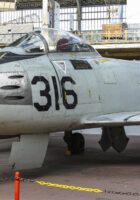
Den Nordamerikanske F-86 Sabre, undertiden kaldet Sabrejet, var et transonisk jetjagerfly. Sabre er produceret af North American Aviation og er bedst kendt som USAs første fejede vingejager, der kunne imødegå den tilsvarende vingede sovjetiske MiG-15 i højhastighedskampe over Koreakrigens himmel (1950–1953). F-86 betragtes som et af de bedste og vigtigste kampfly i den krig og vurderes også højt sammenlignet med krigere fra andre epoker. Selvom den blev udviklet i slutningen af 1940'erne og var forældet i slutningen af 50'erne, viste Sabre sig alsidig og tilpasningsdygtig og fortsatte som frontlinjejager i adskillige luftvåben, indtil de sidste aktive operationelle eksempler blev pensioneret af det bolivianske luftvåben i 1994.

Kilde: Nordamerikanske F-86 Sabre på Wikipedia

Fortsæt med at læse

Views : 8896

Steyr 680M

Steyr 680M

LandØstrig
TypeLastbil
FotografiGunther Neumahr
Produktionsperiode1960-1984
Emne

Album af 19 billeder walk-around af en «Steyr 680M»

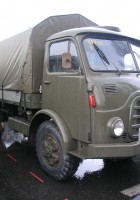
Fotogalleri af en Steyr 680M, The Steyr 680M was a truck of the brand Steyr. It was produced from 1960 to about 1984 of the former Steyr Daimer Puch AG in Austria and in its branch in Greece. The vehicle is powered by a liquid-cooled , six-cylinder four-stroke – diesel engine series WD-609 (Vorkammereinspritzer) or WD-610 (direct injection) with 88 kW (120 hp), and from 1979 to the from the Steyr 91 derived, and 142 PS ( 104 kW) payable WD-612 operated. The design speed is 80 km / h, the range is 450 km. Overall, it can be loaded in the two-axle version with up to 4,500 kg, the maximum permissible total weight is 10,100 kg. The three-axle version 680M3 makes the largely identical engine through turbocharging 110 kW (150 hp) or the series of motors WD612 125 kW (170 hp). The payload is 5.5 tons and the maximum permissible total weight of 12 tons. The five-speed transmission of 680ers is not synchronized , it must therefore with declutching are switched and double domes. When off-road driving means of switchable are front-wheel drive , the reduction gear and the rear axle is available. Partly also vehicles were equipped with a mechanical winch fitted. In the 1990s, the Steyr 680M was combat performance increased. He was charged with double exterior mirrors, reinforced flatbed, new brakes, new roof and the dashboard of the truck Steyr 12M18 equipped.

Kilde: Steyr 680M på Wikipedia

Fortsæt med at læse

Views : 4365

Republik F-84 Thunderjet

Republik F-84 Thunderjet

LandUsa
RolleJagerbomber
Første flyvning28. februar 1946
Bygget7524

Fotogalleri af en Republik F-84 Thunderjet, The Republic F-84 Thunderjet was an American turbojet fighter-bomber aircraft. Originating as a 1944 United States Army Air Forces (USAAF) proposal for a “day fighter”, the F-84 first flew in 1946. Although it entered service in 1947, the Thunderjet was plagued by so many structural and engine problems that a 1948 U.S. Air Force review declared it unable to execute any aspect of its intended mission and considered canceling the program. The aircraft was not considered fully operational until the 1949 F-84D model and the design matured only with the definitive F-84G introduced in 1951. In 1954, the straight-wing Thunderjet was joined by the swept-wing F-84F Thunderstreak fighter and RF-84F Thunderflash photo reconnaissance aircraft.

Kilde: Republik F-84 Thunderjet på Wikipedia

Fortsæt med at læse

Views : 7300