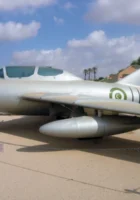
T28 Súper Tanque

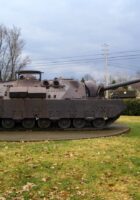
Tanque súper pesado T-28

PaísE.e.u.u
TipoCazatanques/tanque súper pesado
Producido1945
Construido2

Galería de fotos de un Tanque súper pesado T-28, The T28 Super Heavy Tank was an American heavily armored tank self-propelled gun designed for the United States Army during World War II. It was originally designed to be used to break through German defenses of the Siegfried Line, and was later considered as a possible participant in the planned invasion of the Japanese mainland. The 100-ton vehicle was initially designated a heavy tank, it was re-designated as the 105 mm Gun Motor Carriage T95 in 1945, and then renamed in 1946 as the Super Heavy Tank T28.

Fuente: T-28 Super Heavy Tank en Wikipedia

Continuar leyendo

Vistas : 4718

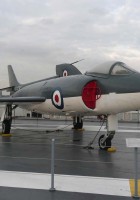
Supermarine Scimitar F.1

Supermarine Scimitar F.1

PaísUk
TipoAviones de combate
FotografíaVladimir Yakubov
Tema

Álbum de 76 fotos de una «Supermarine Scimitar F.1»

Galería de fotos de un Supermarine Scimitar F.1, The Supermarine Scimitar was a British naval fighter aircraft operated by the Royal Navy Fleet Air Arm. The prototype for the eventual production version flew in January 1956 and production aircraft were delivered in 1957. It saw service with the Royal Navy from 1958 until 1969.

Fuente: Supermarine Scimitar F.1 en Wikipedia

Continuar leyendo

Vistas : 3181

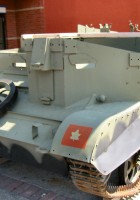
Portador Universal T-16

Portador Universal T-16

PaísCanadá
TipoTransportista Universal
FotografíaRuiseñor de Daryl
Tema

Álbum de 19 fotos walk-around de un «Universal Carrier T-16»

Galería de fotos de un Portador Universal T-16, The Universal Carrier, also known as the Bren Gun Carrier from the light machine gun armament, is a common name describing a family of light armoured tracked vehicles built by Vickers-Armstrong and other companies. The first carriers – the Bren Carrier and the Scout Carrier with specific roles – entered service before the war, but a single improved design that could replace these, the Universal, was introduced in 1940. The vehicle was used widely by British Commonwealth forces during the Second World War. Universal Carriers were usually used for transporting personnel and equipment, mostly support weapons, or as machine gun platforms. With some 113,000 built by 1960 in the United Kingdom and abroad, it is the most produced armoured fighting vehicle in history

Variante T-16: The Carrier, Universal, T16, Mark I. was a significantly improved vehicle based upon those built by Ford of Canada, manufactured under Lend Lease by Ford in the United States from March 1943 to 1945. It was longer than the Universal with an extra road wheel on the rear bogie, the engine was a Ford Mercury delivering the same power. Instead of the steering wheel controlling the combination brake/warp mechanism, the T-16 had track-brake steering operated by levers (two for each side). During the war, it was chiefly used by Canadian forces as an artillery tractor. After the war, was used by Argentine, Swiss (300) and Netherlands forces.

Fuente: Universal Carrier T-16 en Wikipedia
Continuar leyendo

Vistas : 3458

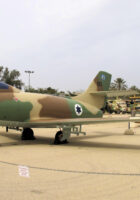
Dassault MD-450

Dassault M.D.450 Ouragan

PaísFrancia
TipoCazabombarderos
Primer vuelo28 de febrero de 1949
Construido118

Galería de fotos de un Dassault M.D.450 Ouragan, The Dassault M.D.450 Ouragan (French: Hurricane) was the first French-designed jet fighter-bomber to enter production, playing a key role in resurgence of the French aviation industry after World War II. The Ouragan was operated by France, India, Israel and El Salvador. While in Israeli service, it participated in both the Suez Crisis and the Six-Day War.

Fuente: Dassault M.D.450 Ouragan en Wikipedia

Continuar leyendo

Vistas : 4702

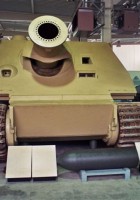
Sturmtiger

Sturmtiger

PaísAlemania nazi
TipoArma de asalto pesado
FotografíasUlrich Wrede, Jan Peters
DescripciónÁlbum de 19 fotos de un «Sturmtiger»

Galería de fotos de un Sturmtiger, Sturmtiger (German: “Assault Tiger”) was a World War II German assault gun built on the Tiger I chassis and armed with a large rocket launcher. The official German designation was Sturmmörserwagen 606/4 mit 38 cm RW 61. Its primary task was to provide heavy fire support for infantry units fighting in urban areas. The few vehicles produced fought in the Warsaw Uprising, the Battle of the Bulge and the Battle of the Reichswald. The fighting vehicle is also known under a large number of informal names, among which the Sturmtiger became the most popular.

Fuente: Sturmtiger en Wikipedia

Continuar leyendo

Views : 3258

Dodge WC-57

Dodge WC-57

PaísE.e.u.u
TipoCamión ligero 4×4>
FotografíaYuri Pasholok
Descripción

Álbum de 144 fotos walk-around de un «Dodge WC-57»

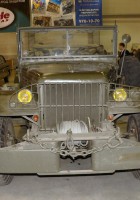
Galería de fotos de un Dodge WC-57, The Dodge WC series was a range of light military trucks produced by Dodge and Fargo during World War II. The series included weapon carriers, telephone installation trucks, ambulances, reconnaissance vehicles, mobile workshops and command cars. They were replaced after the war by the Dodge M-series vehicles. WC was a Dodge model code: W for 1941 and C for half-ton rating. The C code was retained for the ¾ ton and 1½ ton 6×6 Dodges.

El WC57 Truck, Command Reconnaissance, de 3/4 toneladas, 4×4 w/Winch Dodge (G502) era idéntico al WC56, pero equipado con un cabrestante Braden MU2 de 5.000 lb / 2 268 kg de capacidad en el parachoques delantero. 6.010 construidos.

Fuente: Dodge WC-57 en Wikipedia

Continuar leyendo

Vistas: 4797

Mig-19PF - Shenyang J-6

Mig-19PF – Shenyang J-6A

PaísChina
TipoCombatiente
FotografíaVladimir Yakubov
Tema

Álbum de 165 fotos walk-around de un «Mig-19PF – Shenyang J-6A»

Galería de fotos de un Mig-19PF – Shenyang J-6A, The Shenyang J-6 (Chinese: 歼-6; designated F-6 for export versions; NATO Code: Farmer) was the Chinese-built version of the Soviet MiG-19 ‘Farmer’ fighter aircraft. Although the MiG-19 had a comparatively short life in Soviet service, the Chinese came to value its agility, turning performance, and powerful cannon armament, and produced it for their own use between 1958 and 1981. While the basic Soviet-designed MiG-19 has been retired from all nations, the Shenyang J-6 still flies for nine of its original 15 operators, however, in a very limited capacity. The J-6 airframe contributed to the Chinese ground attack version, the Q-5, which still flies for numerous nations. The J-6 was considered “disposable” and was intended to be operated for only 100 flight hours (or approximately 100 sorties) before being overhauled. The Pakistan Air Force was often able to extend this to 130 hours with diligent maintenance.

Fuente: Mig-19PF – Shenyang J-6A en Wikipedia

Continuar leyendo

Vistas : 3555

Mundo de tanques - T-34/85

Italeri

Ref 36509
SerieMundo de tanques
Escala1/35
Tema

T-34/85

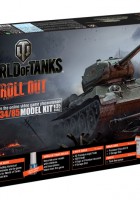
THE BOX CONTAIN: 1 MODEL KIT – 1 LIQUID CEMENT – 1 TANK GUIDE – 1 POSTER (42×59,4cm) – WORLD oF TANKS DECALS – 3 INVITE CODES – 1 BONUS CODE

Arguably the best medium tank of World War II, the T-34-85 was a crucial factor in the outcome of the conflict. Over 35,000 were produced, meaning that it also came to represent, from a Soviet standpoint, the supremacy of socialist industry over capitalism. It was the antithesis of German over-engineering. Designers favoured simple solutions that used fewer resources. It was therefore available in greater numbers – a telling factor as Axis forces were pushed out of the Soviet Union and back to Berlin. The T-34-85 was an up-gunned version of the T-34 tank which carried a 76mm gun that was insufficient at dealing with tanks like the Tiger and Panther. A new turret allowed the installation of an 85mm gun that was capable of penetrating German armour with greater ease. This tank also represented the first proper mass production of a sloped-hull design which meant that the armour could afford to be thinner while still providing the same effective protection. Coupled with sloping on the turret, the survivability of the tank compared to the original T-34 design was much better.

Fuente: Italeri

Continuar leyendo

Vistas : 2117

M1127 Stryker

Stryker ICV

PaísE.e.u.u
PapelVehículo portaaviones de infantería

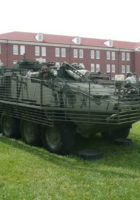
Galería de fotos de un Stryker ICV, The M1126 Infantry Carrier Vehicle (ICV) is an armoured personnel carrier and part of the Stryker family of vehicles (derived from the Canadian LAV III/Swiss MOWAG Piranha IIIH 8×8) used by the United States Army. The Infantry Carrier Vehicle provides protected transport and, during dismounted assault, supporting fire for the infantry squad. The Stryker is a full-time four-wheel drive, selectively eight-wheel drive, armoured vehicle weighing approximately 19t which carries an infantry squad with their equipment. On paved roads the vehicle can attain speeds of 62 mph without a governor and 37 mph with a governor. The basic infantry carrier vehicle (ICV) provides armored protection for the two-man crew and a squad of nine soldiers.

Fuente: Stryker ICV en Wikipedia

Continuar leyendo

Vistas : 4532

MiG-15UTI

Mikoyan-Gurevich MiG-15bis

PaísUnión Soviética
PapelCombatiente
Primer vuelo30 de diciembre de 1947
ConstruidoMás de 12000

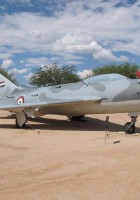
el Mikoyan-Gurevich MiG-15 (Russian: Микоян и Гуревич МиГ-15; NATO reporting name: “Fagot”) was a jet fighter aircraft developed by Mikoyan-Gurevich OKB for the Soviet Union. The MiG-15 was one of the first successful jet fighters to incorporate swept wings to achieve high transonic speeds. In combat over Korea, it outclassed straight-winged jet day fighters which were largely relegated to ground attack roles, and was quickly countered by the similar American swept-wing F-86 Sabre. The MiG-15 is often mentioned, along with the North American F-86 Sabre, as the best fighter aircraft of the Korean War, and among the best fighter aircraft of all time. When refined into the more advanced MiG-17, the basic design would again surprise the West when it proved effective against supersonic fighters such as the F-105 Thunderchief and McDonnell Douglas F-4 Phantom II in the Vietnam War of the 1960s. The MiG-15 is believed to have been one of the most widely produced jet aircraft ever made; in excess of 12,000 were manufactured. Licensed foreign production may have raised the production total to over 18,000. The MiG-15 remains in service with the North Korean Air Force as an advanced trainer.

Fuente: MiG-15bis en Wikipedia

Continuar leyendo

Vistas : 9232