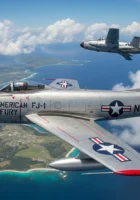
North American FJ-1 Fury sky

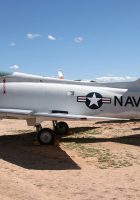
North American FJ-1 Fury

LandUsa
RolleKampfflugzeuge
Erstflug11. September 1946
Gebaut31

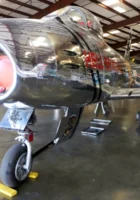
das North American FJ-1 Fury ist das erste operative Düsenflugzeug im Dienst der United States Navy und wurde von North American Aviation als NA-135 entwickelt. Der FJ-1 war ein früher Übergangsstrahl mit begrenztem Erfolg, der ähnliche Heckoberflächen, Flügel und Baldachin aus dem kolbenmotorigen P-51D Mustang transportierte. Die Entwicklung des Entwurfs, geschwungene Flügel zu integrieren, würde die Grundlage für den landgestützten XP-86-Prototyp werden, der ursprünglich mit einer sehr ähnlichen, geraden Planform wie die FJ-1-Flugzeugform entworfen wurde – des enorm einflussreichen F-86 Sabre der United States Air Force, der selbst die Grundlage für die trägerbasierte nordamerikanische FJ-2/-3 Fury der Navy bildete.

Quelle: Nordamerikanische FJ-1 Fury auf Wikipedia

Weiterlesen

Aufrufe : 2962

North American FJ-4 Fury

North American FJ-4 Fury Spezifikationen

Hersteller North American Aviation
Rolle Trägergestützter Jagdbomber
Erstflug 3. Oktober 1954
Einleitung 1955
Pensioniert 1965 (US Navy), 1972 (Venezuela)
Primäre Benutzer United States Navy, venezolanische Luftwaffe
Anzahl gebaut 374
Stückkosten 780.000 US$ (FJ-4B)
Motor Ein Pratt & Whitney J48-P-8A Turbojet, 7.250 lbf (32,3 kN) Schub
Maximum speed 680 mph (1.094 km/h)
Range 1.900 km (1.200 mi)
Service ceiling 44.000 ft (13.400 m)
Bewaffnung
  • 4× 20 mm (0,79 Zoll) M3-Kanonen
  • Bis zu 2.270 kg (5.000 lb) Bomben, Raketen oder Flugkörper

das North American FJ-4 Fury war ein trägerfähiger Jagdbomber für die United States Navy und das Marine Corps. Die endgültige Entwicklung in einer Linie, die die F-86 Sabre der Air Force umfasste, teilte die FJ-4 ihr allgemeines Layout und ihren Motor mit dem früheren FJ-3, hatte aber ein völlig neues Flügeldesign und war in ihrer endgültigen Ausführungeinsicht ein völlig anderes Design.

Quelle: Nordamerikanische FJ-4 Fury auf Wikipedia

Weiterlesen

Views : 3251

Vought OS2U-3 Eisvogel

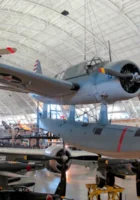
Vought OS2U Kingfisher

LandUsa
RolleBeobachtungs-Floatplane
Erstflug1938
Gebaut1519

das Vought OS2U Eisvogel was an American catapult-launched observation floatplane. It was a compact mid-wing monoplane, with a large central float and small stabilizing floats. Performance was modest, because of its light engine. The OS2U could also operate on fixed, wheeled, taildragger landing gear. The OS2U was the main shipboard observation aircraft used by the United States Navy during World War II, and 1,519 of the aircraft were built. It served on battleships and cruisers of the US Navy, with the United States Marine Corps in Marine Scouting Squadron Three (VMS-3), with the United States Coast Guard at coastal air stations, at sea with the Fleet Air Arm of the Royal Navy, and with the Soviet Navy. The Royal Australian Air Force also operated a few Kingfishers from shore bases.

Quelle: Vought OS2U Kingfisher auf Wikipedia

Weiterlesen

Views : 7717

Packard LePere LUSAC-11

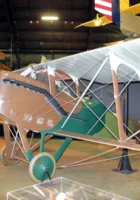
Packard-Le Père LUSAC-11

LandUsa
RolleKampfflugzeuge
Erstflug15 May 1918
Gebaut30

das LUSAC-11 (Lepère United States Army Combat) was an early American two-seat fighter aircraft. It was a French design, commissioned and built in the United States during World War I and ordered in large numbers by the United States Army Air Corps, but these were cancelled at the end of the war, and only 30 were built. The type was used for experimental purposes, setting several altitude records during the 1920s.

Quelle: Packard-Le Père LUSAC-11 auf Wikipedia

Weiterlesen

Aufrufe : 1723

Canadair F-86E mk.6 Sabre

Canadair Sabre

LandKanada
RolleKämpfer
Erstflug9. August 1950
Gebaut1815

das Canadair Sabre war ein Düsenkampfflugzeug, das von Canadair in Lizenz von North American Aviation gebaut wurde. Als Variante der North American F-86 Sabre wurde sie bis 1958 produziert und hauptsächlich von der Royal Canadian Air Force (RCAF) eingesetzt, bis sie 1962 durch die Canadair CF-104 ersetzt wurde. Mehrere andere Luftstreitkräfte betrieben das Flugzeug ebenfalls.

Quelle: Canadair Sabre auf Wikipedia

Weiterlesen

Views : 3784

Lockheed F-94 Starfire sky

Lockheed F-94 Starfire

LandUsa
RolleAllwetter-Abfangjäger
Erstflug16. April 1949
Gebaut855

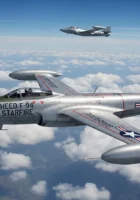
das Lockheed F-94 Starfire was a first-generation jet aircraft of the United States Air Force. It was developed from the twin-seat Lockheed T-33 Shooting Star in the late 1940s as an all-weather, day/night interceptor. The aircraft reached operational service in May 1950 with Air Defense Command, replacing the piston-engined North American F-82 Twin Mustang in the all-weather interceptor role. The F-94 was the first operational USAF fighter equipped with an afterburner and was the first jet-powered all-weather fighter to enter combat during the Korean War in January 1953. It had a relatively brief operational life, being replaced in the mid-1950s by the Northrop F-89 Scorpion and North American F-86D Sabre. The last aircraft left active-duty service in 1958 and Air National Guard service in 1959.

Quelle: Lockheed F-94 Starfire auf Wikipedia

Weiterlesen

Aufrufe : 3329

Bell UH-1 Iroquois sky

Bell UH-1 Iroquois

LandUsa
RolleVersorgungshubschrauber
Erstflug20. Oktober 1956
Gebaut16000+

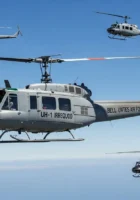
das Bell UH-1 Irokesen (nicknamed “Huey”) is a utility military helicopter powered by a single turboshaft engine, with two-blade main and tail rotors. The first member of the prolific Huey family, it was developed by Bell Helicopter to meet a United States Army’s 1952 requirement for a medical evacuation and utility helicopter, and first flew in 1956. The UH-1 was the first turbine-powered helicopter to enter production in 1960 for the United States military, and more than 16,000 have been built since. The Iroquois was originally designated HU-1, hence the Huey nickname, which has remained in common use, despite the official redesignation to UH-1 in 1962. The UH-1 first saw service in combat operations during the Vietnam War, with around 7,000 helicopters deployed. The Bell 204 and 205 are Iroquois versions developed for the civil market.

Quelle: Bell UH-1 Irokesen auf Wikipedia

Weiterlesen

Views : 5892

Jakowlew Jak-1B

Yakovlev Yak-1

LandSowjetunion
RolleKämpfer
Erstflug13. Januar 1940
Gebaut8700

das Jakowlew Jak-1 (Russian: Яковлев Як-1) was a World War II Soviet fighter aircraft. Production began in early 1940. It was a single-seat monoplane with a composite structure and wooden wings. The Yak-1 was manoeuvrable, fast and well armed, and it was easy to maintain and reliable. It formed an excellent basis for subsequent developments from the Yakovlev bureau. It was the founder of a family of aircraft, with some 37,000 being built. As a reward, designer Alexander Yakovlev was awarded the Order of Lenin (Russian: Орден Ленина, Orden Lenina) – the highest decoration bestowed by the Soviet Union – a 100,000 ruble prize, plus a Zis[6] motor car.

Quelle: Jakowlew Jak-1 auf Wikipedia

Weiterlesen

Views : 7639

North American RA-5C Vigilante

North American A-5 Vigilante

LandUsa
RolleAtombomber – Aufklärungsflugzeug
Erstflug31. August 1958
Gebaut156

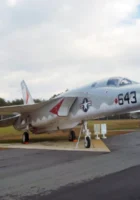
das North American A-5 Vigilante Ist ein US-amerikanischer Überschallbomber, der von North American Aviation für die United States Navy entwickelt und gebaut wurde. Sein Einsatz in der Rolle des Atomschlags als Ersatz für den Douglas A-3 Skywarrior war sehr kurz; Als RA-5C wurde sie jedoch während des Vietnamkrieges in der taktischen Streikaufklärungsrolle weitgehend im Einsatz. Vor der Vereinigung der Navy-Bezeichnungssequenz mit der Air Force-Sequenz im Jahr 1962 wurde sie als A3J Vigilante bezeichnet.

Quelle: North American A-5 Vigilante auf Wikipedia

Weiterlesen

Views : 5734