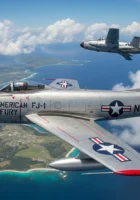
North American FJ-1 Fury sky

North American FJ-1 Fury

RiikUSA
RolliHävituslennukid
Esimene lend11 September 1946
Ehitatud31

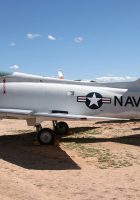
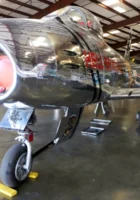
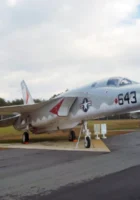
2007 Põhja-Ameerika FJ-1 Fury is the first operational jet aircraft in United States Navy service, and was developed by North American Aviation as the NA-135. The FJ-1 was an early transitional jet of limited success which carried over similar tail surfaces, wing and canopy derived from the piston-engined P-51D Mustang. The evolution of the design to incorporate swept wings would become the basis for the land-based XP-86 prototype – itself originally designed with a very similar straight-wing planform to the FJ-1 airframe – of the United States Air Force’s enormously influential F-86 Sabre, which itself formed the basis for the Navy’s carrier-based North American FJ-2/-3 Fury.

Allikas: Põhja-Ameerika FJ-1 raev Vikipeedias

Jätka lugemist

Views : 2962

Põhja-Ameerika FJ-4 raev

North American FJ-4 Fury Specifications

Tootja Põhja-Ameerika lennundus
Rolli Kanderaketil põhinev hävitaja-pommitaja
Esimene lend October 3, 1954
Sissejuhatus 1955
Pensionil 1965 (US Navy), 1972 (Venezuela)
Esmased kasutajad United States Navy, Venezuelan Air Force
Number on loodud 374
Unit cost US$780,000 (FJ-4B)
Mootor One Pratt & Whitney J48-P-8A turbojet, 7,250 lbf (32.3 kN) thrust
Maksimaalne kiirus 680 mph (1,094 km/h)
Vahemik 1,200 mi (1,900 km)
Teenuse lagi 44,000 ft (13,400 m)
Armament
  • 4× 20 mm (0.79 in) M3 cannons
  • Up to 5,000 lb (2,270 kg) of bombs, rockets, or missiles

2007 Põhja-Ameerika FJ-4 raev was a swept-wing carrier-capable fighter-bomber for the United States Navy and Marine Corps. The final development in a lineage that included the Air Force’s F-86 Sabre, the FJ-4 shared its general layout and engine with the earlier FJ-3, but featured an entirely new wing design and was a vastly different design in its final embodiment.

Allikas: North American FJ-4 Fury on Wikipedia

Jätka lugemist

Vaadatud : 3251

Vought OS2U-3 Kingfisher

Vought OS2U Kingfisher

RiikUSA
RolliVaatlus ujuvlennuk
Esimene lend1938
Ehitatud1519

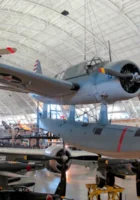
2007 Vought OS2U Kingfisher was an American catapult-launched observation floatplane. It was a compact mid-wing monoplane, with a large central float and small stabilizing floats. Performance was modest, because of its light engine. The OS2U could also operate on fixed, wheeled, taildragger landing gear. The OS2U was the main shipboard observation aircraft used by the United States Navy during World War II, and 1,519 of the aircraft were built. It served on battleships and cruisers of the US Navy, with the United States Marine Corps in Marine Scouting Squadron Three (VMS-3), with the United States Coast Guard at coastal air stations, at sea with the Fleet Air Arm of the Royal Navy, and with the Soviet Navy. The Royal Australian Air Force also operated a few Kingfishers from shore bases.

Allikas: Vought OS2U Kingfisher Vikipeedias

Jätka lugemist

Views : 7717

Packard LePere LUSAC-11

Packard-Le Père LUSAC-11

RiikUSA
RolliHävituslennukid
Esimene lend15 May 1918
Ehitatud30

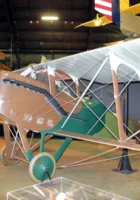
2007 LUSAC-11 (Lepère United States Army Combat) was an early American two-seat fighter aircraft. It was a French design, commissioned and built in the United States during World War I and ordered in large numbers by the United States Army Air Corps, but these were cancelled at the end of the war, and only 30 were built. The type was used for experimental purposes, setting several altitude records during the 1920s.

Allikas: Packard-Le Père LUSAC-11 Vikipeedias

Jätka lugemist

Vaadatud : 1724

Canadair F-86E mk.6 Sabre

Canadair Sabre

RiikKanada
RolliFighter
Esimene lend9. august 1950
Ehitatud1815

2007 Canadair Sabre oli Kanadairi ehitatud reaktiivhävituslennuk Põhja-Ameerika lennunduse litsentsi alusel. Põhja-Ameerika F-86 Sabre variant toodeti seda kuni 1958. aastani ja seda kasutasid peamiselt Kanada kuninglikud õhujõud (RCAF), kuni see asendati Canadair CF-104-ga 1962. aastal. Lennukit käitasid ka mitmed teised õhujõud.

Allikas: Canadair Sabre Vikipeedias

Jätka lugemist

Vaadatud : 3784

Lockheed F-94 Starfire sky

Lockheed F-94 Starfire

RiikUSA
RolliIga ilmaga pealtkuulaja
Esimene lend16. aprill 1949
Ehitatud855

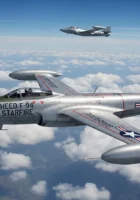
2007 Lockheed F-94 Starfire was a first-generation jet aircraft of the United States Air Force. It was developed from the twin-seat Lockheed T-33 Shooting Star in the late 1940s as an all-weather, day/night interceptor. The aircraft reached operational service in May 1950 with Air Defense Command, replacing the piston-engined North American F-82 Twin Mustang in the all-weather interceptor role. The F-94 was the first operational USAF fighter equipped with an afterburner and was the first jet-powered all-weather fighter to enter combat during the Korean War in January 1953. It had a relatively brief operational life, being replaced in the mid-1950s by the Northrop F-89 Scorpion and North American F-86D Sabre. The last aircraft left active-duty service in 1958 and Air National Guard service in 1959.

Allikas: Lockheed F-94 tähetuli Vikipeedias

Jätka lugemist

Views : 3353

Bell UH-1 Iroquois sky

Bell UH-1 Iroquois

RiikUSA
RolliKommunaalhelikopter
Esimene lend20 October 1956
Ehitatud16000+

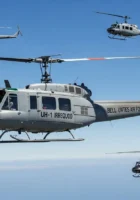
2007 Bell UH-1 Iroquois (nicknamed “Huey”) is a utility military helicopter powered by a single turboshaft engine, with two-blade main and tail rotors. The first member of the prolific Huey family, it was developed by Bell Helicopter to meet a United States Army’s 1952 requirement for a medical evacuation and utility helicopter, and first flew in 1956. The UH-1 was the first turbine-powered helicopter to enter production in 1960 for the United States military, and more than 16,000 have been built since. The Iroquois was originally designated HU-1, hence the Huey nickname, which has remained in common use, despite the official redesignation to UH-1 in 1962. The UH-1 first saw service in combat operations during the Vietnam War, with around 7,000 helicopters deployed. The Bell 204 and 205 are Iroquois versions developed for the civil market.

Allikas: Bell UH-1 Iroquois Vikipeedias

Jätka lugemist

Views : 5893

Jakovlev Jak-1B

Yakovlev Yak-1

RiikNõukogude Liit
RolliFighter
Esimene lend13. jaanuar 1940
Ehitatud8700

2007 Jakovlev Jak-1 (Russian: Яковлев Як-1) was a World War II Soviet fighter aircraft. Production began in early 1940. It was a single-seat monoplane with a composite structure and wooden wings. The Yak-1 was manoeuvrable, fast and well armed, and it was easy to maintain and reliable. It formed an excellent basis for subsequent developments from the Yakovlev bureau. It was the founder of a family of aircraft, with some 37,000 being built. As a reward, designer Alexander Yakovlev was awarded the Order of Lenin (Russian: Орден Ленина, Orden Lenina) – the highest decoration bestowed by the Soviet Union – a 100,000 ruble prize, plus a Zis[6] motor car.

Allikas: Jakovlev Jak-1 Vikipeedias

Jätka lugemist

Views : 7639

Põhja-Ameerika RA-5C Vigilante

North American A-5 Vigilante

RiikUSA
RolliNuclear strike bomber – reconnaissance aircraft
Esimene lend31 August 1958
Ehitatud156

2007 Põhja-Ameerika A-5 Vigilante is an American carrier-based supersonic bomber designed and built by North American Aviation for the United States Navy. Its service in the nuclear strike role to replace the Douglas A-3 Skywarrior was very short; however, as the RA-5C, it saw extensive service during the Vietnam War in the tactical strike reconnaissance role. Prior to the unification of the Navy designation sequence with the Air Force sequence in 1962, it was designated the A3J Vigilante.

Allikas: Põhja-Ameerika A-5 Vigilante Vikipeedias

Jätka lugemist

Views : 5734