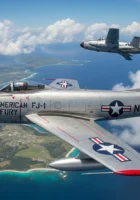
North American FJ-1 Fury sky

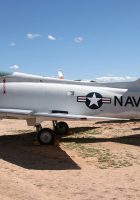
North American FJ-1 Fury

PaísE.e.u.u
PapelAviones de combate
Primer vuelo11 de septiembre de 1946
Construido31

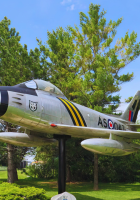
el Furia norteamericana FJ-1 es el primer avión a reacción operacional en servicio de la Armada de los Estados Unidos, y fue desarrollado por North American Aviation como el NA-135. El FJ-1 fue un jet de transición temprano de éxito limitado que llevó superficies de cola, alas y dosel similares derivadas del P-51D Mustang con motor de pistón. La evolución del diseño para incorporar alas barridas se convertiría en la base para el prototipo XP-86 con base en tierra , a su vez diseñado originalmente con una forma de ala recta muy similar al fuselaje FJ-1 , del enormemente influyente F-86 Sabre de la Fuerza Aérea de los Estados Unidos, que a su vez formó la base para el FJ-2/-3 Fury norteamericano basado en portaaviones de la Armada.

Fuente: FJ-1 Fury norteamericano en Wikipedia

Continuar leyendo

Vistas : 2637

Furia norteamericana FJ-4

North American FJ-4 Fury Especificaciones

Fabricante Aviación norteamericana
Papel Cazabombarderos basados en portaaviones
Primer vuelo 3 de octubre de 1954
Introducción 1955
Retirado 1965 (Marina de los Estados Unidos), 1972 (Venezuela)
Usuarios principales Armada de los Estados Unidos, Fuerza Aérea Venezolana
Número construido 374
Coste unitario US$780.000 (FJ-4B)
Motor Un turborreactor Pratt & Whitney J48-P-8A, 7.250 lbf (32,3 kN) de empuje
Velocidad máxima 680 mph (1,094 km/h)
gama 1.900 km (1.200 mi)
Techo de servicio 44.000 pies (13.400 m)
Armamento
  • 4× cañones M3 de 20 mm (0,79 pulgadas)
  • Hasta 5,000 lb (2,270 kg) de bombas, cohetes o misiles

el Furia norteamericana FJ-4 fue un cazabombardero con capacidad de portaaviones barrido para la Marina y el Cuerpo de Marines de los Estados Unidos. El desarrollo final en un linaje que incluía el F-86 Sabre de la Fuerza Aérea, el FJ-4 compartía su diseño general y motor con el FJ-3 anterior, pero presentaba un diseño de ala completamente nuevo y era un diseño muy diferente en su encarnación final.

Fuente: Furia norteamericana FJ-4 en Wikipedia

Continuar leyendo

Vistas : 2906

Vought OS2U-3 Kingfisher

Vought OS2U Kingfisher

PaísE.e.u.u
PapelFlotador de observación
Primer vuelo1938
Construido1519

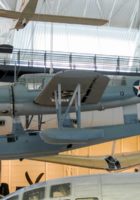
el Vought OS2U Kingfisher was an American catapult-launched observation floatplane. It was a compact mid-wing monoplane, with a large central float and small stabilizing floats. Performance was modest, because of its light engine. The OS2U could also operate on fixed, wheeled, taildragger landing gear. The OS2U was the main shipboard observation aircraft used by the United States Navy during World War II, and 1,519 of the aircraft were built. It served on battleships and cruisers of the US Navy, with the United States Marine Corps in Marine Scouting Squadron Three (VMS-3), with the United States Coast Guard at coastal air stations, at sea with the Fleet Air Arm of the Royal Navy, and with the Soviet Navy. The Royal Australian Air Force also operated a few Kingfishers from shore bases.

Fuente: Vought OS2U Kingfisher en Wikipedia

Continuar leyendo

Views : 7077

Packard LePere LUSAC-11

Packard-Le Père LUSAC-11

PaísE.e.u.u
PapelAviones de combate
Primer vuelo15 de mayo de 1918
Construido30

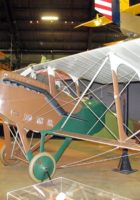
el LUSAC-11 (Lepère United States Army Combat) fue un avión de combate biplaza estadounidense. Fue un diseño francés, encargado y construido en los Estados Unidos durante la Primera Guerra Mundial y ordenado en grandes cantidades por el Cuerpo Aéreo del Ejército de los Estados Unidos, pero estos fueron cancelados al final de la guerra, y sólo 30 fueron construidos. El tipo fue utilizado con fines experimentales, estableciendo varios récords de altitud durante la década de 1920.

Fuente: Packard-Le Père LUSAC-11 en Wikipedia

Continuar leyendo

Vistas : 1432

Loening OA-1A

Loening OL

PaísE.e.u.u
PapelAvión anfibio de observación
Primer vuelo1923
Construido165

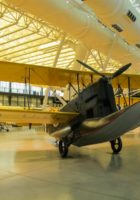
el Loening OL, también conocido como el Anfibio de Loening, fue un biplano anfibio biplaza estadounidense construido por Loening para el Cuerpo Aéreo del Ejército de los Estados Unidos y la Armada de los Estados Unidos.

Fuente: Loening OL en Wikipedia

Continuar leyendo

Vistas : 2232

Canadair Sabre

Canadair Sabre

PaísCanadá
PapelCombatiente
Primer vuelo9 de agosto de 1950
Construido1815

el Canadair Sabre fue un avión de combate a reacción construido por Canadair bajo licencia de North American Aviation. Una variante del North American F-86 Sabre, fue producido hasta 1958 y utilizado principalmente por la Real Fuerza Aérea Canadiense (RCAF) hasta que fue reemplazado por el Canadair CF-104 en 1962. Varias otras fuerzas aéreas también operaron el avión.

Fuente: Canadair Sabre en Wikipedia

Continuar leyendo

Vistas : 3400

Lockheed F-94 Starfire sky

Lockheed F-94 Starfire

PaísE.e.u.u
PapelInterceptor para todo tipo de clima
Primer vuelo16 de abril de 1949
Construido855

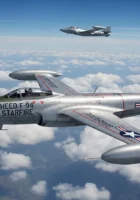
el Lockheed F-94 Starfire was a first-generation jet aircraft of the United States Air Force. It was developed from the twin-seat Lockheed T-33 Shooting Star in the late 1940s as an all-weather, day/night interceptor. The aircraft reached operational service in May 1950 with Air Defense Command, replacing the piston-engined North American F-82 Twin Mustang in the all-weather interceptor role. The F-94 was the first operational USAF fighter equipped with an afterburner and was the first jet-powered all-weather fighter to enter combat during the Korean War in January 1953. It had a relatively brief operational life, being replaced in the mid-1950s by the Northrop F-89 Scorpion and North American F-86D Sabre. The last aircraft left active-duty service in 1958 and Air National Guard service in 1959.

Fuente: Lockheed F-94 Starfire en Wikipedia

Continuar leyendo

Vistas : 3026

Bell UH-1 Iroquois sky

Bell UH-1 Iroquois

PaísE.e.u.u
PapelHelicóptero utilitario
Primer vuelo20 de octubre de 1956
ConstruidoMás de 16000

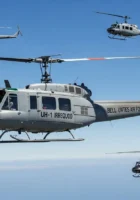
el Bell UH-1 Iroquois (nicknamed “Huey”) is a utility military helicopter powered by a single turboshaft engine, with two-blade main and tail rotors. The first member of the prolific Huey family, it was developed by Bell Helicopter to meet a United States Army’s 1952 requirement for a medical evacuation and utility helicopter, and first flew in 1956. The UH-1 was the first turbine-powered helicopter to enter production in 1960 for the United States military, and more than 16,000 have been built since. The Iroquois was originally designated HU-1, hence the Huey nickname, which has remained in common use, despite the official redesignation to UH-1 in 1962. The UH-1 first saw service in combat operations during the Vietnam War, with around 7,000 helicopters deployed. The Bell 204 and 205 are Iroquois versions developed for the civil market.

Fuente: Bell UH-1 Iroquois en Wikipedia

Continuar leyendo

Vistas : 5391

Yakovlev Yak-1B

Yakovlev Yak-1

PaísUnión Soviética
PapelCombatiente
Primer vuelo13 de enero de 1940
Construido8700

el Yakovlev Yak-1 (Russian: Яковлев Як-1) was a World War II Soviet fighter aircraft. Production began in early 1940. It was a single-seat monoplane with a composite structure and wooden wings. The Yak-1 was manoeuvrable, fast and well armed, and it was easy to maintain and reliable. It formed an excellent basis for subsequent developments from the Yakovlev bureau. It was the founder of a family of aircraft, with some 37,000 being built. As a reward, designer Alexander Yakovlev was awarded the Order of Lenin (Russian: Орден Ленина, Orden Lenina) – the highest decoration bestowed by the Soviet Union – a 100,000 ruble prize, plus a Zis[6] motor car.

Fuente: Yakovlev Yak-1 en Wikipedia

Continuar leyendo

Views : 6872

Vigilante norteamericano ra-5C

North American A-5 Vigilante

PaísE.e.u.u
PapelBombardero de ataque nuclear – aviones de reconocimiento
Primer vuelo31 de agosto de 1958
Construido156

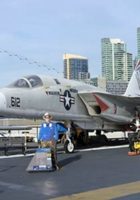
el Vigilante norteamericano de la A-5 es un bombardero supersónico basado en portaaviones estadounidense diseñado y construido por North American Aviation para la Armada de los Estados Unidos. Su servicio en el papel de ataque nuclear para reemplazar al Douglas A-3 Skywarrior fue muy corto; sin embargo, como el RA-5C, vio un amplio servicio durante la guerra de Vietnam en el papel de reconocimiento de ataque táctico. Antes de la unificación de la secuencia de designación de la Armada con la secuencia de la Fuerza Aérea en 1962, fue designado vigilante A3J.

Fuente: Vigilante norteamericano A-5 en Wikipedia

Continuar leyendo

Vistas : 4880