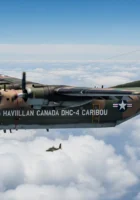
de Havilland Canada DHC-4 Caribou sky
de Havilland Canada DHC-4 Caribou
CountryUSA
RoleSTOL Transport
First flight30 July 1958
Built307

The de Havilland Canada DHC-4 Caribou (designated by the United States military as the CV-2 and later C-7 Caribou) is a Canadian-designed and produced specialized cargo aircraft with short takeoff and landing (STOL) capability. The Caribou was first flown in 1958 and although mainly retired from military operations, is still in use in small numbers as a rugged “bush” aircraft.

Source: de Havilland Canada DHC-4 Caribou on Wikipedia

Continue reading

Views : 3145

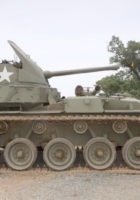
Twin 40mm GMC M19
M19 Multiple Gun Motor Carriage
CountryUSA
RoleSelf-propelled anti-aircraft weapon
In service1945–1953
Built285

The M19 Multiple Gun Motor Carriage (MGMC) was a World War II United States Army self-propelled anti-aircraft weapon on the M24 light tank chassis. It was equipped with two Bofors 40 mm (1.6 in) guns. It was produced by Cadillac and Massey-Ferguson of Canada near the end of 1944. The M19 was developed from the T65 which was based on the M5 light tank chassis. The original design was improved upon and designated the T65E1. It was accepted into service in May 1944 as the M19 MGMC, equipping several U.S. Army anti-aircraft units during World War II. The M19A1 was an improved variant with an auxiliary engine and spare barrels for the 40 mm Bofors guns.

Source: M19 Multiple Gun Motor Carriage on Wikipedia

Continue reading

Views : 4036

ZPU-4
ZPU anti-aircraft
CountrySoviet Union
RoleAnti-aircraft gun
In service1949–present
Built442

The ZPU (Russian: зенитная пулемётная установка, meaning “anti-aircraft machine gun mount”) is a family of towed anti-aircraft gun based on the Soviet 14.5×114mm KPV heavy machine gun. It entered service with the Soviet Union in 1949 and is used by over 50 countries worldwide. Quadruple (ZPU-4), double- (ZPU-2 and ZU-2) and single-barreled (ZPU-1) versions of the weapon exist.

Source: ZPU anti-aircraft on Wikipedia

Continue reading

Views : 2659

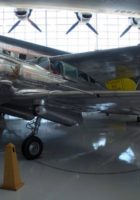
Curtiss-Wright A-22 Falcon
Curtiss-Wright CW-22
CountryUSA
RoleScout and advanced trainer
First flight1940
Built442

The Curtiss-Wright CW-22 was a 1940s American general-purpose advanced training monoplane aircraft built by the Curtiss-Wright Corporation. It was operated by the United States Navy as a scout trainer with the designation SNC-1 Falcon.. It was operated by the United States Navy as a scout trainer with the designation SNC-1 Falcon.

Source: Curtiss-Wright CW-22 on Wikipedia

Continue reading

Views : 2150

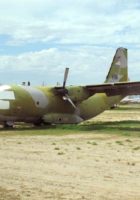
Alenia C-27A Spartan
Aeritalia G.222
CountryItalia
RoleMilitary transport aircraft
First flight18 July 1970
Built111

The Aeritalia G.222 (formerly Fiat Aviazione, later Alenia Aeronautica) is a medium-sized STOL military transport aircraft. It was developed to meet a NATO specification, but Italy was initially the only NATO member to adopt the type. The United States purchased a small number of G.222s, designating them the C-27A Spartan. A modernised variant, the Alenia C-27J Spartan, has been developed. While it retains many aspects of the original aircraft, the C-27J adopts the same engines and many of the systems used on the larger Lockheed Martin C-130J Super Hercules.

Source: Aeritalia G.222 on Wikipedia

Continue reading

Views : 2103

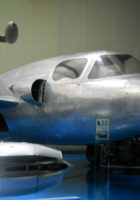
SO.6000 Triton
Sud-Ouest Triton
CountryFrance
RoleExperimental trainer aircraft
First flight11 November 1946
Built5+2

The Sud-Ouest SO.6000 Triton was the first French jet aircraft to be manufactured and was completed during the 1940s by SNCASO. The SO.6000 design began in 1943, as a clandestine project due to the German occupation, under engineer Lucien Servanty. Shortly after the war, the French government required five prototypes to be built.

Source: Sud-Ouest Triton on Wikipedia

Continue reading

Views : 2000

Hawker Siddeley Nimrod
CountryUK
RoleMaritime patrol, ELINT, AEW
First flight23 May 1967
Built49+2

The Hawker Siddeley Nimrod was a maritime patrol aircraft developed and operated by the United Kingdom. It was an extensive modification of the de Havilland Comet, the world’s first operational jet airliner. It was originally designed by de Havilland’s successor firm, Hawker Siddeley; further development and maintenance work was undertaken by Hawker Siddeley’s own successor companies, British Aerospace and BAE Systems, respectively.

Source: Hawker Siddeley Nimrod on Wikipedia

Continue reading

Views : 3686

Saab J-21 R
Saab 21R
CountrySweden
RoleFighter and attack aircraft
First flight10 March 1947
Built64

The Saab 21R was a Swedish twin-boom fighter/attack aircraft developed and produced by Saab. It was a jet-powered development of the earlier piston-engined 21. It was the first jet aircraft to be produced by Saab. Along with the Russian Yakovlev Yak-15, the 21R was one of only two jet fighters to have been successfully converted from a piston-powered aircraft.

Source: Saab 21R on Wikipedia

Continue reading

Views : 3038

Interstate Cadet S-1A
Interstate Cadet
CountryUSA
RoleUtility monoplane
First flight1940
Built574

The Interstate Cadet was an American two-seat tandem, high wing, single-engine monoplane light aircraft. Around 320 of these aircraft were produced between the years 1941 and 1942 by the Interstate Aircraft and Engineering Corporation based in El Segundo, California. The construction techniques employed were a welded steel tube fuselage, wood (spruce) wing structure with metal ribs, and fabric covering, all of which were fairly standard in the 1940s.

Source: Interstate Cadet on Wikipedia

Continue reading

Views : 2118