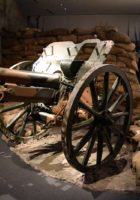
British 4.5'' QF Howitzer

QF 4.5-inch howitzer

PaeseRegno unito
RuoloObice di campo
In servizio1908–1944
Costruito3359

Le Ordnance QF obice da 4,5 pollici was the standard British Empire field (or ‘light’) howitzer of the First World War era. It replaced the BL 5-inch howitzer and equipped some 25% of the field artillery. It entered service in 1910 and remained in service through the interwar period and was last used in the field by British forces in early 1942. It was generally horse drawn until mechanisation in the 1930s. The QF 4.5-inch howitzer was used by British and Commonwealth forces in most theatres, by Russia and by British troops in Russia in 1919. Its calibre (114 mm) and hence shell weight were greater than those of the equivalent German field howitzer (105 mm); France did not have an equivalent. In the Second World War it equipped some units of the BEF and British, Australian, New Zealand and South African batteries in East Africa and the Middle and Far East.

fonte: QF 4.5-inch howitzer on Wikipedia

Continua a leggere

visualizzazioni : 2483

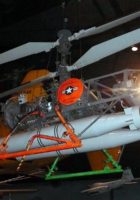
Gyrodyne QH-50C DASH

Gyrodyne QH-50 DASH

PaeseUsa
RuoloDrone ASW
Primo volo1959
Costruito755

Le Gyrodyne QH-50 DASH (Drone Anti-Submarine Helicopter) è un piccolo elicottero drone costruito dalla Gyrodyne Company of America per l'uso come arma anti-sottomarino a lungo raggio su navi che altrimenti sarebbero troppo piccole per operare un elicottero a grandezza naturale. Rimase in produzione fino al 1969. Molti sono ancora oggi utilizzati per vari ruoli terrestri.

fonte: Gyrodyne QH-50 DASH su Wikipedia

Continua a leggere

Visualizzazioni : 1676

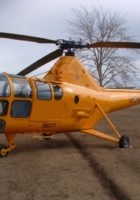
Sikorskij H-5

Sikorsky H-5

PaeseUsa
RuoloElicottero
Primo voloIl 18 agosto 1943
CostruitoOltre 300

Le Sikorskij H-5, (initially designated R-5 and also known as S-48, S-51 and by company designation VS-327) was a helicopter built by Sikorsky Aircraft Corporation. It was used by the United States Air Force, and its predecessor, the United States Army Air Forces, as well as the United States Navy and United States Coast Guard (with the designations HO2S and HO3S). It was also used by the United States Post Office Department. In December 1946, an agreement was signed between the British company Westland Aircraft and Sikorsky to produce a British version of the H-5, to be manufactured under license in Britain as the Westland-Sikorsky WS-51 Dragonfly. By the time production ceased in 1951, more than 300 examples of all types of the H-5 had been built.

fonte: Sikorsky H-5 su Wikipedia

Continua a leggere

Punti di vista: 3180

Culver PQ-14 Cadetto

Culver PQ-14 Cadet

PaeseUsa
RuoloDrone bersaglio
Primo volo1942
Costruito2043

Le Culver PQ-14 Cadetto is a modified version of the Culver LFA Cadet used as a target drone. In 1940, the U.S. Army Air Corps drew up a requirement for a radio-controlled target drone for training anti-aircraft artillery gunners. The first aircraft in a series of target drones was a modification of the Culver LFA Cadet which eventually led to the PQ-14 series used throughout World War II and beyond.

fonte: Culver PQ-14 Cadet su Wikipedia

Continua a leggere

Numero visioni : 1344

Focke-Achgelis FA 330 Bachstelze

Focke-Achgelis Fa 330

PaeseGermania nazista
RuoloAquilone autogiro
Primo voloInconsapevole
Costruito200

Le Focke-Achgelis Fa 330 Bachstelze (Inglese: Wagtail) era un tipo di aquilone ad ala rotante, noto come girogliero o aquilone a rotore. Furono trainati dietro gli U-Boot tedeschi durante la seconda guerra mondiale per consentire a una vedetta di vedere oltre.

fonte: Focke-Achgelis Fa 330 su Wikipedia

Continua a leggere

Views : 1927

Northrop F-20 Tigershark

Northrop F-20 Tigershark

PaeseUsa
RuoloCaccia
Primo volo30 agosto 1982
Costruito3

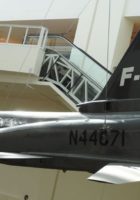
Le Northrop F-20 Tigershark (inizialmente F-5G) era un caccia leggero finanziato privatamente, progettato e costruito da Northrop. Il suo sviluppo iniziò nel 1975 come un'ulteriore evoluzione dell'F-5E Tiger II di Northrop, con un nuovo motore che migliorava notevolmente le prestazioni complessive e una moderna suite avionica che include un radar potente e flessibile. Rispetto all'F-5E, l'F-20 era molto più veloce, acquisì capacità aria-aria oltre il raggio visivo e aveva una suite completa di modalità aria-terra in grado di sparare la maggior parte delle armi statunitensi. Con queste capacità migliorate, l'F-20 divenne competitivo con i progetti di caccia contemporanei come il General Dynamics F-16 Fighting Falcon, ma era molto meno costoso da acquistare e gestire.

fonte: Northrop F-20 Tigershark su Wikipedia

Continua a leggere

Visualizzazioni : 4125

Harley-Davidson WLA.45 Moto

Harley-Davidson WLA

PaeseUsa
RuoloMoto militare
PeriodoDal 1940
Costruito90000+ (guerra)

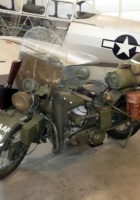
Le Harley-Davidson WLA è una motocicletta Harley-Davidson prodotta secondo le specifiche dell'esercito degli Stati Uniti negli anni durante e intorno alla seconda guerra mondiale. Era basato su un modello civile esistente, il WL, ed è del tipo solista 45, così chiamato grazie alla sua cilindrata del motore da 45 pollici cubi (740 cm3) e al design a pilota singolo. Lo stesso motore, in uno stato di sintonia leggermente inferiore, alimentava anche la Servi-Car a tre ruote (la famiglia "G", portando alla distinzione "solista".

fonte: Harley-Davidson WLA su Wikipedia

Continua a leggere

Views : 2882

North American FJ-1 Fury sky

North American FJ-1 Fury

PaeseUsa
RuoloCaccia
Primo volo11 settembre 1946
Costruito31

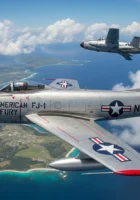
Le Furia FJ-1 nordamericana è il primo aereo a reazione operativo in servizio nella Marina degli Stati Uniti, ed è stato sviluppato dalla North American Aviation come NA-135. L'FJ-1 era un primo jet di transizione di scarso successo che trasportava superfici di coda, ali e baldacchino simili derivati dal P-51D Mustang con motore a pistoni. L'evoluzione del progetto per incorporare le ali spazzate sarebbe diventata la base per il prototipo XP-86 terrestre – a sua volta originariamente progettato con una planimetria ad ala dritta molto simile alla cellula FJ-1 – dell'enormemente influente F-86 Sabre della United States Air Force, che a sua volta costituì la base per la portaerei nordamericana FJ-2/-3 Fury della Marina.

fonte: North American FJ-1 Fury su Wikipedia

Continua a leggere

Punti di vista: 2646

FJ-4 Fury nordamericano

North American FJ-4 Fury Specifiche

Produttore Aviazione nordamericana
Ruolo Cacciabombardardo imbarcato su portaerei
Primo volo 3 ottobre 1954
Introduzione 1955
Pensionati 1965 (US Navy), 1972 (Venezuela)
Utenti principali Marina degli Stati Uniti, Aeronautica militare venezuelana
Numero costruito 374
Costo unitario US$ 780.000 (FJ-4B)
Motore Un turbogetto Pratt & Whitney J48-P-8A, 7.250 lbf (32,3 kN) di spinta
Velocità massima 680 mph (1.094 km/h)
Gamma 1.200 mi (1.900 km)
Soffitto di servizio 44.000 piedi (13.400 m)
Armamento
  • 4× cannoni M3 da 20 mm (0,79 in)
  • Fino a 5.000 libbre (2.270 kg) di bombe, razzi o missili

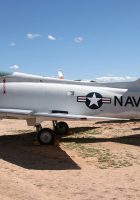
Le FJ-4 Fury nordamericano era un cacciabombardiere ad ala spazzata per la Marina degli Stati Uniti e il Corpo dei Marines. Lo sviluppo finale in un lignaggio che includeva l'F-86 Sabre dell'Air Force, l'FJ-4 condivideva il suo layout generale e il suo motore con il precedente FJ-3, ma presentava un design dell'ala completamente nuovo ed era un design molto diverso nella sua incarnazione finale.

fonte: North American FJ-4 Fury su Wikipedia

Continua a leggere

Visualizzazioni : 2913

Vought OS2U-3 Martin pescatore

Vought OS2U Kingfisher

PaeseUsa
RuoloIdrovolante di osservazione
Primo volo1938
Costruito1519

Le Martin pescatore Vought OS2U was an American catapult-launched observation floatplane. It was a compact mid-wing monoplane, with a large central float and small stabilizing floats. Performance was modest, because of its light engine. The OS2U could also operate on fixed, wheeled, taildragger landing gear. The OS2U was the main shipboard observation aircraft used by the United States Navy during World War II, and 1,519 of the aircraft were built. It served on battleships and cruisers of the US Navy, with the United States Marine Corps in Marine Scouting Squadron Three (VMS-3), with the United States Coast Guard at coastal air stations, at sea with the Fleet Air Arm of the Royal Navy, and with the Soviet Navy. The Royal Australian Air Force also operated a few Kingfishers from shore bases.

fonte: Vought OS2U Kingfisher su Wikipedia

Continua a leggere

Views : 7101