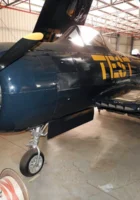
Canadair F-86E mk.6 Sabre

Canadair Sabre

CountryCanada
RoleFighter
First flight9 August 1950
Built1815

The Canadair Sabre was a jet fighter aircraft built by Canadair under licence from North American Aviation. A variant of the North American F-86 Sabre, it was produced until 1958 and used primarily by the Royal Canadian Air Force (RCAF) until replaced with the Canadair CF-104 in 1962. Several other air forces also operated the aircraft.

Source: Canadair Sabre on Wikipedia

Continue reading

Views : 3949

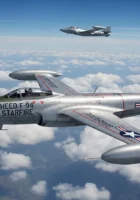
Lockheed F-94 Starfire sky

Lockheed F-94 Starfire

CountryUSA
RoleAll-weather interceptor
First flight16 April 1949
Built855

The Lockheed F-94 Starfire was a first-generation jet aircraft of the United States Air Force. It was developed from the twin-seat Lockheed T-33 Shooting Star in the late 1940s as an all-weather, day/night interceptor. The aircraft reached operational service in May 1950 with Air Defense Command, replacing the piston-engined North American F-82 Twin Mustang in the all-weather interceptor role. The F-94 was the first operational USAF fighter equipped with an afterburner and was the first jet-powered all-weather fighter to enter combat during the Korean War in January 1953. It had a relatively brief operational life, being replaced in the mid-1950s by the Northrop F-89 Scorpion and North American F-86D Sabre. The last aircraft left active-duty service in 1958 and Air National Guard service in 1959.

Source: Lockheed F-94 Starfire on Wikipedia

Continue reading

Views : 3567

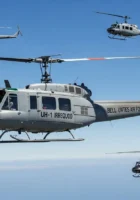
Bell UH-1 Iroquois sky

Bell UH-1 Iroquois

CountryUSA
RoleUtility helicopter
First flight20 October 1956
Built16000+

The Bell UH-1 Iroquois (nicknamed “Huey”) is a utility military helicopter powered by a single turboshaft engine, with two-blade main and tail rotors. The first member of the prolific Huey family, it was developed by Bell Helicopter to meet a United States Army’s 1952 requirement for a medical evacuation and utility helicopter, and first flew in 1956. The UH-1 was the first turbine-powered helicopter to enter production in 1960 for the United States military, and more than 16,000 have been built since. The Iroquois was originally designated HU-1, hence the Huey nickname, which has remained in common use, despite the official redesignation to UH-1 in 1962. The UH-1 first saw service in combat operations during the Vietnam War, with around 7,000 helicopters deployed. The Bell 204 and 205 are Iroquois versions developed for the civil market.
Source: Bell UH-1 Iroquois on Wikipedia

Continue reading

Views : 6166

Yakovlev Yak-1B

Yakovlev Yak-1

CountrySoviet Union
RoleFighter
First flight13 January 1940
Built8700

The Yakovlev Yak-1 (Russian: Яковлев Як-1) was a World War II Soviet fighter aircraft. Production began in early 1940. It was a single-seat monoplane with a composite structure and wooden wings. The Yak-1 was manoeuvrable, fast and well armed, and it was easy to maintain and reliable. It formed an excellent basis for subsequent developments from the Yakovlev bureau. It was the founder of a family of aircraft, with some 37,000 being built. As a reward, designer Alexander Yakovlev was awarded the Order of Lenin (Russian: Орден Ленина, Orden Lenina) – the highest decoration bestowed by the Soviet Union – a 100,000 ruble prize, plus a Zis[6] motor car.

Source: Yakovlev Yak-1 on Wikipedia

Continue reading

Views : 7974

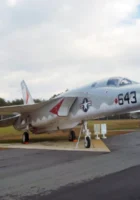
North American RA-5C Vigilante

North American A-5 Vigilante

CountryUSA
RoleNuclear strike bomber – reconnaissance aircraft
First flight31 August 1958
Built156

The North American A-5 Vigilante is an American carrier-based supersonic bomber designed and built by North American Aviation for the United States Navy. Its service in the nuclear strike role to replace the Douglas A-3 Skywarrior was very short; however, as the RA-5C, it saw extensive service during the Vietnam War in the tactical strike reconnaissance role. Prior to the unification of the Navy designation sequence with the Air Force sequence in 1962, it was designated the A3J Vigilante.

Source: North American A-5 Vigilante on Wikipedia

Continue reading

Views : 6165

Curtiss O-52A-1-CW Owl

Curtiss O-52 Owl

CountryUSA
RoleReconnaissance
In service1940
Built203

The Curtiss O-52 “Owl” was an observation aircraft used by the United States Army Air Corps before and during World War II. Developed in 1939, the Curtiss O-52 was the last “heavy” observation aircraft developed for the US Army Air Corps. The concept of the two-seat observation aircraft, classed as the “O” series aircraft, dated to World War I, and in 1940, the Army Air Corps ordered 203 Curtiss O-52s for observation duties. By 1941, the O-52 was no match for modern combat conditions.

Source: Curtiss O-52 Owl on Wikipedia

Continue reading

Views : 2262

North American O-47B

North American O-47

CountryUSA
RoleObservation
In serviceNovember 1935
Built239

The North American O-47 is an observation fixed-wing aircraft monoplane used by the United States Army Air Corps. It had a low-wing configuration, retractable landing gear and a three-blade propeller. The O-47 was developed as a replacement for the Thomas-Morse O-19 and Douglas O-38 observation biplanes.

Source: North American O-47 on Wikipedia

Continue reading

Views : 1646

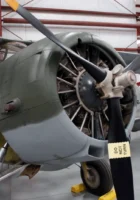
Ryan FR-1 Fireball

Ryan FR Fireball

CountryUSA
RoleFighter
In service25 June 1944
Built71

The Ryan FR Fireball was a mixed-power (piston and jet-powered) fighter aircraft designed by Ryan Aeronautical for the United States Navy during World War II. It was the Navy’s first aircraft with a jet engine. Only 66 aircraft were built before Japan surrendered in August 1945. The FR-1 Fireball equipped a single squadron before the end of the war, but did not see combat. The aircraft ultimately proved to lack the structural strength required for operations aboard aircraft carriers and was withdrawn in mid-1947.

Source: Ryan FR Fireball on Wikipedia

Continue reading

Views : 2711

Cessna O-2A Skymaster

Cessna O-2A Skymaster

CountryUSA
RoleObservation aircraft
In serviceJanuary 1967
Built532

The Cessna O-2 Skymaster (nicknamed “Oscar Deuce”) is a military version of the Cessna 337 Super Skymaster, used for forward air control (FAC) and psychological operations (PSYOPS) by the US military between 1967 and 2010. In 1966 the United States Air Force (USAF) commissioned Cessna to build a military variant to replace the O-1 Bird Dog and the O-2 resulted.

Source: Cessna O-2A Skymaster on Wikipedia

Continue reading

Views : 3645