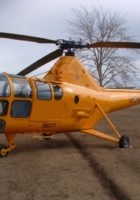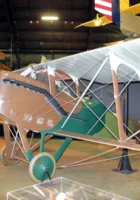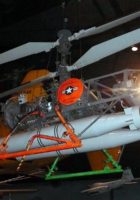
Gyrodyne QH-50C DASH

Gyrodyne QH-50 DASH

CountryUSA
RoleASW drone
First flight1959
Built755

The Gyrodyne QH-50 DASH (Drone Anti-Submarine Helicopter) is a small, drone helicopter built by Gyrodyne Company of America for use as a long-range anti-submarine weapon on ships that would otherwise be too small to operate a full-sized helicopter. It remained in production until 1969. Several are still used today for various land-based roles.

Source: Gyrodyne QH-50 DASH on Wikipedia

Continue reading

Views : 2217

Sikorsky H-5

Sikorsky H-5

CountryUSA
RoleHelicopter
First flight18 August 1943
Built300+

The Sikorsky H-5, (initially designated R-5 and also known as S-48, S-51 and by company designation VS-327) was a helicopter built by Sikorsky Aircraft Corporation. It was used by the United States Air Force, and its predecessor, the United States Army Air Forces, as well as the United States Navy and United States Coast Guard (with the designations HO2S and HO3S). It was also used by the United States Post Office Department. In December 1946, an agreement was signed between the British company Westland Aircraft and Sikorsky to produce a British version of the H-5, to be manufactured under license in Britain as the Westland-Sikorsky WS-51 Dragonfly. By the time production ceased in 1951, more than 300 examples of all types of the H-5 had been built.

Source: Sikorsky H-5 on Wikipedia

Continue reading

Views : 3944

Culver PQ-14 Cadet

Culver PQ-14 Cadet

CountryUSA
RoleTarget drone
First flight1942
Built2043

The Culver PQ-14 Cadet is a modified version of the Culver LFA Cadet used as a target drone. In 1940, the U.S. Army Air Corps drew up a requirement for a radio-controlled target drone for training anti-aircraft artillery gunners. The first aircraft in a series of target drones was a modification of the Culver LFA Cadet which eventually led to the PQ-14 series used throughout World War II and beyond.

Source: Culver PQ-14 Cadet on Wikipedia

Continue reading

Views : 1714

Focke-Achgelis FA 330 Bachstelze

Focke-Achgelis Fa 330

CountryNazi Germany
RoleAutogyro kite
First flightUnknow
Built200

The Focke-Achgelis Fa 330 Bachstelze (English: Wagtail) was a type of rotary-wing kite, known as a gyroglider or rotor kite. They were towed behind German U-boats during World War II to allow a lookout to see further.

Source: Focke-Achgelis Fa 330 on Wikipedia

Continue reading

Views : 2396

Northrop F-20 Tigershark

Northrop F-20 Tigershark

CountryUSA
RoleFighter aircraft
First flight30 August 1982
Built3

The Northrop F-20 Tigershark (initially F-5G) was a privately financed light fighter, designed and built by Northrop. Its development began in 1975 as a further evolution of Northrop’s F-5E Tiger II, featuring a new engine that greatly improved overall performance, and a modern avionics suite including a powerful and flexible radar. Compared with the F-5E, the F-20 was much faster, gained beyond-visual-range air-to-air capability, and had a full suite of air-to-ground modes capable of firing most U.S. weapons. With these improved capabilities, the F-20 became competitive with contemporary fighter designs such as the General Dynamics F-16 Fighting Falcon, but was much less expensive to purchase and operate.

Source: Northrop F-20 Tigershark on Wikipedia

Continue reading

Views : 4806

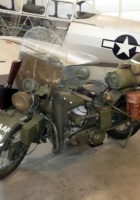
Harley-Davidson WLA.45 Motorcycle

Harley-Davidson WLA

CountryUSA
RoleMilitary motorcycle
PeriodFrom 1940
Built90000+ (war)

The Harley-Davidson WLA is a Harley-Davidson motorcycle that was produced to US Army specifications in the years during and around World War II. It was based on an existing civilian model, the WL, and is of the 45 solo type, so called due to its 45-cubic-inch (740 cm3) engine displacement and single-rider design. The same engine, in a slightly lower state of tune, also powered the three-wheeled Servi-Car (the “G” family), leading to the “solo” distinction.

Source: Harley-Davidson WLA on Wikipedia

Continue reading

Views : 3447

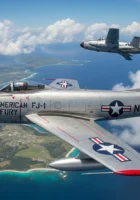
North American FJ-1 Fury sky

North American FJ-1 Fury

CountryUSA
RoleFighter aircraft
First flight11 September 1946
Built31

The North American FJ-1 Fury is the first operational jet aircraft in United States Navy service, and was developed by North American Aviation as the NA-135. The FJ-1 was an early transitional jet of limited success which carried over similar tail surfaces, wing and canopy derived from the piston-engined P-51D Mustang. The evolution of the design to incorporate swept wings would become the basis for the land-based XP-86 prototype – itself originally designed with a very similar straight-wing planform to the FJ-1 airframe – of the United States Air Force’s enormously influential F-86 Sabre, which itself formed the basis for the Navy’s carrier-based North American FJ-2/-3 Fury.

Source: North American FJ-1 Fury on Wikipedia

Continue reading

Views : 3135

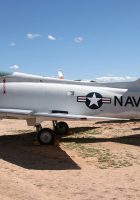
North American FJ-4 Fury

North American FJ-4 Fury Specifications

Manufacturer North American Aviation
Role Carrier-based fighter-bomber
First flight October 3, 1954
Introduction 1955
Retired 1965 (US Navy), 1972 (Venezuela)
Primary users United States Navy, Venezuelan Air Force
Number built 374
Unit cost US$780,000 (FJ-4B)
Engine One Pratt & Whitney J48-P-8A turbojet, 7,250 lbf (32.3 kN) thrust
Maximum speed 680 mph (1,094 km/h)
Range 1,200 mi (1,900 km)
Service ceiling 44,000 ft (13,400 m)
Armament
  • 4× 20 mm (0.79 in) M3 cannons
  • Up to 5,000 lb (2,270 kg) of bombs, rockets, or missiles

The North American FJ-4 Fury was a swept-wing carrier-capable fighter-bomber for the United States Navy and Marine Corps. The final development in a lineage that included the Air Force’s F-86 Sabre, the FJ-4 shared its general layout and engine with the earlier FJ-3, but featured an entirely new wing design and was a vastly different design in its final embodiment.

Source: North American FJ-4 Fury on Wikipedia

Continue reading

Views : 3490

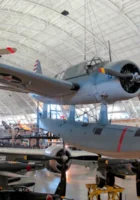
Vought OS2U-3 Kingfisher

Vought OS2U Kingfisher

CountryUSA
RoleObservation floatplane
First flight1938
Built1519

The Vought OS2U Kingfisher was an American catapult-launched observation floatplane. It was a compact mid-wing monoplane, with a large central float and small stabilizing floats. Performance was modest, because of its light engine. The OS2U could also operate on fixed, wheeled, taildragger landing gear. The OS2U was the main shipboard observation aircraft used by the United States Navy during World War II, and 1,519 of the aircraft were built. It served on battleships and cruisers of the US Navy, with the United States Marine Corps in Marine Scouting Squadron Three (VMS-3), with the United States Coast Guard at coastal air stations, at sea with the Fleet Air Arm of the Royal Navy, and with the Soviet Navy. The Royal Australian Air Force also operated a few Kingfishers from shore bases.

Source: Vought OS2U Kingfisher on Wikipedia

Continue reading

Views : 7973

Packard LePere LUSAC-11

Packard-Le Père LUSAC-11

CountryUSA
RoleFighter aircraft
First flight15 May 1918
Built30

The LUSAC-11 (Lepère United States Army Combat) was an early American two-seat fighter aircraft. It was a French design, commissioned and built in the United States during World War I and ordered in large numbers by the United States Army Air Corps, but these were cancelled at the end of the war, and only 30 were built. The type was used for experimental purposes, setting several altitude records during the 1920s.

Source: Packard-Le Père LUSAC-11 on Wikipedia

Continue reading

Views : 1894