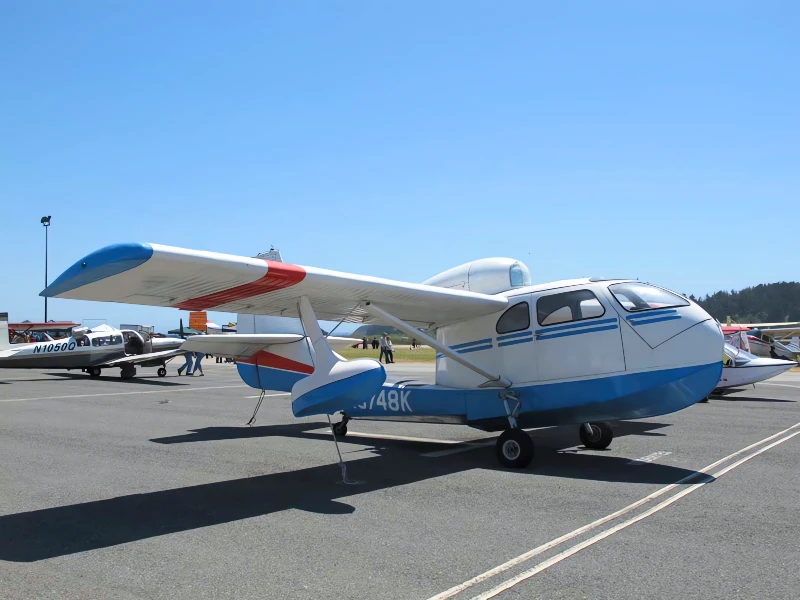
Republic RC-3 Seabee | |
|---|---|
| Land | Usa |
| Rolle | Amphibienflugzeug |
| Erstflug | 1. Dezember 1945 |
| Gebaut | 1060 |
das Republik RC-3 Seabee ist ein Amphibien-Sportflugzeug aus Ganzmetall, das von Percival Spencer entworfen und von der Republic Aircraft Corporation hergestellt wird.
| Republik RC-3 Sea Bee Walk Around | |
|---|---|
| Fotograf | Wladimir Nikolajewitsch Jakubow |
| Lokalisierung | Pacific Coast Dream Machines |
| Fotos | 74 |

| Republic SeaBee Walk Around | |
|---|---|
| Fotograf | Unbekannter |
| Lokalisierung | Unbekannter |
| Fotos | 24 |
Siehe auch:


The Iconic Post-War All-Metal Amphibian “Family Car”
das Republik RC-3 Seabee was a four-seat, all-metal amphibious sports aircraft designed by Percival “Spencer” Spencer and manufactured by the Republic Aviation Corporation in the immediate post-World War II era. Conceived during the anticipated post-war civilian aviation boom, the Seabee was engineered as an affordable, rugged “flying family car” capable of operating seamlessly from land, lakes, and coastal bays. Featuring a distinctive pusher-propeller configuration, a high-wing layout, a room cabin with automotive-style doors, and fully retractable landing gear, the RC-3 stands out as a masterpiece of low-cost manufacturing engineering. Despite a brief production run, the Seabee became one of the most popular civilian amphibious aircraft in aviation history, serving bush pilots, air-taxi operators, and recreational flyers for decades.
| Attribute | Technical Specification (Republic RC-3 Seabee Standard) |
|---|---|
| Rolle | 4-Seat Civil Utility & Personal Amphibious Aircraft |
| Crew | 1 Pilot + 3 Passengers |
| Triebwerk | 1 × Franklin 6A8-215-B8H (or B9F) 6-cylinder air-cooled horizontally opposed piston engine (215 hp) |
| Höchstgeschwindigkeit | 238 km/h (148 mph / 128 knots) max speed | ~166 km/h (103 mph) cruise speed |
| Gross / Takeoff Weight | 1,429 kg (3,150 lbs) maximum gross weight | ~885 kg (1,950 lbs) empty weight |
| Service Ceiling / Operational Range | 3,658 m (12,000 ft) ceiling | ~805 km (500 miles) maximum range |
| Wing Structure & Dimensions | Wingspan: 11.48 m (37 ft 8 in) | All-metal cantilever high wing with underwing stabilizing floats |
| Hull Construction | All-aluminum semi-monocoque hydrodynamic hull with heavy-gauge stamped metal skin |
| Propeller Configuration | Rear-facing 2-blade Hartzell or Koppers pitch-reversible pusher propeller mounted above cabin |
| Production Total | 1,060 units produced by Republic Aviation at Farmingdale, New York (1946–1947) |
Design Engineering: Simplified Sheet-Metal Stamping and Pusher Layout
- Cost-Saving Sheet-Metal Simplification: Republic engineer Alfred Boyajian radically redesigned Spencer’s prototype to reduce production costs. By replacing complex internal wing ribs and gussets with heavy-gauge, corrugated stamped-aluminum sheet metal skins, the total number of airframe parts was slashed from over 1,800 to just 450, significantly lowering factory assembly hours.
- Rear-Mounted Pusher Engine Configuration: The Franklin 6-cylinder engine was mounted above and behind the passenger cabin in a pusher layout. This configuration provided the pilot and passengers with exceptional forward visibility, kept the propeller safely clear of passengers boarding from water docks or bow doors, and reduced cabin spray during water takeoffs.
- Reversible-Pitch Propeller for Water Docking: To solve the challenge of maneuvering on water without brakes, many Seabees were fitted with pitch-reversible propellers. This permitted the pilot to reverse thrust in the water, making docking, backing away from shorelines, and tight water taxiing remarkably precise.
- Bow Door and Dual Cabin Accessibility: Designed with recreational outdoorsmen in mind, the Seabee featured a hinged door on the front right nose/bow in addition to side cabin doors. This allowed passengers to step directly out of the front cabin onto a dock, beach, or boat deck for mooring and fishing.
Operational History: Bush Flying, Pop-Culture Fame, and Modern Modifications
- The Post-War Bush Transport Workhorse: While the expected boom in private pilot ownership proved smaller than predicted, the RC-3 found an eager customer base among commercial bush operators in Canada, Alaska, Scandinavia, and Latin America. Its ability to haul heavy cargo in and out of remote, roadless lakes made it an essential transport for wilderness lodges and mining camps.
- James Bond Movie Legacy: The RC-3 Seabee gained international pop-culture fame in the 1974 James Bond film *The Man with the Golden Gun*, where villain Francisco Scaramanga’s island base featured a distinctive Seabee used for tropical transport.
- Popular Engine Upgrades (The “Super Seabee”): To overcome the original Franklin engine’s modest power output under heavy loads, many surviving Seabees were modified with larger Lycoming GO-480 or Chevrolet LS V8 engine conversions, turning the airframe into a high-performance utility amphibian.
- Enduring Enthusiast Community: Of the 1,060 built during its brief two-year production run, hundreds remain airworthy worldwide today, supported by a dedicated network of owners who cherish the plane’s unmatched roominess, rugged metal hull, and nostalgic post-war charm.
Aufrufe : 2425
Sie können auch sehen:
 Avro Canada VZ-9 Avrocar – Fotos & Videos
 Republic XF-84H Thunderscreech – Fotos & Videos
 Republic XF-91 – Fotos & Videos
 A-90 Orlyonok – Fotos und Videos
 Boeing 307 Stratoliner – Fotos & Videos
 Northrop Alpha – Fotos & Video
 Interstate Cadet – Fotos und Videos
 Beechcraft Model 18 – Fotos & Video
 Republic F-105 Thunderchief – Fotos & Video
 Republic F-84 Thunderjet – Fotos & Video