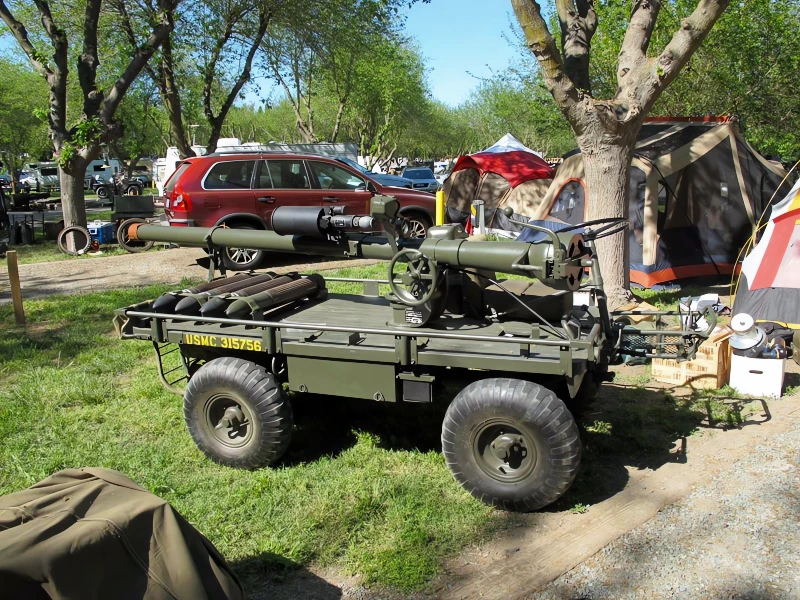
M274 ½-ton 4×4 utility platform truck | |
|---|---|
| Land | Usa |
| Rolle | 1/2 Ton (454kg) 4×4 Prallwagen |
| Produziert | 1956-1970 |
| Varianten | M274A1, A2, A3, A4 |
Das US-Militär M274 LKW, Plattform, Utility, 1/2 Ton, 4X4 oder "Carrier, Light Weapons, Infantry, 1/2 ton, 4×4", auch bekannt als "Mule" Military Mule" oder "Mechanical Mule" ist ein Fahrzeug mit Allradantrieb, ein Benzinfahrzeug vom Typ Truck/Traktor, das bis zu 1/2 Tonnen im Gelände transportieren kann. Es wurde 1956 eingeführt und bis in die 1980er Jahre genutzt.
Quelle: M274 Mule auf Wikipedia
| M274 1/2-Tonner 4×4 Utility Platform LKW | |
|---|---|
| Fotograf | Wladimir Nikolajewitsch Jakubow |
| Lokalisierung | MVCC Camp Delta |
| Fotos | 85 |

Siehe auch:


The Unstoppable “Mechanical Mule” of Vietnam Infantry Operations
das M274 ½-ton 4×4 Utility Platform Truck—universally known in military parlance as the “Mechanical Mule”—was a lightweight, air-mobile cargo vehicle developed in the mid-1950s by Willys-Overland and manufactured by Willys, Bowen-McLaughlin-York, and Baifield Industries for the United States Military. Designed as a bare-bones, highly mobile transport platform to replace draft animals and heavy infantry carts, the M274 was engineered to carry light infantry weapons, ammunition, rations, and wounded casualties over extreme cross-country terrain. Lacking doors, a windshield, or traditional body panels, the vehicle was essentially a motorized flatbed cargo platform on four wheels. Widely deployed throughout the Vietnam War by the US Army and US Marine Corps, the Mechanical Mule established a legendary reputation for rugged mechanical reliability, amphibious parachuting transportability, and versatile tactical utility.
| Attribute | Technical Specification (M274 / M274A1 through M274A5) |
|---|---|
| Rolle | Lightweight Air-Mobile Off-Road Cargo Platform / Infantry Weapon Carrier |
| Crew | 1 Driver (plus capacity for up to 3 additional passengers or infantrymen) |
| Triebwerk | Willys 4-cylinder air-cooled petrol (M274/A1, 16 hp) | Brunswick/HATZ 2-cylinder air-cooled diesel/petrol (M274A2–A5, 14 hp) |
| Höchstgeschwindigkeit | 40 km/h (25 mph) highway speed | Selectable low-range crawling speeds down to 1.6 km/h (1 mph) |
| Vehicle Weight & Payload | ~400 kg (880 lbs) curb weight | 454 kg (1,000 lbs / ½-ton) off-road payload capacity |
| Drivetrain & Steering | 4-speed manual transmission with 2-speed transfer case | Full-time 4×4 with 4-wheel steering (M274 to M274A4) |
| Dimensions | Length: 3.0 m (118 in) | Width: 1.2 m (49 in) | Height: 0.7 m (27.5 in to bed surface) |
| Armament Options | Pintle-mounted M60 7.62mm, M2HB .50-cal machine guns, M40 106mm recoilless rifles, or TOW missile systems |
| Chassis Construction | Magnesium alloy deck plate (M274/A1) or aluminum sheet bed with steel tube ladder frame |
| Production Total | ~11,240 units produced across all variants between 1956 and 1970 |
Design Engineering: Four-Wheel Steering, Adjustable Steering Columns, and Modular Decks
- Four-Wheel Steering Maneuverability: Early variants (M274 through M274A4) featured a synchronized four-wheel mechanical steering system connected to both front and rear axles. This provided an exceptionally tight turning radius of just 10 feet (3 meters), allowing the Mule to negotiate dense jungle vegetation, narrow mountain paths, and tight trenches.
- Swing-Out Reversible Steering Column: To protect the driver in direct combat environments, the steering column, foot pedals, and operator seat were designed to adjust or disconnect. The driver could unbolt or swing the steering column forward, allowing them to walk or crawl behind the vehicle while operating the throttle and steering controls to use the Mule as a moving armor-shield or weapon mount.
- High Ground Clearance and Portal Axles: To clear rocks, logs, and deep jungle mud, the M274 utilized portal axles and high flotation tires. This provided a ground clearance of over 12 inches (30 cm) on an extremely small wheelbase while keeping the overall center of gravity exceptionally low.
- Magnesium and Aluminum Structural Construction: In order to meet strict air-drop weight limits for helicopter sling-loading and parachute drops, early M274 decks were cast from ultra-lightweight magnesium alloy. Later variants (M274A5) transitioned to extruded aluminum decks to eliminate magnesium’s susceptibility to saltwater corrosion and intense fire hazards.
Operational History: Firebase Logistics, Recoilless Rifle Mounts, and Replacement
- The Logistics Backbone in Vietnam: Introduced right before the escalation of the Vietnam War, the M274 became indispensable to US Marine Corps and US Army air-mobile units (such as the 101st Airborne and 1st Cavalry Division). Operating out of remote artillery Fire Support Bases (FSBs), Mules hauled heavy 105mm artillery shells, mortar rounds, and fuel drums across mud tracks where larger trucks bogged down.
- Heavy Direct-Fire Weapon Platform: Beyond transport, troops frequently turned the M274 into a mobile tank destroyer or fire-support vehicle. By mounting M40 106mm recoilless rifles or BGM-71 TOW anti-tank missile launchers on the rear deck, light infantry units possessed airborne-capable heavy anti-armor firepower.
- Helicopter Air-Mobility Operations: Weighing less than 900 lbs, the Mule could easily be carried internally or sling-loaded underneath CH-34 Choctaw, UH-1 Huey, and CH-47 Chinook helicopters, making it possible to drop mobile cargo capability directly into remote landing zones (LZs).
- Retirement and Transition to Quad-AVs: The M274 remained in active service through the 1980s before being phased out in favor of the high-mobility HMMWV (Humvee) and specialized light All-Terrain Vehicles (ATVs / John Deere Gator M-Gators). Today, the Mechanical Mule remains a favorite among military vehicle collectors due to its iconic shape and simple mechanics.
Aufrufe : 3802
Sie können auch sehen:
 Albion CX22S – Photos & Videos
 Berliet CBA – Fotos & Videos
 Heavy Wrecking Truck M1 – Fotos & Video
 Bedford QL – Fotos & Videos
 MAZ-543 – Fotos & Videos
 M915 LKW – Fotos & Videos
 Krupp Kfz.81 Protze – Fotos & Videos
 Mack NO 71/2-Tonner 6×6 LKW – Fotos & Video
 ZIL-131 – Fotos & Video
 AEC 0853 Matador – Fotos und Videos