オランダの PRTL

オランダの PRTL

オランダ語
役割対空砲戦車

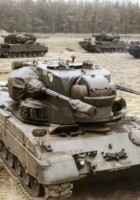
フルガブヴェールカノネンツァーゲパール(「対空砲戦車チーター」、より良いフラクパンツァーゲパールとして知られている)は、自律的な、全天候型ドイツの自走式対空砲(SPAAG)です。それは1960年代に開発され、1970年代にフィールド化され、最新のエレクトロニクスで数回アップグレードされています。これは、ドイツ軍(ドイツ連邦軍)と他の多くのNATO諸国の防空の礎を構成しました。ドイツでは、ゲパードは2010年後半に段階的に廃止され、LFK NGミサイルと新しいMANTISガンシステムを使用した移動式および静止した防空システムである「SysFla」に置き換えられました。SysFlaのモバイルプラットフォームは、GTKボクサーに基づいている可能性が高いです。

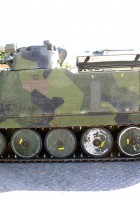
オランダの変種: Search radar: X band, 15 km range Tracking radar: X/Ka band, 13 km range The Dutch version was officially called the PRTL (PantserRupsTegenLuchtdoelen translating to “ArmourTrackAgainstAirtargets”), pronounced as “pruttel” (meaning ‘to sputter’) by the soldiers. The Dutch series version was made public through a photograph of a vehicle from a C-Company, the first to be equipped with the new weapon. Traditionally all Dutch vehicles in a company have names beginning with the company designation letter and this vehicle happened to have the individual name Cheetah painted in bold type on its turret. Inevitably the international press assumed “Cheetah” was the Dutch name for their Gepard version and this mistake found its way into most armour publications on the subject. In 2000 the Dutch military authorities, tired of constantly having to explain all this and considering “pruttle” was hardly a martial name anyway, conformed themselves to common error and made “Cheetah” the official designation, when the system was upgraded.

ソース: ウィキペディアのオランダの PRTL

続きを読む

Views : 6550

RM-70 MLRS

RM-70 MLRS

東ドイツ
複数のロケットランチャー
写真ロバート・デ・クレーク
トピック

アルバムのアルバム 151 タンクの写真 RM-70 MLRS

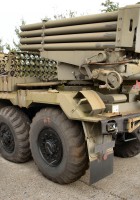
The RM-70 (raketomet vzor 1970) multiple rocket launcher is a Czechoslovakian army version and the heavier variant of the BM-21 Grad multiple rocket launcher, providing enhanced performance over its parent area-saturation artillery system that was introduced in 1971 (but the NATO designation is M1972). RM-70 was developed in Czechoslovakia as a successor for the RM-51, achieving initial operational capability with its Army in 1972. The launcher was being produced in Dubnica nad Váhom (Slovakia). Originally, it was sold to East Germany. After the Soviet Union collapse and the split of Czechoslovakia into the Czech Republic and Slovak Republic, it was sold to several states in Africa, America, Asia and Europe.

ソース: RM-70 MLRS ウィキペディア

続きを読む

再生 : 4187

グラマン F-11A タイガー

グラマン F-11A タイガー

米国
超音速戦闘機
初飛行1954年7月30日
構築200

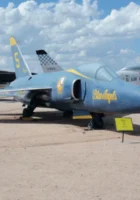
フォトギャラリー グラマン F-11A タイガー, The Grumman F11F/F-11 Tiger was the first supersonic, single-seat carrier-based United States Navy fighter aircraft in operation during the 1950s and 1960s. Originally designated the F11F Tiger in April 1955 under the pre-1962 Navy designation system, it was redesignated as F-11 Tiger under the 1962 United States Tri-Service aircraft designation system. The F11F/F-11 was used by the Blue Angels flight team from 1957–1969. Grumman Aircraft Corporation made 200 Tigers, with the last aircraft being delivered to the U.S. Navy on 23 January 1959.

ソース: グラマンF-11Aタイガーウィキペディア

続きを読む

Views : 6168

ピラニア10x10

ピラニア 10×10

スイス
役割装甲戦闘車両
生産1972年~現在
構築知りません

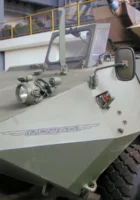
The MOWAG Piranha is a family of armoured fighting vehicles designed by the Swiss company MOWAG (since April 2010 the name has changed to General Dynamics European Land Systems – Mowag GmbH). Five generations of vehicles have been produced, manufactured by Mowag or under licence by other companies, and variants are in service with military forces throughout the world. Piranhas are available in 4×4, 6×6, 8×8, and 10×10 wheel versions. There are several variants within these versions, giving different degrees of armour protection and several kinds of turret, for use in a variety of roles. Piranha derivatives have been assigned roles as troop transports, command vehicles, fire support vehicles, tank trainers, and police vehicles.

ソース: ウィキペディアのピラニア 10×10

続きを読む

再生 : 3422

パンサルバンドヴァグン 401

パンサルバンドヴァグン 401

スウェーデン
多目的装甲車
写真ソード・ウェッドマン
トピック

アルバムのアルバム 182 タンクの写真 パンサルバンドヴァグン 401

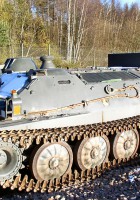
The MT-LB (Russian: Многоцелевой Тягач Легкий Бронированный, Mnogotselevoy Tyagach Logkiy Bronirovannyi / light multi-purpose armoured towing vehicle) is a Soviet multi-purpose fully amphibious auxiliary armoured tracked vehicle, which was first introduced in the late 1960s. Initially, the vehicle was known as the M 1970 in the west. Swedish MT-LB converted into Pbv 401 Pbv 401 (pansarbandvagn) – modified former East-German vehicle with 7.62 mm machine guns Ksp 95 and Ksp 58. Stripbv 4011 (stridsledningbandvagn) – battalion-level command post. Bgbv 4012 (bärgningsbandvagn) – Swedish designator for the MTP-LB. Rlpbv 4014/T (radiolänkbandvagn) – signals vehicle. Stripbv 4021 (stridsledningbandvagn) – company-level command post. Sjvpbv 4024 (sjukvårdspansarbandvagn) – Military ambulance. Lvrbpbv 4016 (luftvärnsrobotbandvagn) – unconfirmed designator for vehicles, equipped with RBS 70. Pvrbbv 452 (pansarvärnrobotbandvagn) – with RBS 56 BILL 1 Anti-tank guided weapon.

ソース: ウィキペディアのパンサルバンドヴァグン 401

続きを読む

再生 : 3962

フェルディナンド・イタレリ 36501

イタレリ

参考 36501
セリエワールド・オブ・タンク
スケール1/35
トピック

フェルディナンド

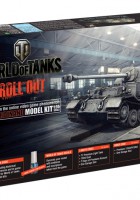
THE BOX CONTAIN: 1 MODEL KIT – 1 LIQUID CEMENT – 1 TANK GUIDE – WORLD oF TANKS DECALS – 3 INVITE CODES – 1 BONUS CODE

Official German designation: Sturmgeschutz (StuG) 8.8cm Pak43/2 (Ferdinand/Elefant) The StuG 8.8cm was based on the unsuccessful Porsche Tiger chassis fitted with a heavily armoured superstructure in the front and a mounted 8,8cm Pak 43/2 L/71 gun. A total of 90 vehicles were produced; they first saw combat in the Battle of Kursk (Operation Citadel). It was built in 1943 under the name Ferdinand, after its designer Ferdinand Porsche, but was soon renamed. After the Battle of Kursk, the remaining 48 vehicles were pulled out of service and given an overhaul. This included a ball-mount machine gun in the front along with a commander’s cupola. The name Elefant was soon decided upon. The vehicle was received with mixed feelings. It provided good protection with its thick armour but was severely unreliable in its mechanics due to the use of non-standard parts. Nevertheless, the Ferdinand/Elefant might well have been the most successful tank destroyer employed during the war, with a kills to losses ratio of approximately 10:1.

ソース: イタレリ

続きを読む

再生 : 1980年

PBV 302

パンサルバンドヴァグン 302

スウェーデン
装甲兵員輸送車
写真ソード・ウェッドマン
トピック

アルバムのアルバム 155 タンクの写真 パンサルバンドヴァグン 302

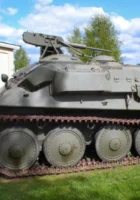
パンサーバンドヴァグン302(Pbv 302)は、スウェーデン軍の運用要件を満たすために開発されたスウェーデンの高移動装甲兵員輸送車です。これは、Örnsköldsvik(現在のヘグルンド車AB)のヘグルンドとセーナーによって設計され、製造されました。設計はPbv 301の代わりとして1961年に就役した。生産は1966年から1971年まで続いた。CV 90シリーズは現在、スウェーデンの標準的な歩兵戦闘車両であるにもかかわらず、車両はアップグレードされ、限られたサービスで継続され、国内と海外のスウェーデン軍の両方で使用されています。

ソース: ウィキペディアのパンサルバンドヴァグン 302

続きを読む

Views : 5302

パンサルバンドヴァグン 301

パンサルバンドヴァグン 301

スウェーデン
装甲兵員輸送車
写真ソード・ウェッドマン
トピックアルバムのアルバム 38 タンクの写真 パンサルバンドヴァグン 301

Pansarbandvagn 301 (pbv 301), was a Swedish armoured personnel carrier used by the Swedish Army. It was a typical “battle taxi”, armed with a 20 mm Bofors gun from the scrapped J21-fighters and with room for transporting 8 fully armed soldiers. The pbv 301 was an interim solution, built on the chassis from the obsolete Stridsvagn m/41, introduced in 1961 and removed from service in the late 1960s and early 1970s when the replacement pbv 302 came into use. The pbv 301 replaced the open-topped KP-bil armoured car as the armoured troop transport in the Swedish Army.

ソース: ウィキペディアのパンサルバンドヴァグン 301

続きを読む

ビュー : 3294

ダグラス F4D-1 (F-6A) スカイレイ

ダグラス F4D スカイレイ

米国
超音速戦闘機/インターセプター
カメラマンウラジーミル・ヤクボフ
トピック

アルバムのアルバム 121 写真の歩き回る«ダグラスF4D-1 (F-6A) スカイレイ»

フォトギャラリー ダグラス F4D-1 (F-6A) スカイレイ, The Douglas F4D Skyray (later redesignated F-6 Skyray) was an American carrier-based supersonic fighter/interceptor built by the Douglas Aircraft Company. Although it was in service for a relatively short time and never entered combat, it was notable for being the first carrier-launched aircraft to hold the world’s absolute speed record, at 752.943 mph,[1] and was the first United States Navy and United States Marine Corps fighter that could exceed Mach 1 in level flight. It was the last fighter produced by the Douglas Aircraft Company before it merged with McDonnell Aircraft and became McDonnell Douglas. The F5D Skylancer was an advanced development of the F4D Skyray that did not go into service.

ソース: ウィキペディアのダグラス F4D スカイレイ

続きを読む

再生 : 4641

ノースロップ F-5E タイガー II
Northrop F-5
米国
役割ライトファイター
初飛行1959年7月30日<
構築2200+

ノースロップ F-5A/BフリーダムファイターとF-5E /FタイガーIIは、ノースロップ社によって1950年代後半に設計された超音速軽戦闘機ファミリーの一部です。マクドネル・ダグラスF-4ファントムIIのような同時代人よりも小型でシンプルで、F-5は調達と運用の両方にコストが低く、人気の輸出航空機となっています。F-5は1950年代にノースロップによって民間資金による軽戦闘機プログラムとしての生活を始めました。設計チームは、小型で高空力戦闘機を2基のコンパクトで高推力のゼネラル・エレクトリックJ85エンジンの周りに巻き付け、性能と低コストのメンテナンスに焦点を当てました。主に日の空気優位の役割のために設計されているが、航空機はまた、有能な地上攻撃プラットフォームです。F-5Aは1960年代初頭にサービスを受けた。冷戦中、米国の同盟国のために1972年まで800以上が生産されました。USAFは軽戦闘機の必要性を認めていなかったが、F-5Aに直接基づいていた約1,200ノースロップT-38タロントレーナー機を調達した。

ソース: ノースロップ F-5E タイガー II オン ウィキペディア

続きを読む

ビュー : 19040