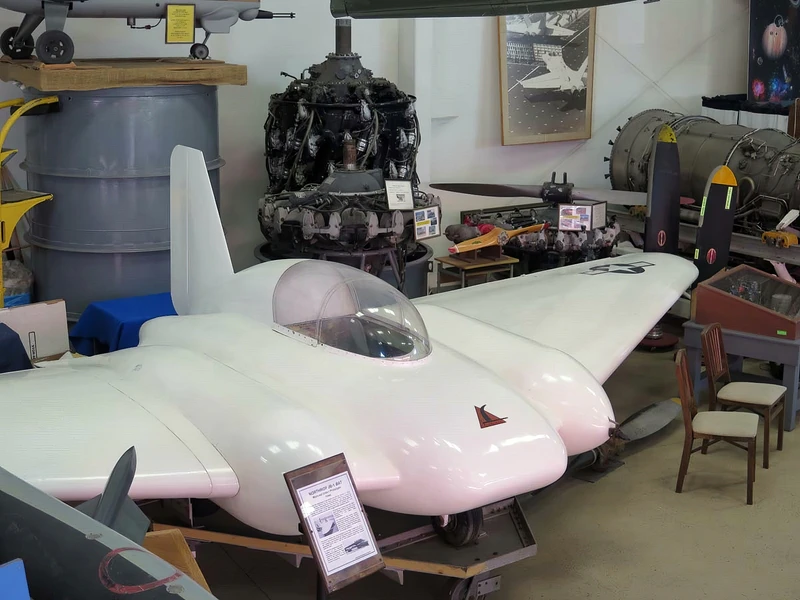
Northrop JB-1 Bat | |
|---|---|
| 国家 | 美国 |
| 作用 | 原型喷气动力飞行翼 |
| 第一只苍蝇 | 1943年8月27日 |
| 建立 | 未知 |
这 诺斯罗普JB-1 "蝙蝠"是美国地对地巡航导弹,是喷气动力飞行翼的原型。美国陆军空军MX-543计划于1942年9月启动,使用弗兰克·惠特尔喷气发动机(通用电气J31)的许可制造版本。诺斯罗普公司于1943年底签订合同,只建造了10架JB-1机身。1943年8月27日,有人从罗杰斯干湖拖出第一次飞行,滑翔机从火箭推进的雪橇上发射,于1944年12月坠毁。1944年12月7日,一架由简易通用电气B-1涡轮增压喷气机驱动的无人驾驶JB-1型飞机,机翼跨度为28英尺4英寸(8.64米),从佛罗里达州埃格林菲尔德的圣罗莎岛进行了第一次飞行,在距离铁路发射器400码处坠毁。
| Northrop JB-1 Bat Walk Around | |
|---|---|
| Photographer | Vladimir Yakubov |
| Localisation | Western Museum of Flight, Torrance |
| Photos | 40 |


另请参阅:


General Characteristics and Role
The Northrop JB-1 Bat was an experimental, unpiloted pulse-jet powered flying wing missile developed by the United States during World War II, based heavily on aerodynamic work done by the German Horten brothers. Its development was part of the United States Army Air Forces’ (USAAF) Jet-Propelled Missile program (JB). The JB-1’s design was highly unconventional, utilizing a pure flying wing configuration with twin rudders and a very clean aerodynamic profile. It was intended as a short-range surface-to-surface cruise missile that could carry a massive warhead (comparable to the German V-1 flying bomb). The project was ultimately terminated due to propulsion issues and the end of the war, but it significantly contributed to Northrop’s pioneering work on tailless aircraft.
| Property | Typical Value (JB-1) |
|---|---|
| 作用 | Experimental Cruise Missile / Flying Bomb |
| National Origin | 美国 |
| 制造商 | Northrop Aircraft |
| First Flight (Glider) | August 1944 |
| 船员 | 0 (Unmanned) |
| Guidance | Preset gyro-pilot system |
| Warhead | Approximately 900 kg (2,000 lb) |
| 长度 | 4.37 m (14 ft 4 in) |
| 翼展 | 9.14 m (30 ft 0 in) |
| Launch Weight | 3,175 kg (7,000 lb) |
Propulsion and Launch Method
- Engine: 2 x General Electric BQ-7 (pulse-jet engines).
- Thrust (Total): Approximately 4.45 kN (1,000 lbf).
- Maximum Speed: Designed for high subsonic speeds.
- Launch Method: The JB-1 was designed to be launched from a rocket-powered sled running on a fixed railway track, similar to the method used for the German V-1 missile.
- Propulsion Issues: Initial tests with the pulse-jets were unsuccessful due to performance and reliability problems, leading to a modified glide-only prototype being tested first.
Legacy and Further Development
- Pilot Modification: After the failure of the pulse-jet system, the design was briefly converted into a piloted glider (designated JB-1A) for aerodynamic testing, including a side-by-side cockpit, which helped validate the flying wing concept.
- Follow-on: The JB-1 project provided valuable data that directly influenced Northrop’s later, larger flying wing aircraft, such as the XB-35 and YB-49 bombers, and eventually the B-2 Spirit stealth bomber.
- Termination: The program was cancelled shortly after the end of the war, as the need for the short-range missile rapidly diminished, allowing resources to be shifted to long-range missile and bomber programs.
意见:1545