Matilda

Matilda Tank

CountryUK
RoleInfantry tank
In service1939–1945
Built2987

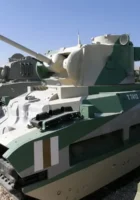
The Infantry Tank Mark II, best known as the Matilda, was a British infantry tank of the Second World War. The design began as the A12 specification in 1936, as a gun-armed counterpart to the first British infantry tank, the machine gun armed, two-man A11 Infantry Tank Mark I. The Mark I was also known as Matilda, and the larger A12 was initially known as the Matilda II, Matilda senior or Waltzing Matilda. The Mark I was abandoned in 1940, and from then on the A12 was almost always known simply as “the Matilda”.

Source: Matilda Tank on Wikipedia

Continue reading

Views : 9666

Das waffen arsenal 012 - Panther

Waffen Arsenal

SeriesWaffen Arsenal
Sujet

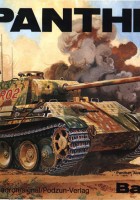
Panther - PzKpfw V - Sdkfz.171

Réf012

Signed documentation Waffen Arsenal "Panther - Waffen Arsenal 012" magazine .

The Panther tank is a medium tank widely used by the German army during World War II, starting in mid-1943. Designed to counter the Soviet T-34 tank, from which it was largely inspired, and replace the Panzerkampfwagen III and Panzerkampfwagen IV, it ultimately served alongside them until the end of the war. Until an order from Adolf Hitler, dated February 27, 1944, he was designated as PzKpfw V Panther and, in the ordinance inventory, as SdKfz 171.

Source: Wikipedia

Continue reading

Views : 756

Jagdpanzer - Jagdpanther - JagdTiger - Photos

Jagdpanzer - Jagdpanther - JagdTiger

PaysGermany
Type

Tank hunter

Description

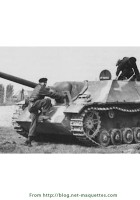
Album de 79 Jagdpanzer tank photos - Jagdpanther - JagdTiger

A tank destroyer est un engin blindé, le plus souvent chenillé, destiné à combattre et à détruire les autres blindés. Ceci en fait une unité particulière, spécialisée, possédant les qualités universellement reconnues comme nécessaires pour un char d’assaut : mobilité, puissance de feu, protection. Plus qu’un autre char, il doit satisfaire à ces conditions : les autres chars sont aussi employés pour réduire l’infanterie ou parfois même les fortifications légères ennemies. Ils satisfont donc à d’autres nécessités, ce sont des unités plus polyvalentes.

Ces engins sont apparus pendant la Seconde Guerre mondiale, et leur importance a diminué depuis 1945. Durant la Seconde Guerre mondiale, les unités blindées étaient plus diversifiées qu’aujourd’hui, où l’on ne retrouve sur la plupart des théâtres d’opération que des MBT (main battle tanks, par exemple le char Leclerc), des véhicules de l’avant blindés, plus légers et destinés au soutien des troupes d’infanterie mécanisées, et des transports de troupes blindés. Le rôle de chasseur de char est aujourd’hui plutôt dévolu à l’hélicoptère de combat. Les armées de terre se sont munies de ces véhicules spécialisés, plus particulièrement la Wehrmacht et l’US Army, ainsi que toutes les autres puissances alliées ayant massivement dépendu du matériel américain durant cette période. À l’origine, le besoin pour ces véhicules est venu d’une supériorité matérielle de l’arme blindée ennemie, et ce dans les deux cas.

Source: Jagdpanzer – Jagdpanther – JagdTiger sur Wikipedia
Continue reading

Views : 4302

Das waffen arsenal 010 - Britische Panzer

Waffen Arsenal

PublisherWaffen Arsenal
Sujet

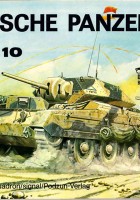
British Tanks

Réf010

Signed documentation Waffen Arsenal la revue «British Tanks – Waffen Arsenal 010» .

The Crusader is a British tank of the Second World War. It was the most built Cruiser tank (5,300 units). Widely used in 1942 in Libya and Egypt, it could not match the German Panzer IV except from a short distance, where its cannon was also effective.

Source: Wikipedia

Continue reading

Views : 656

Halbketten Fahrzeuge - Waffen Arsenal 008

Waffen Arsenal

EditeurWaffen Arsenal
Sujet

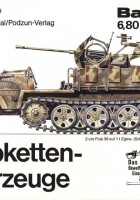
Halbketten Fahrzeuge

Réf008

Signed documentation Waffen Arsenal magazine "Halbketten Fahrzeuge - Waffen Arsenal 008" .

The "SdKfz 10 leichter Zugkraftwagen 1 t." (Sonderkraftfahrzeug 10) was a German semi-tracked product produced at 17,000 between 1934/1937 and 1944, capable of carrying eight men, and towing the 3.7-cm Pak 35/36 anti-tank guns; Pak 38 5-cm and Pak 40 7.5-cm; or the 7.5-cm LeIG 18 infantry howitzers; sIG 33 of 15-cm; 12-cm Heavy Granatwerfer 42 mortars; as well as any artillery or Flak pieces with the weight included in the cathegorie of these weapons. The chassis of the "SdKfz 10" was used for the production of the SdKfz 250.

Source: Wikipedia

Continue reading

Views: 764

Das waffen arsenal 007 - Schützenpanzerwagen

Waffen Arsenal

SeriesWaffen Arsenal
Sujet

Schützpanzerwagen

Réf007

Signed documentation Waffen Arsenal the magazine "Schützpanzerwagen – Waffen Arsenal 007".

The Sonderkraftfahrzeug 251 (SdKfz.251) (literally: special combat vehicle) was a German semi-tracked combat armoured vehicle built during World War II, which was produced throughout the conflict. It was primarily intended to equip Panzer Divisions and Panzergrenadieren units and shared many mechanical elements with the SdKfz 7.

Source: Wikipedia

Continue reading

Views : 884

Das waffen arsenal 006 - Sowjetische Panzer T34

Waffen Arsenal

PublisherWaffen Arsenal
Sujet

T-34

Réf006

Signed documentation Waffen Arsenal la revue «T-34 – Waffen Arsenal 006» .

The T-34 was a medium tank that entered service in 1940 with the Red Army. At the time, it was a remarkable balance between the three major factors that defined the quality of an armoured vehicle: firepower, protection and mobility. This success made it one of the Soviet Union's strengths in the face of the invasion of the Wehrmacht. In order to counter it, it will have to revise its armoured design policy by developing, for example, the Panzer-V 'Panther', which borrowed some of its technical features from the T-34. Although quickly surpassed by foreign production, the T-34 remained in production from 1940 to 1958, with a total of units produced estimated at 84,070, making it the second most produced tank of all time, just behind its successors, the T-54 and T-55.

Source: Wikipedia

Continue reading

Views : 691

Panzer III - Stug III - Waffen Arsenal 004

Waffen Arsenal

PublisherWaffen Arsenal
Sujet

Panzer III - Stug III

Réf004

Signed documentation Waffen Arsenal "Panzer III - Stug III - Waffen Arsenal 004" magazine .

The assault cannon Sturmgesch-tz III (StuG III) fut le véhicule blindé de combat produit au plus grand nombre d’exemplaires par l’Allemagne au cours de la Seconde Guerre mondiale. Il était construit sur le châssis du char Panzer III. Conçu au départ comme un canon léger blindé destiné à soutenir l’infanterie, le StuG fut continuellement modifié et fut largement employé comme chasseur de chars. La série des Sturmgeschütz est reconnue pour son excellent rapport prix/qualité. À la fin de la guerre, plus de 10 500 avaient été construits.

Source: Wikipedia

Continue reading

Views : 881

Nashorn, Hummel, Brummbär - Waffen Arsenal 003

Waffen Arsenal

PublisherWaffen Arsenal
Sujet

Nashorn, Hummel, Brummbur

Réf003

Signed documentation Waffen Arsenal the magazine "Nashorn, Hummel, Brummbur - Waffen Arsenal 003" .

The Nashorn (literally Rhinoceros), originally referred to as Hornisse (Frelon in German) was a German tank destroyer of the Second World War. It was developed as an intermediate solution in 1942 and was armed with the powerful 88 mm anti-tank gun. Although slightly armored and with a high figure, he remained in service until the end of the war and demonstrated that he was a pretty good tank destroyer.

Source: Wikipedia

Continue reading

Views : 1219

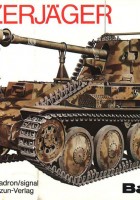
Das waffen arsenal 002 - Panzerjager

Waffen Arsenal

PublisherWaffen Arsenal
Sujet

Tank fighters

Réf002

Signed documentation Waffen Arsenal la revue «Panzerjäger – Waffen Arsenal 002» .

Le Panzerjäger I (chasseur de chars en allemand) fut le premier des chasseurs de chars conçus par l’Allemagne au cours de la Seconde Guerre mondiale. Il était conçu en 1940 sur un châssis converti de Panzerkampfwagen I Ausf. B et était armé du canon antichar Skoda 4.7cm PaK L/43. Le Panzerjäger s’avéra être une solution peu coûteuse et relativement efficace pour contrer les chars soviétiques et permit de prolonger l’utilisation des chars Panzer I devenus désuets. Comme pour la majorité des chasseurs de chars, l’équipage était très vulnérable, sa seule protection étant fournie par le bouclier frontal du canon ; le canon avait en outre un faible rotation latérale. En tout, 202 chars Panzer I furent convertis, 132 par Alkett et 70 par Skoda. Les conversions opérées par Skoda sont reconnaissables au bouclier du canon qui présente sept faces alors que les modèles d’Alkett n’en présentent que cinq.

Source: Wikipedia

Continue reading

Views: 783