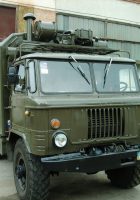
GAZ-66

GAZ-66

LandSovjet-Unie
Onderwerp4×4 military truck
GeproduceerdOnbewust
GebouwdOnbewust

De GAZ-66 is a Soviet and later Russian 4×4 all-road (off-road) military truck produced by GAZ. It was one of the main cargo vehicles for motorized infantry of the Soviet Army and is still employed in former Soviet Union countries. It is nicknamed shishiga (шишига) shehsherik (шешерик) trueman (in Siberia). The GAZ-66 has gained legendary status in many countries around the world due to its reliability, simplicity and off-road capability. Thanks to standard features, such as a front-mounted winch, Central Tire Inflation System (CTIS) and self-locking differentials, the GAZ-66 is extremely popular worldwide with armed forces and off-road enthusiasts. Production ceased in 1999, with the GAZ-3308 being produced instead.

Bron: GAZ-66 on Wikipedia

Lees verder

Views : 7785

BTR-152

BTR-152

LandSovjet-Unie
OnderwerpGepantserde personeelsdrager
Geproduceerd1950-1959
In gebruikJaren 1950-1990
Gebouwd15000+

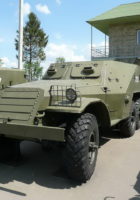
De BTR-152 (ook bekend als BTR-140) was een niet-amfibisch Sovjet gepantserd personeelstransportschip (БТР, uit Бронетранспортер/Bronetransporter, letterlijk "gepantserde transporter") †) die in 1950 in Sovjetdienst kwam. Tegen het begin van de jaren 1970 was het in de rol van infanterievoertuig vervangen door de BTR-60. Het bleef echter in dienst in het Sovjetleger en het Russische leger tot 1993 in verschillende andere rollen. Het werd ook geëxporteerd naar vele derdewereldlanden.

BTR-152v1 (1957) – Nachtzichtapparatuur, lier, open bovenkant en verbeterd extern bandenspanningsregelsysteem ontvangen.

Bron: BTR-152 op Wikipedia

Lees verder

Views : 3511

Btm-3

LandSovjet-Unie
RoleMilitaire loopgraafmachine
OntworpenOnbewust

De Btm-3 (Russisch: БТМ-Bisztrohodnaja transejnaja Быстроходная траншейная машина/machine, Hongaars: redelijke árokoló-machine), vervaardigd in de militaire sleuvenmachine van de Sovjet-Unie. Niet meer dan 1,5 m diepte en de verantwoordelijkheid van 1,1 m breed (markeringen) snelle uitgraving van sleuven. Rotsachtige grond was niet van toepassing.

Bron: BTM-3 op Wiki

Lees verder

Views : 3575

SU-101 Uralmash Tank Vernietigen

zo-101 Uralmash

LandSovjet-Unie
RoleSelf-propelled gun (prototype)
Ontworpen1944-1945

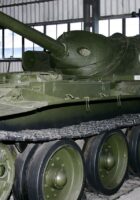
De Uralmash-1 Zoekertjes (Уралмаш-1) was a Soviet prototype self-propelled gun developed during World War II. It was a turretless, tracked armoured fighting vehicle designed by the Yekaterinburg-based Uralmash design bureau (UZTM) between autumn 1944 and spring 1945. It used the chassis of the T-44 medium tank and was intended to replace the SU-100 which itself had only entered service with the Red Army in late 1944. Two prototypes of the Uralmash-1 with different armament were built in early 1945, one with the 100 mm D-10 tank gun, the other with the 122 mm D-25S tank gun. While mass production was initially recommended, the end of the war with Germany in May 1945 eventually caused the project to be cancelled due to lack of necessity. If the Uralmash-1 had entered service, the 100 mm variant would have been designated SU-101 (СУ-101) while the 122 mm variant would have been designated SU-102 (СУ-102), in accordance with Soviet military nomenclature, where the “SU”-label stood for Samokhodnaya Ustanovka, or self-propelled gun.

Bron: Su-101 Uralmash op Wiki

Lees verder

Aantal keren bekeken: 2196

BREM-1

LandSovjet-Unie
RoleGepantserd reparatie- en bergingsvoertuig

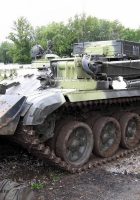
Een gepantserd bergingsvoertuig (ARV) is an armoured vehicle used during combat for recovery or repair of battle-damaged and inoperable armoured fighting vehicles. The term “Armoured Repair and Recovery Vehicle” (ARRV) is also used. The Russian acronym BREM (cyr. БРЭМ) stands for “бронированная ремонтно-эвакуационная машина”, literally “armoured repair and recovery vehicle”. BTS-2 (T-54 Chassis) BTS-4A (T-54 Chassis) BREM-1 (T-72 Chassis) BREM-2 (BMP-1 Chassis) BREM-L (BMP-3 Chassis) BREM-K (BTR-80 Chassis) BREM-80U (T-80U Chassis)

Bron: BREM-1 op Wiki

Lees verder

Bekeken : 3298

Sud SA-316B Alouette III

Alouette III

LandFrankrijk
RoleLichte nutshelikopter
Geproduceerd1961-1985
Gebouwd2000+

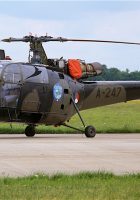
De Aérospatiale Alouette III is a single-engine, light utility helicopter developed by Sud Aviation. It was manufactured by Aérospatiale of France, and under license by Hindustan Aeronautics Limited in India as the HAL Chetak, by Industria Aeronautică Română in Romania as the IAR 316 and F+W Emmen (de) in Switzerland. The Alouette III is the successor to the Alouette II, being larger and having more seating.

Bron: Alouette III op Wiki

Lees verder

Views : 5734

BMP-2

BMP-2

LandSovjet-Unie
RoleInfanterie het vechten voertuig
Geproduceerd1980-heden
In gebruik1980-heden

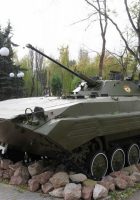
De BMP-2 (Boyevaya Mashina Pekhoty, Russian: Боевая Машина Пехоты; infantry combat vehicle) is a second-generation, amphibious infantry fighting vehicle introduced in the 1980s in the Soviet Union, following on from the BMP-1 of the 1960s.

Bron: BMP-2 on Wiki

Lees verder

Bekeken : 3272

Chance Vought F4U-4 Corsair

Vought F4U Corsair

LandUsa
RoleCarrier-gebaseerde jachtbommenwerper
Geproduceerd1942–53
Aantal gebouwd12571

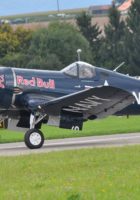
De Vought F4U Corsair is een Amerikaans gevechtsvliegtuig dat voornamelijk dienst deed in de Tweede Wereldoorlog en de Koreaanse oorlog. De vraag naar het vliegtuig overweldigde al snel de productiecapaciteit van Vought, wat resulteerde in productie door Goodyear en Brewster: door Goodyear gebouwde Corsairs werden aangeduid als FG en Brewster-gebouwde vliegtuigen F3A. Van de eerste prototypelevering aan de Amerikaanse marine in 1940 tot de uiteindelijke levering in 1953 aan de Fransen, werden 12.571 F4U Corsairs geproduceerd, in 16 afzonderlijke modellen, in de langste productierun van een jager met zuigermotor in de Amerikaanse geschiedenis (1942-53)

Bron: Vought F4U Corsair op Wiki

Lees verder

Views : 17469

Bm-13

LandSovjet-Unie
RoleMeerdere raketwerpers
In gebruik1939-heden
Geproduceerd1939-heden

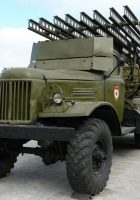
De Katjoesja multiple rocket launcher (Russian: Катю́ша; IPA: [kɐˈtʲuʂə] (About this sound listen)) is a type of rocket artillery first built and fielded by the Soviet Union in World War II. Multiple rocket launchers such as these deliver explosives to a target area more quickly than conventional artillery, but with lower accuracy and requiring a longer time to reload. They are fragile compared to artillery guns, but are inexpensive, easy to produce, and usable on any chassis. The Katyushas of World War II, the first self-propelled artillery mass-produced by the Soviet Union, were usually mounted on ordinary trucks. This mobility gave the Katyusha, and other self-propelled artillery, another advantage: being able to deliver a large blow all at once, and then move before being located and attacked with counter-battery fire. Katyusha weapons of World War II included the BM-13 launcher, light BM-8, and heavy BM-31. Today, the nickname is also applied to newer truck-mounted post-Soviet – in addition to non-Soviet – multiple rocket launchers, notably the common BM-21 Grad and its derivatives.

Bron: BM-13 op ZiL-157 op Wiki

Lees verder

Views : 4415

BM Smerch

BM-30 Smerch

LandSovjet-Unie
RoleMeerdere raketwerpers
In gebruik1989-heden
Geproduceerd1989-heden

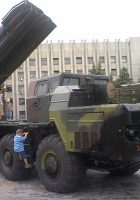
De BM-30 Smerch (Russisch: Смерч, "wervelwind"), 9K58 Smerch of 9A52-2 Smerch-M is een Sovjet-zware meervoudige raketwerper. Het systeem is ontworpen om personeel, gepantserde en zachte doelen te verslaan in concentratiegebieden, artilleriebatterijen, commandoposten en munitiedepots. Het werd opgericht in het begin van de jaren 1980 en kwam in 1989 in dienst bij het Sovjetleger. Toen het voor het eerst door het Westen werd waargenomen in 1983, kreeg het de code MRL 280 mm M1983. Het zal naar verwachting worden vervangen door de 9A52-4 Tornado

Bron: BM-30 Smerch op Wiki

Lees verder

Bekeken : 2474