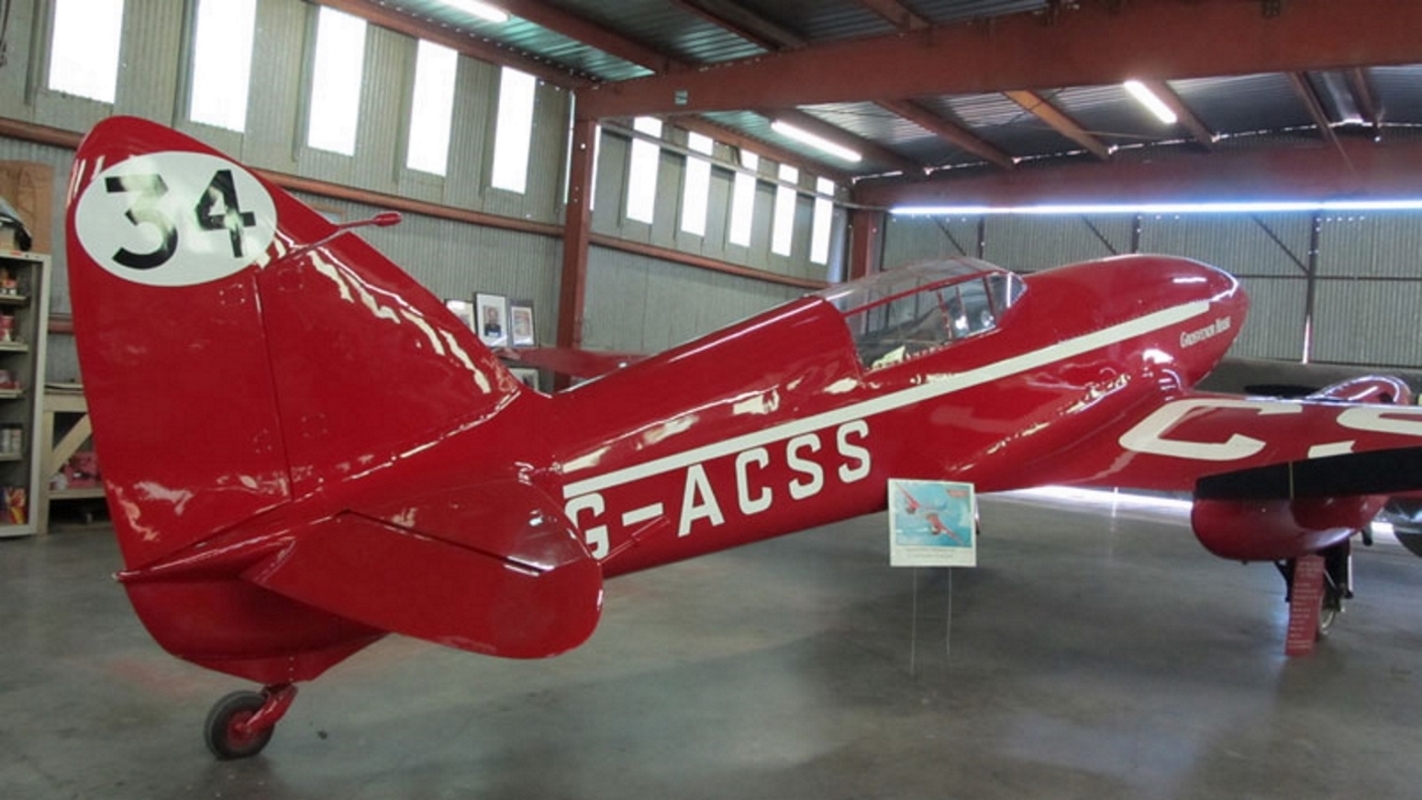
de Havilland DH.88 Comet | |
|---|---|
| Paese | Regno unito |
| Ruolo | Aerei da corsa |
| Primo volo | 1934 |
| Produttore | 431+ |
Le de Havilland DH.88 Cometa was a two-seat, twin-engined aircraft developed specifically to participate in the 1934 England-Australia MacRobertson Air Race from the United Kingdom to Australia. Development of the DH.88 had been initiated at the behest of British aviation pioneer Geoffrey de Havilland, along with the support of de Havilland’s board, being keen to garner prestige from producing the victorious aircraft as well as to gain from the research involved in producing it. The DH.88 was designed by Arthur Ernest Hagg around the specific requirements of the race; Hagg produced a relatively innovative design for the era in the form of a stressed-skin cantilever monoplane, complete with an enclosed cockpit, retractable undercarriage, landing flaps, and variable-pitch propellers.
| De Havilland DH.88 Cometa a spasso | |
|---|---|
| Fotografi | Cees Hendriks |
| Localizzazione | Inconsapevole |
| Foto | 19 |

Vedi anche:


| de Haviland DH.88 Comet | |
|---|---|
| Fotografo | Vladimir Jakubov |
| Localizzazione | Moffet Air Show e Pacific Coast Dream Machines |
| Foto | 86 |
Le de Havilland DH.88 Cometa was a remarkable aircraft that achieved fame and glory in the 1934 MacRobertson Air Race from England to Australia. It was designed and built by the de Havilland Aircraft Company in a very short time, using innovative techniques and materials. The Comet was a sleek, twin-engined monoplane with a wooden structure, retractable landing gear, variable-pitch propellers and a streamlined cockpit. It was powered by two modified Gipsy Six engines that gave it a top speed of over 320 km/h. The Comet could fly up to 4,000 feet on one engine and had a range of 4,100 km.
Tre comete sono state ordinate da privati per la gara, ognuna dipinta in un colore diverso: G-ACSS Grosvenor House (rosso), G-ACSP Black Magic (nero) e G-ACSR Reine Astrid (verde). Affrontarono una forte concorrenza da parte di altri 17 aerei, tra cui un aereo di linea Douglas DC-2 e due bombardieri Fairey Fox. La gara iniziò il 20 ottobre 1934 a Mildenhall, nel Suffolk, e si concluse il 23 ottobre all'ippodromo di Flemington di Melbourne. I Comets si sono comportati eccezionalmente bene, stabilendo diversi record lungo la strada. Grosvenor House, pilotato da C.W.A. Scott e Tom Campbell Black, vinse la gara in 71 ore, battendo il DC-2 di oltre un giorno. La Black Magic, pilotata da Jim e Amy Mollison, era seconda fino a quando non dovette ritirarsi ad Allahabad a causa di problemi al motore. Reine Astrid, pilotata da Owen Cathcart-Jones e Ken Waller, è arrivata quarta dopo aver fatto una deviazione per consegnare le riprese della gara.
Le Comets continued to make history after the race, as they were used for various purposes such as mail delivery, record attempts and military evaluation. Grosvenor House was sold to the Portuguese government and renamed Salazar. It crashed in 1937 while attempting a record flight from Lisbon to Rio de Janeiro. Black Magic was recovered and sold to the French government, where it was used for testing new equipment. It was destroyed by German bombs in 1940. Reine Astrid was bought by de Havilland and renamed The Orphan. It was used for research and development until it was scrapped in 1947. Two more Comets were built after the race: G-ADEF Boomerang and G-AEYE Comet. They were also used for various flights and experiments until they were retired.
Il de Havilland DH.88 Comet era un aereo straordinario che dimostrò il potenziale dei viaggi aerei ad alta velocità e ispirò progetti futuri come il de Havilland Mosquito e l'aereo di linea a reazione de Havilland Comet. Ha anche catturato l'immaginazione del pubblico ed è diventato un simbolo dell'eccellenza dell'aviazione britannica.
Visualizzazioni : 4419
Puoi anche vedere:
 de Havilland DH.104 Dove – Foto e Video
 de Havilland Dragon Rapide – Foto e Video
 de Havilland Canada DHC-2 – Foto e Video
 de Havilland DH.60 Moth – Foto e Video
 de Havilland DH112 Venom – Foto e Video
 de Havilland Canada DHC-4 Caribou – Foto e Video
 de Havilland Dragon – Foto e Video
 de Havilland Mosquito – Foto e Video
de Havilland DH112 Venom – Foto e Video
de Havilland Mosquito – Foto e Video
de Havilland DH112 Venom – Foto e Video
 de Havilland DH.82 Tiger Moth – Foto e Video