Verlinden | |
|---|---|
| Réf | 2697 |
| Type | Accessoires |
| Echelle | 1/35 |
| Description | Point Blank Tiger I avec zimmerit |
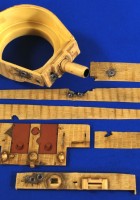
A novelty 2011 of the verlinden brand the improvement kit: «Point Blank Tiger I – Zimmerit – Verlinden 2697».
Views : 1203
Verlinden | |
|---|---|
| Réf | 2697 |
| Type | Accessoires |
| Echelle | 1/35 |
| Description | Point Blank Tiger I avec zimmerit |
A novelty 2011 of the verlinden brand the improvement kit: «Point Blank Tiger I – Zimmerit – Verlinden 2697».
Views : 1203
Hobby Boss | |
|---|---|
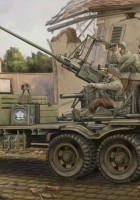
| Sujet | GMC Bofors 40mm Gun |
| Echelle | 1/35 |
| Réf | 82459 |
Source: GMC on Hobby Boss
Views : 1740
Char KW – Kliment Voroshilov | |
|---|---|
| Editeur | Wydawnictwo Militaria |
| Série | Tank Power |
| Réf | 163 |
Une documentation signée Wydawnictwo Militaria le livre «Chars KW – Kliment Voroshilov Vol 1 – Wydawnictwo 163» .
Le char Kliment Voroshilov (KV) est un char de rupture soviétique. Il fut une désagréable surprise pour la Wehrmacht lors de l’opération Barbarossa : il était à l’époque quasiment invulnérable à toutes ses armes excepté le canon antiaérien Flak de 88 mm et des tirs directs d’artillerie.
Source: Wikipedia
Views : 1510
E.T.MODEL | |
|---|---|
| Réf | E35-091 |
| Type | Photo-cutting |
| Echelle | 1/35 |
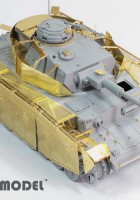
| Description | Set of photo-cuts for kits Dragon Pz.Kpfw.IV Ausf.J Schurzen |
A set from the brand E.T.Model kit: "WWII German Pz.Kpfw.IV Ausf.J Schurzen".
The SdKfz 161 Panzerkampfwagen IV (PzKpfW IV), known as Panzer IV, was a middle-class tank used by the German army during World War II. Originally designed as a fire support tank and armed with a 75 mm short KwK 37 L/24 gun for the Panzer IV Ausf. A / B / C / D / E / F, it was rearmed with a long anti-tank gun 75 mm KwK 40 L/43 from March 1942 for the Panzer IV Ausf. F2 / G / H / J. The PzKpfW IV was the most widely used tank by the Panzerwaffe, with 9,000 units produced, and it gave birth to many versions.
Source: Panzer IV on Wikipedia
Views : 3003
Il-28 Beagle | |
|---|---|
| Editeur | Wydawnictwo Militaria |
| Série | Aviation Power |
| Période | 1945-1950 |
| Réf | 297 |
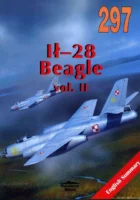
Une documentation signée Wydawnictwo Militaria la revue «Il-28 Beagle Vol 2 – Wydawnictwo Militaria 297» .
L’Iliouchine Il-28 (code OTAN Beagle) est le premier bombardier à réaction construit en grande série par l’URSS. Il a fait son premier vol en 1948 et a été construit à plusieurs milliers d’exemplaires (entre 2 000 et 6 000 suivant les sources), utilisés par une vingtaine de pays différents.
<Source: Il-28 Beagle sur Wikipedia>
Views : 1037
Boeing B-29 Super Fortress | |
|---|---|
| Country | USA |
| Role | Strategic bomber |
| First fly | 21 September 1942 |
| Built | 3970 |
The Boeing B-29 Superfortress is a four-engine propeller-driven heavy bomber designed by Boeing, which was flown primarily by the United States during World War II and the Korean War. It was one of the largest aircraft operational during World War II and featured state-of-the-art technology. Including design and production, it was the single most expensive weapons project undertaken by the United States in World War II, exceeding the cost of the Manhattan Project by between $1 and 1.7 billion.
Views : 6114
M7B2 Priest | |
|---|---|
| Pays | USA |
| Period | Korean War |
| Type | Self-propelled gun |
| Description | Album de 131 walk-around photos of the self-propelled gun "M7B2 Priest" |
Photo Gallery on an M7B2 Priest, officially named 105mm Howitzer Motor Carriage M7, the M7 Priest is a self-propelled gun produced during World War II by the United States. Priest is the nickname given by the British, due to the fact that the machine gun placed on a rail gave the impression that the tank was equipped with a pulpit. It followed the Bishop English and they officially eded it 105mm SP Priest. (The British liked to give names related to religion to their self-propelled guns (Priest - priest, Bishop , bishop, Sexton - sacristan), a tradition that lasted until the 1960s with the Abbot (abbot).) Version M7B2 : During the Korean War, the limited elevation of the howitzer became a real problem, and it was increased to 65 degrees. The machine gun mount also had to be improved to give the ability to fire 360 degrees. This problem stemmed from the fact that most of the Time the Korean conflict took place in hilly terrain, with the North Koreans deploying their artillery pieces on the hilltops north of Seoul.
Source: M7B2 Priest on Wikipedia
Views: 3399
Hawker Typhoon | |
|---|---|
| Pays | UK |
| Period | World War II |
| Type | Hunter |
| Description | Album de 56 walk-around photos of the "Hawker Typhoon" fighter |
Photo Gallery on a Hawker Typhoon , The Hawker Typhoon was a single-seat British fighter aircraft produced by Hawker Aircraft from 1941. Intended to replace the Hawker Hurricane as an interceptor, he suffered from initial performance problems and was upgraded to become one of the best fighter-bombers of world war.
Source: Hawker Typhoon on Wikipedia
Views: 7790
Concord Publications | |
|---|---|
| Série | Concord Publications |
| Titre | Panzerkampfwagen-IV-Medium-Tank-1939-1945 |
| Réf | 6081 |
| Description | Panzerkampfwagen-IV-Medium-Tank-1939-1945 |
Le SdKfz 161 Panzerkampfwagen IV (PzKpfW IV), appelé « Panzer IV », fut un char d’assaut de classe moyenne utilisé par l’armée allemande lors de la Seconde Guerre mondiale. Conçu initialement comme char d’appui-feu et armé d’un canon de 75 mm court KwK 37 L/24 pour les Panzer IV Ausf. A / B / C / D / E / F, il fut réarmé avec un canon long antichar 75 mm KwK 40 L/43 à partir de mars 1942 pour les Panzer IV Ausf. F2 / G / H / J. Le PzKpfW IV fut le char le plus utilisé par la Panzerwaffe, avec 9 000 exemplaires produits, et il donna naissance à de nombreuses versions.
Views : 1389
Concord Publications | ||
|---|---|---|
| Series | Concord Publications | |
| Title | Battle of Stalingrad | |
| Réf | 6511 | |
| Description | Battle of Stalingrad – Russian Great Patriotic War | |
The bataille de Stalingrad refers to the battles between the union of Soviet socialist republics and the Third Reich for control of the eponymous city, now Volgograd, from 17 July 1942 to 2 February 1943. They include the approach of the city by the German armies, the urban battles for its conquest, then the Soviet counter-offensive, until the encirclement and surrender of the German troops. All of these fightings, in and out of the city, spanred just over six months and claimed the lives of an unknown 750,000 fighters and an unknown number of civilians, making it one of the deadliest battles in history.
With the Battle of Moscow in December 1941, and the Battle of Kursk, in July 1943, it was one of the great defeats of the German army and was considered a major strategic turning point in the Second World War. It is remembered for the bitterness of urban fighting, sparing neither civilians nor military, as well as for its psychological and symbolic impact.
Views : 1274