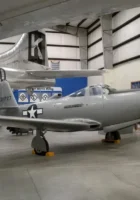
Bell P-63E KingCobra

Bell P-63E KingCobra

PaysUSA
TypeHunter

Photo Gallery of a Bell P-63E KingCobra, The Bell P-63 Kingcobra (Model 24) is an American fighter aircraft developed during World War II. It is an evolution of the P-39 Airacobra intended to correct the deficiencies of the latter. Although he was not accepted by the USAAF for operational service, he served successfully under the Soviet Air Force.

Source: Bell P-63E KingCobra on Wikipedia

Continue reading

Views : 2919

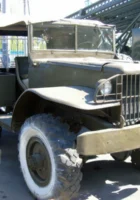
Dodge WC51

Dodge WC51

PaysUSA
TypeLight truck

The range of Dodge WC est une série de camions militaires légers produite par la société Dodge durant la Seconde Guerre mondiale. Cette gamme comprenait des weapon carriers (littéralement transporteurs d’armes), des camions d’installation téléphonique, des ambulances, des véhicules de reconnaissance, des ateliers mobiles et des voitures de commandement. Ils furent remplacés après la guerre par la série M fabriquée par cette même société. Le sigle WC est un code du fabricant signifiant : W pour l’année 1941 et C pour la gamme des half-ton. Le code C fut également retenu pour les gammes Dodge 6×6 ¾ ton et 1 ½ ton.

Source: Dodge WC51 on Wikipedia

Continue reading

Views: 6559

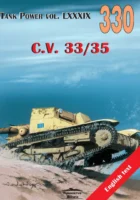
Wydawnictwo Militaria 330 - C.V.33-35

WCV.33 - CV.35

PublisherWydawnictwo Militaria
Series

Tank Power

Réf330

Signed documentation Wydawnictwo Militaria the book "Char T-50 - Wydawnictwo 283" .

The L3 caterpillar est une série de chenillettes italiennes en usage avant et pendant la Seconde Guerre mondiale. Elles furent développées à partir du Carden-Loyd Mark VI britannique. D’un équipage de deux hommes, sa masse est de 3,2 tonnes avec un blindage de 6 à 14 mm (à l’avant). Son armement de base est composé de deux mitrailleuses de 8 mm. En 1933, un nouveau modèle fut mis au point conjointement par Fiat à Turin et Ansaldo à Gênes. Il s’agit de la chenillette Fiat-Ansaldo C.V.33 modèle 1933. L’année suivante, quelques modifications apportées à l’armement et à d’autres parties du véhicule furent à l’origine de la C.V.33 modèle 1934. Au total, quelque 300 exemplaires de la C.V.33 furent construits. En 1935, un modèle légèrement amélioré de la C.V.33 fut produit, sous le nom de C.V.35. The main differences are that the armour is screwed rather than riveted, and that the single 6.5 mm machine gun is replaced by two twin Breda 8 mm machine guns. Many C.V.33s were recalled to be converted to C.V.35. In 1938, these two vehicles were given new names L3/33 and L3/35, the L designating a light tank (L for Leggero).

Source: L3 caterpillars on Wikipedia
Continue reading

Views: 828

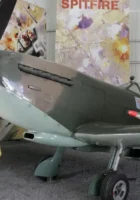
Spitfire Mk XV

Spitfire Mk XVI

PaysUK
PeriodWorld War II
TypeHunter
DescriptionAlbum de 29 walk-around photos of the hunter "Spitfire Mk XVI"

The Supermarine Spitfire (en anglais cracheur de feu, mais aussi au sens figuré soupe au lait) fut l’un des chasseurs monoplaces les plus utilisés par la RAF et par les Alliés pendant la Seconde Guerre mondiale. Les ailes elliptiques du Spitfire lui ont donné une apparence très reconnaissable ; leur section transversale mince lui a donné une vitesse impressionnante ; la conception brillante du concepteur en chef Reginald Mitchell et de ses successeurs (il est mort en 1937), a fait du Spitfire un avion apprécié par les pilotes. Il a servi pendant toute la durée de la Seconde Guerre mondiale, et avec toutes ses variantes a été de tous les combats. Plus de 20 300 appareils furent construits, et les Spitfire sont restés en service jusque dans les années 1950. Spitfire XVI In: Mk.IX equipped with the Packard-Merlin 266; F wing or LF; generally, armament C or E; the majority with a dripping canopy (l 054 copies)

Source: Spitfire on Wikipedia

Continue reading

Views : 5071

M9A1

M9A1

CountryUSA
TypeHalfTrack
TopicAlbum of 47 photos walk-around of a M9A1

Photo gallery of a M9A1 HalfTrack, The M9A1 resulted from the fact that White and Autocar could not keep pace with the demand for half-track cars, and was analogous to the M2 half-track. M9A1s differed in several respects from the M2A1, however. M9A1s lacked the side ammunition compartments, featured rear doors, the fenders on the M9A1s were flat in cross-section, and unlike the M2A1 the M9A1’s body was the same length as the M5’s, its personnel carrier counterpart. The M9A1 also never had the large fender-mounted headlights. International Harvester used rolled homogeneous steel armor on their vehicles, which allowed plates to be welded together, giving IHC’s half-tracks a smoother appearance than the bolted half-tracks.

Source: Afvdb

Continue reading

Views : 3693

Curtiss SB2C-5 Helldiver

Curtiss SB2C-5 Helldiver

PaysUSA
TypeBombardier

Photo Gallery on a Curtiss SB2C-5 Helldiver, The Curtiss SB2C Helldiver surnommé « The beast » (La bête) par ses équipages est un avion militaire de la Seconde Guerre mondiale. L’usine Curtiss received as the Brewster an order from the U.S. Navy in May 1939 to replace the Douglas SBD Dauntless as a dive bomber on U.S. aircraft carriers. The prototype first flew on December 18, 1940, but was destroyed in an accident a few days later. This incident, as well as the numerous modifications (increased fuel carrying capacity, hitchhiking tanks, reinforcement of the on-board armament, increased surface area of the drift and rudder) caused a significant delay and although the first series copy flew in June 1942, the first war mission did not take place until 11 November 1943 with the bombardment of Rabaul Island.

Source: Curtiss SB2C-5 Helldiver sur Wikipedia Vu sur le forum

Continue reading

Views : 8097

SU-100

SU-100

PaysUssr
TypeSelf-propelled gun

Photo gallery on a SU-100, The SU-100 is a tank destroyer on a T-34 base with a 100 mm D-10S part in a front superstructure.
The Soviets, who had already experimented with the construction of self-propelled cannons, both on a truck basis and on a tank basis, produced some Komsomoletz early in the war, based on a 57mm Zis-2 gun mounted on tractor chassis. In 1943, they produced the SU-85 and, at the end of 1944, the SU-100, which combined a powerful cannon on a modern chassis providing full armour. It had the advantage of being relatively cheap to produce and having a cannon a little more powerful than the one that equipped the tank from which it derided, which gave the Russians great flexibility.

Source: wikipedia

Continue reading

Views : 4459

Ansaldo SVA

Avro Lancaster

CountryUK
RoleBombardier
First flight9 January 1941
Built7377

The Avro Lancaster is a British four-engined Second World War heavy bomber. It was designed and manufactured by Avro as a contemporary of the Handley Page Halifax, both bombers having been developed to the same specification, as well as the Short Stirling, all three aircraft being four-engined heavy bombers adopted by the Royal Air Force (RAF) during the same wartime era. The Lancaster has its origins in the twin-engine Avro Manchester which had been developed during the late 1930s in response to the Air Ministry Specification P.13/36 for a capable medium bomber for “world-wide use”. Originally developed as an evolution of the Manchester (which had proved troublesome in service and was retired in 1942), the Lancaster was designed by Roy Chadwick and powered by four Rolls-Royce Merlins and in one version, Bristol Hercules engines. It first saw service with RAF Bomber Command in 1942 and as the strategic bombing offensive over Europe gathered momentum, it was the main aircraft for the night-time bombing campaigns that followed. As increasing numbers of the type were produced, it became the principal heavy bomber used by the RAF, the RCAF and squadrons from other Commonwealth and European countries serving within the RAF, overshadowing contemporaries such as the Halifax and Stirling

Source: Avro Lancaster on Wikipedia

Continue reading

Views : 12629

M3A1 Scout Car

M3A1 Scout Car

PaysUSA
Type

Half-Tracks

Description

Album de 41 M3A1 Scout Car walkaround photos

Photo Gallery on an M3A1 Scout Car, The Armoured Auto-Track was the first U.S. Army troop transport vehicle to be operationally employed. It was built and used extensively during the Second World War and continued its career well beyond the Middle East, notably where it was used in many versions in Israel or Lebanon (ALS). Some versions are still used today like the Tsefa. Its anti-aircraft version, the M 16, ended its operational career in the mid-1980s. Seventy variants representing 41,000 vehicles came out of Diamond T, White and Autocar factories.

Source: M3 Scout Car sur Wikipedia

Continue reading

Views : 5477

Pz II D/E - Marder II D - FlammPz II - Nuts & Bolts 24

Nuts - Bolts

SeriesNuts - Bolts
Réf

Nuts & Bolts 24

Author
Sujet

Pz II D/E – Marder II D – FlammPz II

Signed documentation Nuts - Bolts la revue «Pz II D/E – Marder II D – FlammPz II – Nuts & Bolts 24».

  • published on September 15, 2009
  • soft cover
  • german & english texts
  • 160 pages
  • 274 photos (237 historic, 26 model, 11 modern)
  • 10 blueprints
  • 10 camouflage schemes, tactical markings, table of organsisation (KStN)

Source: Nuts & Bolts 24

Continue reading

Views : 884