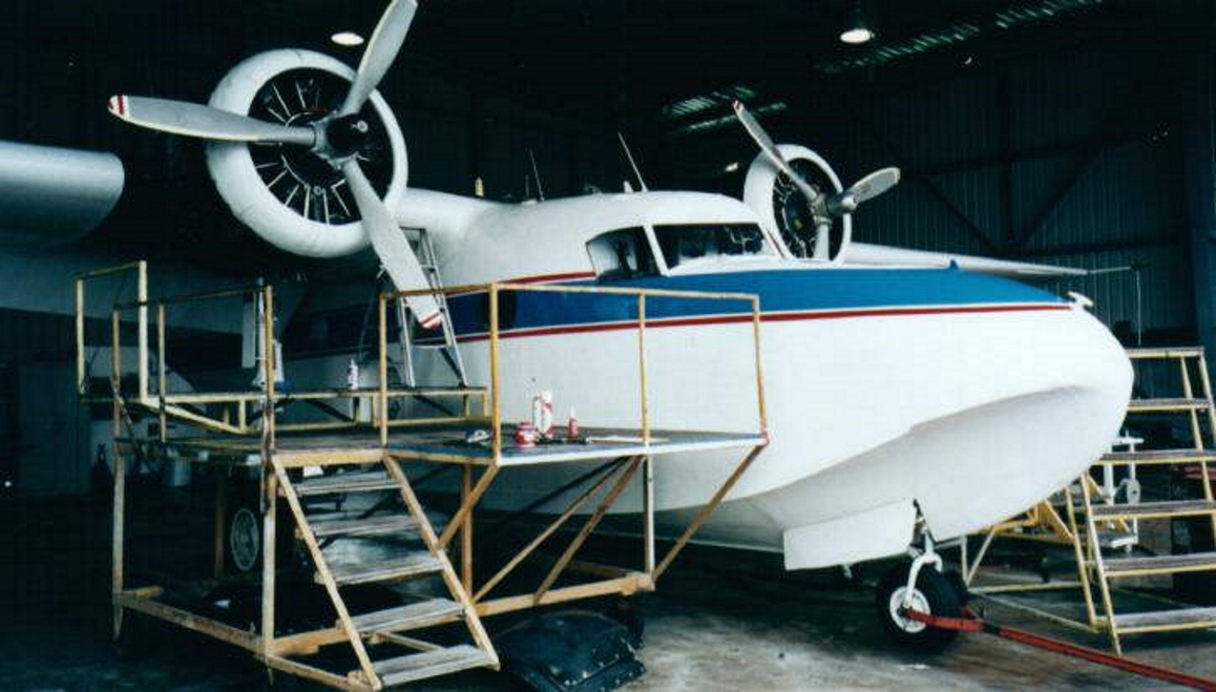
Grumman G-73 Mallard | |
|---|---|
| País | Eua |
| Papel | Avião anfíbio |
| Primeiro voo | 30 de abril de 1946 |
| Construído | 59 |
O Grumman G-73 Pato-real é uma aeronave anfíbia bimotora média. Muitos foram modificados substituindo os motores radiais originais Pratt & Whitney Wasp H por motores turboélice modernos. Fabricado de 1946 a 1951, a produção terminou quando o SA-16 Albatross maior da Grumman foi introduzido.
| Grumman G-73 Mallard Walk Around | |
|---|---|
| Fotógrafo | Vladimir Yakubov |
| Localização | Museu Nacional do Ar & Espaço |
| Fotos | 142 |

| Grumman Mallard Walk Around | |
|---|---|
| Fotógrafo | Greg Knowles |
| Localização | Desconhecido |
| Fotos | 27 |
Veja também:


O Grumman G-73 Pato-real is a twin-engine amphibious aircraft designed and built by Grumman Aircraft Engineering Corporation in the late 1940s. It is a larger and more powerful version of the earlier Grumman Goose, with a longer fuselage, higher wing loading, and retractable landing gear. The Mallard can carry up to 17 passengers or 2,500 lb (1,134 kg) of cargo, and can operate from land or water.
It has a cruising speed of 191 mph (307 km/h) and a range of 1,055 mi (1,698 km). The Mallard was used by various civilian operators for charter flights, air taxi services, aerial photography, and sightseeing tours. It was also adopted by some military and government agencies for utility and transport roles. Some Mallards were modified with turboprop engines for improved performance and reliability. The Mallard was produced from 1946 to 1951, with a total of 59 aircraft built. It is one of the few amphibious aircraft still in service today, with some examples preserved in museums or flying as historic aircraft.
Visualizações : 3215
Você pode ver também:
 Northrop Grumman X-47B – Fotos e Vídeos
 Northrop Grumman EA-6B Prowler – Fotos e Vídeo
 Grumman E-1 Tracer – Fotos e Vídeo
 Grumman F-9 Cougar – Fotos & Vídeo
 Grumman F9F Panther – Fotos & Vídeo
 Grumman F6F Hellcat – Fotos & Vídeo
 C-2A Greyhound – Fotos e Vídeo
 Grumman S-2 Tracker – Fotos e Vídeo
 Grumman F-11A Tiger – Fotos & Vídeo
 Grumman F8F Bearcat – Fotos & Vídeo