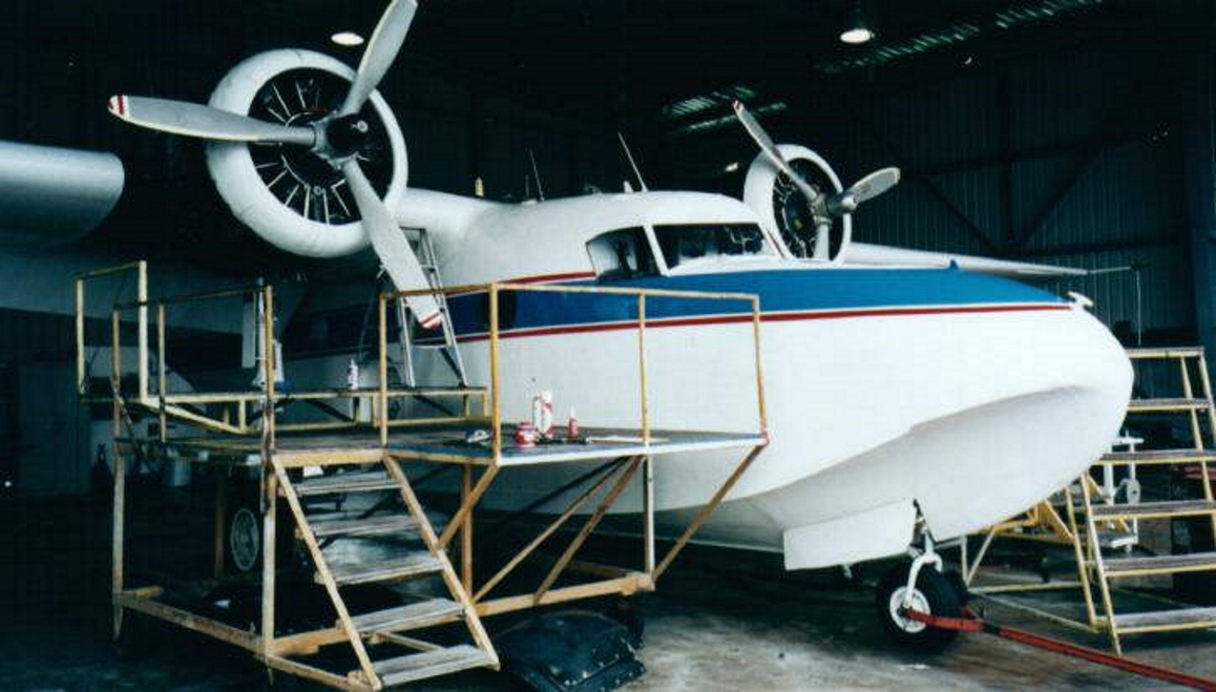
Grumman G-73 Mallard | |
|---|---|
| Land | Usa |
| Roll | Amfibieflygplan |
| Första flygningen | 30 april 1946 |
| Byggd | 59 |
Den Grumman G-73 Gräsand är ett medelstort, tvåmotorigt amfibieflygplan. Många har modifierats genom att ersätta de ursprungliga Pratt & Whitney Wasp H radialmotorerna med moderna turbopropmotorer. Serien tillverkades mellan 1946 och 1951 och upphörde när Grummans större SA-16 Albatross introducerades.
Källkod: Grumman G-73 Gräsand på Wikipedia
| Grumman G-73 Mallard Walk Around | |
|---|---|
| Fotograf | Vladimir Yakubov |
| Lokalisering | Nationella luft- och rymdmuseet |
| Bilder | 142 |

| Grumman Mallard Walk Around | |
|---|---|
| Fotograf | Greg Knowles |
| Lokalisering | Unknow |
| Bilder | 27 |
Se även:


Den Grumman G-73 Gräsand is a twin-engine amphibious aircraft designed and built by Grumman Aircraft Engineering Corporation in the late 1940s. It is a larger and more powerful version of the earlier Grumman Goose, with a longer fuselage, higher wing loading, and retractable landing gear. The Mallard can carry up to 17 passengers or 2,500 lb (1,134 kg) of cargo, and can operate from land or water.
It has a cruising speed of 191 mph (307 km/h) and a range of 1,055 mi (1,698 km). The Mallard was used by various civilian operators for charter flights, air taxi services, aerial photography, and sightseeing tours. It was also adopted by some military and government agencies for utility and transport roles. Some Mallards were modified with turboprop engines for improved performance and reliability. The Mallard was produced from 1946 to 1951, with a total of 59 aircraft built. It is one of the few amphibious aircraft still in service today, with some examples preserved in museums or flying as historic aircraft.
Views : 3215
Du kan också se:
 Northrop Grumman X-47B – Foton & Videor
 Northrop Grumman EA-6B Prowler – Bilder &; Video
 Grumman E-1 Tracer – Foton & Video
 Grumman F-9 Cougar – Foton &; Video
 Grumman F9F Panther – Foton &; Video
 Grumman F6F Hellcat – Foton &; Video
 C-2A Greyhound – Foton &; Video
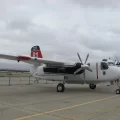 Grumman S-2 Tracker – Foton &; Video
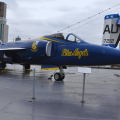 Grumman F-11A Tiger – Foton &; Video
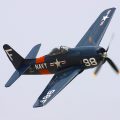 Grumman F8F Bearcat – Foton &; Video