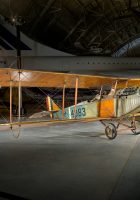
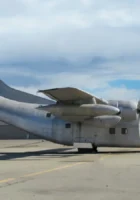
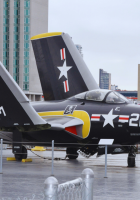
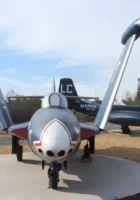
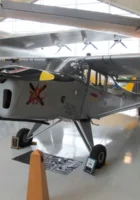
Spijker V.2

Spijker V.2

CountryNetherlands
RoleDual control training aircraft
First flyMarch 1917
Built78

The Spijker V.2, sometimes anglicized to Spyker V.2 or Spyker-Trompenburg V.2, was a low powered, tandem seat biplane designed and built for the Dutch government for pilot training towards the end of World War I. More than seventy were built.

Source: Spijker V.2 on Wikipedia

Continue reading

Views : 2028

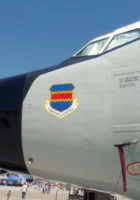
Boeing RC-135W Rivet Joint

Boeing RC-135

CountryUSA
RoleReconnaissance aircraft
StatusActive
Built32

The Boeing RC-135 is a family of large reconnaissance aircraft built by Boeing and modified by a number of companies, including General Dynamics, Lockheed, LTV, E-Systems, and L3 Technologies, and used by the United States Air Force and Royal Air Force to support theater and national level intelligence consumers with near real-time on-scene collection, analysis and dissemination capabilities. Based on the C-135 Stratolifter airframe, various types of RC-135s have been in service since 1961. Unlike the C-135 and KC-135 which are recognized by Boeing as the Model 717, the RC-135 is internally designated as the Model 739 by the company. Many variants have been modified numerous times, resulting in a large variety of designations, configurations, and program names.

Source: Boeing RC-135 on Wikipedia
Continue reading

Views : 3585

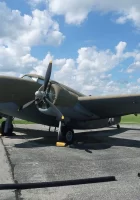
Lockheed C-60A Lodestar

Lockheed Model 18 Lodestar

CountryUSA
RolePassenger transport
First flightSeptember 21, 1939
Built625

The Lockheed Model 18 Lodestar is a passenger transport aircraft of the World War II era. When the United States started to build up its military air strength in 1940–41, many American-operated Lodestars were impressed as the C-56. This was followed by the construction of many new-build Lodestars which were flown by the U.S. Army Air Forces as the C-60 and by the U.S. Navy and U.S. Marine Corps as the R5O. Lend-lease aircraft were used by the RNZAF as transports.

Source: Lockheed Model 18 Lodestar on Wikipedia

Continue reading

Views : 3942

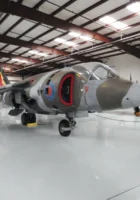
Harrier GR.3

Hawker Siddeley Harrier

CountryUK
RoleV/STOL ground-attack aircraft
First flight28 December 1967
Built278

The Hawker Siddeley Harrier, developed in the 1960s, was the first of the Harrier Jump Jet series of aircraft. It was the first operational close-support and reconnaissance fighter aircraft with vertical/short takeoff and landing (V/STOL) capabilities and the only truly successful V/STOL design of the many that arose in that era. The Harrier was developed directly from the Hawker Siddeley Kestrel prototype aircraft, following the cancellation of a more advanced supersonic aircraft, the Hawker Siddeley P.1154. The British Royal Air Force (RAF) ordered the Harrier GR.1 and GR.3 variants in the late 1960s. It was exported to the United States as the AV-8A, for use by the US Marine Corps (USMC), in the 1970s.

Source: Hawker Siddeley Harrier on Wikipedia

Continue reading

Views : 9087

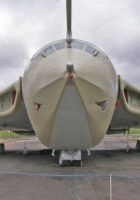
Handley Page HP 80 Victor Mk.2

Handley Page Victor

CountryUK
RoleStrategic bomber or aerial refueling tanker aircraft
First flight24 December 1952
Built86

The Handley Page Victor was a British jet-powered strategic bomber, developed and produced by the Handley Page Aircraft Company, which served during the Cold War. It was the third and final of the V-bombers operated by the Royal Air Force (RAF), the other two V-bombers being the Avro Vulcan and the Vickers Valiant. The Victor had been developed to perform as part of the United Kingdom’s airborne nuclear deterrent. In 1968, the type was retired from the nuclear mission following the discovery of fatigue cracks, which had been exacerbated by the RAF’s adoption of a low-altitude flight profile to avoid interception.

Source: Handley Page Victor on Wikipedia

Continue reading

Views : 3605

Curtiss JN-4D Jenny

Curtiss JN-4D Jenny

CountryUSA
RoleTrainer aircraft
Introduction1915
Built6813

The Curtiss JN-4 “Jenny” was one of a series of “JN” biplanes built by the Curtiss Aeroplane Company of Hammondsport, New York, later the Curtiss Aeroplane and Motor Company. Although the Curtiss JN series was originally produced as a training aircraft for the U.S. Army, the “Jenny” (the common nickname derived from “JN-4”, with an open-topped four appearing as a Y) continued after World War I as a civil aircraft, as it became the “backbone of American postwar aviation.” Thousands of surplus Jennys were sold at bargain prices to private owners in the years after the war and became central to the barnstorming era that helped awaken America to civil aviation through much of the 1920s.

Source: Curtiss JN-4D Jenny on Wikipedia

Continue reading

Views : 4827

Fairchild C-123K Provider

Fairchild C-123 Provider

CountryUSA
RoleFighter aircraft
First flight20 September 1951
Manufacturer1988

The Fairchild C-123 Provider is an American military transport aircraft designed by Chase Aircraft and subsequently built by Fairchild Aircraft for the United States Air Force. In addition to its USAF service, which included later service with the Air Force Reserve and Air National Guard, it also went on to serve most notably with the United States Coast Guard and various air forces in South East Asia. During the Vietnam War, the aircraft was used to spray Agent Orange.

Source: Fairchild C-123 Provider on Wikipedia

Continue reading

Views : 5269

F9F-8

Grumman F-9 Cougar

CountryUSA
RoleFighter aircraft
First flight20 September 1951
Manufacturer1988

The Grumman F9F/F-9 Cougar was an aircraft carrier-based fighter aircraft for the United States Navy and United States Marine Corps. Based on Grumman’s earlier F9F Panther, the Cougar replaced the Panther’s straight wing with a more modern swept wing. Thrust was also increased. The Navy considered the Cougar an updated version of the Panther, despite having a different official name, and thus Cougars started off from F9F-6 upward.

Source: Grumman F-9 Cougar on Wikipedia

Continue reading

Views : 6354

Grumman F9F-2 Panther

Grumman F9F Panther

CountryUSA
RoleFighter-bomber
First flight21 November 1947
Built1382

The Grumman F9F Panther was the manufacturer’s first jet fighter and one of the United States Navy’s first successful carrier-based jet fighters. A single-engined, straight-winged day fighter, it was armed with four 20 mm (0.79 in) cannon and could carry a wide assortment of air-to-ground munitions. The Panther was used extensively by the U.S. Navy and Marine Corps in the Korean War. It was also the first jet aircraft used by the Blue Angels flight team, used by them from 1949 through late 1954. The aircraft was exported to Argentina and was the first jet used by the Argentine Naval Aviation. Total F9F production was 1,382. The design evolved into the swept wing Grumman F-9 Cougar.

Source: Grumman F9F Panther on Wikipedia

Continue reading

Views : 7542