Vought RGM-6 Regulus I

SSM-N-8 Regulus

CountryUSA
RoleCruise missile
In service1955-64
ManufacturerChance Vought

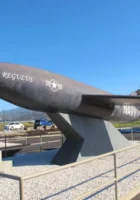
The SSM-N-8A Regulus or the Regulus I was a United States Navy-developed ship-and-submarine-launched, nuclear-capable turbojet-powered second generation cruise missile, deployed from 1955 to 1964. Its development was an outgrowth of U.S. Navy tests conducted with the German V-1 missile at Naval Air Station Point Mugu in California. Its barrel-shaped fuselage resembled that of numerous fighter aircraft designs of the era, but without a cockpit. Test articles of the Regulus were equipped with landing gear and could take off and land like an airplane. When the missiles were deployed they were launched from a rail launcher, and equipped with a pair of Aerojet JATO bottles on the aft end of the fuselage.

Source: SSM-N-8 Regulus on Wikipedia

Continue reading

Views : 1893

USS Midway (CV-41)

USS Midway (CV-41)

CountryUSA
RoleAircraft carrier
Launched20 March 1945
Out of service1992

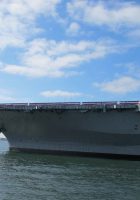
USS Midway (CVB/CVA/CV-41) was an aircraft carrier of the United States Navy, the lead ship of her class. Commissioned a week after the end of World War II, Midway was the largest ship in the world until 1955, as well as the first U.S. aircraft carrier too big to transit the Panama Canal. A revolutionary hull design, based on the planned Montana-class battleship, gave her enhanced protection compared to previous carriers. She operated for 47 years, during which time she saw action in the Vietnam War and served as the Persian Gulf flagship in 1991’s Operation Desert Storm. Decommissioned in 1992, she is now a museum ship at the USS Midway Museum, in San Diego, California, and the only remaining U.S. aircraft carrier commissioned right after World War II ended that was not an Essex-class aircraft carrier.

Source: USS Midway (CV-41) on Wikipedia

Continue reading

Views : 3853

Hawker Sea Hawk

Hawker Sea Hawk

CountryUK
RoleNaval fighter
First fly2 September 1947
Built542

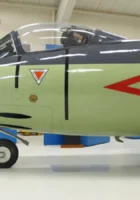
The Hawker Sea Hawk is a British single-seat jet fighter of the Fleet Air Arm (FAA), the air branch of the Royal Navy (RN), built by Hawker Aircraft and its sister company, Armstrong Whitworth Aircraft. Although its origins stemmed from earlier Hawker piston-engined fighters, the Sea Hawk became the company’s first jet aircraft. Following the type’s acceptance in the RN, the Sea Hawk proved to be a reliable and sturdy workhorse. A considerable number were also produced for the export market, and were operated from aircraft carriers in both Dutch and Indian service. The last operational Sea Hawks, operated by the Indian Navy, were retired in 1983.

Source: Hawker Sea Hawk on Wikipedia

Continue reading

Views : 5146

Dornier DO-228-212

Dornier Do-228

CountryGermany
RoleAirliner
First flyMarch 28, 1981
Built245+125

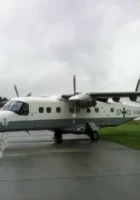
The Dornier Do 228 is a twin-turboprop STOL utility aircraft, manufactured by Dornier GmbH (later DASA Dornier, Fairchild-Dornier) from 1981 until 1998. In 1983, Hindustan Aeronautics (HAL) bought a production licence and manufactured 125 aircraft. In Oberpfaffenhofen, Germany, 245 were built, and 125 in Kanpur, India. In July 2017, 63 aircraft were in airline service. In 2009, RUAG started building a Dornier 228 New Generation in Germany with the fuselage, wings and tail unit manufactured by Hindustan Aeronautics Limited (HAL) in Kanpur (India) and transported to Oberpfaffenhofen near Munich, where RUAG Aviation carries out aircraft final assembly, customized equipment installation, product conformity inspection and aircraft delivery. It is basically the same aircraft with improved technologies and performances, such as a new five blade propeller, glass cockpit and longer range. The first delivery was made in September 2010 to a Japanese operator.

Source: Dornier Do-228 on Wikipedia

Continue reading

Views : 3068

Spijker V.2

Spijker V.2

CountryNetherlands
RoleDual control training aircraft
First flyMarch 1917
Built78

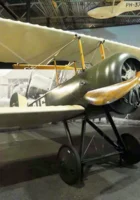
The Spijker V.2, sometimes anglicized to Spyker V.2 or Spyker-Trompenburg V.2, was a low powered, tandem seat biplane designed and built for the Dutch government for pilot training towards the end of World War I. More than seventy were built.

Source: Spijker V.2 on Wikipedia

Continue reading

Views : 1822

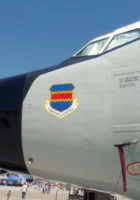
Boeing RC-135W Rivet Joint

Boeing RC-135

CountryUSA
RoleReconnaissance aircraft
StatusActive
Built32

The Boeing RC-135 is a family of large reconnaissance aircraft built by Boeing and modified by a number of companies, including General Dynamics, Lockheed, LTV, E-Systems, and L3 Technologies, and used by the United States Air Force and Royal Air Force to support theater and national level intelligence consumers with near real-time on-scene collection, analysis and dissemination capabilities. Based on the C-135 Stratolifter airframe, various types of RC-135s have been in service since 1961. Unlike the C-135 and KC-135 which are recognized by Boeing as the Model 717, the RC-135 is internally designated as the Model 739 by the company. Many variants have been modified numerous times, resulting in a large variety of designations, configurations, and program names.

Source: Boeing RC-135 on Wikipedia

Continue reading

Views : 3300

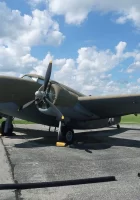
Lockheed C-60A Lodestar

Lockheed Model 18 Lodestar

CountryUSA
RolePassenger transport
First flightSeptember 21, 1939
Built625

The Lockheed Model 18 Lodestar is a passenger transport aircraft of the World War II era. When the United States started to build up its military air strength in 1940–41, many American-operated Lodestars were impressed as the C-56. This was followed by the construction of many new-build Lodestars which were flown by the U.S. Army Air Forces as the C-60 and by the U.S. Navy and U.S. Marine Corps as the R5O. Lend-lease aircraft were used by the RNZAF as transports.

Source: Lockheed Model 18 Lodestar on Wikipedia

Continue reading

Views : 3714

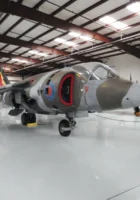
Harrier GR.3

Hawker Siddeley Harrier

CountryUK
RoleV/STOL ground-attack aircraft
First flight28 December 1967
Built278

The Hawker Siddeley Harrier, developed in the 1960s, was the first of the Harrier Jump Jet series of aircraft. It was the first operational close-support and reconnaissance fighter aircraft with vertical/short takeoff and landing (V/STOL) capabilities and the only truly successful V/STOL design of the many that arose in that era. The Harrier was developed directly from the Hawker Siddeley Kestrel prototype aircraft, following the cancellation of a more advanced supersonic aircraft, the Hawker Siddeley P.1154. The British Royal Air Force (RAF) ordered the Harrier GR.1 and GR.3 variants in the late 1960s. It was exported to the United States as the AV-8A, for use by the US Marine Corps (USMC), in the 1970s.

Source: Hawker Siddeley Harrier on Wikipedia

Continue reading

Views : 8867

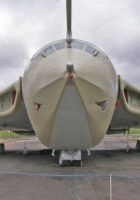
Handley Page HP 80 Victor Mk.2

Handley Page Victor

CountryUK
RoleStrategic bomber or aerial refueling tanker aircraft
First flight24 December 1952
Built86

The Handley Page Victor was a British jet-powered strategic bomber, developed and produced by the Handley Page Aircraft Company, which served during the Cold War. It was the third and final of the V-bombers operated by the Royal Air Force (RAF), the other two V-bombers being the Avro Vulcan and the Vickers Valiant. The Victor had been developed to perform as part of the United Kingdom’s airborne nuclear deterrent. In 1968, the type was retired from the nuclear mission following the discovery of fatigue cracks, which had been exacerbated by the RAF’s adoption of a low-altitude flight profile to avoid interception.

Source: Handley Page Victor on Wikipedia

Continue reading

Views : 3443

Curtiss JN-4D Jenny

Curtiss JN-4D Jenny

CountryUSA
RoleTrainer aircraft
Introduction1915
Built6813

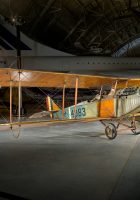
The Curtiss JN-4 “Jenny” was one of a series of “JN” biplanes built by the Curtiss Aeroplane Company of Hammondsport, New York, later the Curtiss Aeroplane and Motor Company. Although the Curtiss JN series was originally produced as a training aircraft for the U.S. Army, the “Jenny” (the common nickname derived from “JN-4”, with an open-topped four appearing as a Y) continued after World War I as a civil aircraft, as it became the “backbone of American postwar aviation.” Thousands of surplus Jennys were sold at bargain prices to private owners in the years after the war and became central to the barnstorming era that helped awaken America to civil aviation through much of the 1920s.

Source: Curtiss JN-4D Jenny on Wikipedia

Continue reading

Views : 4628