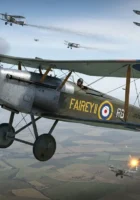
Fairey III war

Fairey III

CountryUK
Rolereconnaissance aircraft
First flight14 September 1917
Built964

The Fairey Aviation Company Fairey III was a family of British reconnaissance biplanes that enjoyed a very long production and service history in both landplane and seaplane variants. First flying on 14 September 1917, examples were still in use during the Second World War.

Source: Fairey III on Wikipedia

Continue reading

Views : 640

Macchi M72

Macchi M.C.72

CountryItaly
RoleSeaplane racing aircraft
First flightJuly 1931
Built5

The Macchi M.C. 72 is an experimental seaplane designed and built by the Italian aircraft company Macchi Aeronautica. The M.C. 72 held the world speed record for all aircraft for five years. In 1933 and 1934 it set world speed records for piston engine-powered seaplanes; the latter still stands.

Source: Macchi M.C.72 on Wikipedia

Continue reading

Views : 1913

ZMAJ Fizir FN Mars Walter I

Zmaj Fizir FN

CountryYugoslav
RoleTrainer aircraft
First flightMay 1929
Built206 + 4 floatplane

The Zmaj Fizir FN (Serbian Cyrillic: Змај Физир ФН) was a plane designed for primary (initial) training of pilots in Yugoslavia before World War II. It was constructed in Zmaj, a Zemun-based factory, in the Rogožarski factory in Belgrade, and Albatros in Sremska Mitrovica. Fizir FN had an exceptional low-speed stability, a desirable trait for a training aircraft, and was reliable and easy to maintain. It was also widely used as a sport aircraft.

Source: Zmaj Fizir FN on Wikipedia

Continue reading

Views : 729

Object 770

Object 770

CountrySoviet Union
RoleHeavy tank
Produced1957
Built1 prototype

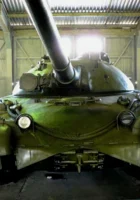
The Obiekt 770, or Object 770, was a prototype heavy tank designed by Pavel Isakov. The hull of the Object 770 had a sloped front like the T-54. The tank was manned by a crew of 4. The Object 770 had an NBC protection system. The turret was mounted in the front while the engine is located at the rear. The Object 770 had a dome-shaped 3 man turret. The turret houses the 130 mm M-65 gun). The gun had a gun stabilizer and an autoloader. Day and night sighting devices were also installed in the turret. Ammunition consists of 37 rounds. A 1x 14.5mm KPVT machine gun is located in a mount behind the rear of the turret for anti-aircraft defense. The Object 770 had six roadwheels and no support rollers. The tank had a hydropneumatic suspension for crew comfort and better accuracy. The tank was powered by a 10-cylinder, four-stroke, DST-10 experimental diesel engine. The engine also had a supercharger. The engine can output 1000 hp and allow the tank to cruise at 55 km/h.

Source: Object 770 on Wikipedia

Continue reading

Views : 983

Tank Infantry A43 Black Prince

Tank Infantry A43 Black Prince

CountryUK
RoleInfantry tank
Produced1945
Built6 prototypes

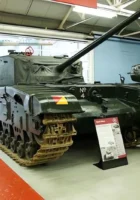
Tank, Infantry, Black Prince (A43) is the name that was assigned to an experimental development of the Churchill tank with a larger, wider hull and a QF 17-pounder (76 mm) gun. It was named after Edward, the Black Prince, a famous 14th century military leader.

Source: Tank Infantry A43 Black Prince on Wikipedia

Continue reading

Views : 973

TOG II

TOG2

CountryUK
RoleSuper-heavy tank
Produced1941
Built1 prototype

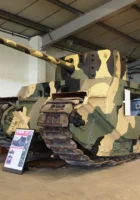
The Tank, Heavy, TOG II was a prototype British tank design produced in the early part of the Second World War in case the battlefields of northern France devolved into a morass of mud, trenches and craters as had happened during the First World War. When this did not happen the tank was deemed unnecessary and the project terminated. A development of the TOG I design, only a single prototype was built before the project was dropped.

Source: TOG2 on Wikipedia

Continue reading

Views : 1207

SU-14-2

SU-14

CountrySoviet Union
RoleSelf-propelled gun
Built2 prototypes

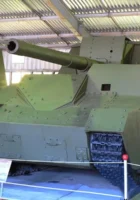
The SU-14 was a prototype Soviet heavy self-propelled gun built on a T-35 chassis. The original prototype mounted a 152 mm gun M1935 (Br-2); the SU-14-1 variant of 1936 carried a 203 mm gun B-4 which could fire 48.9 kilogram shells at ranges up to 25 km. Its armour was 20 to 50 mm thick. It never entered serial production.

Source: SU-14 on Wikipedia

Continue reading

Views : 538

BO-105 PAH

MBB Bo 105

CountryWest Germany
RoleLight utility helicopter
First flight6 February 1967
Built1500+

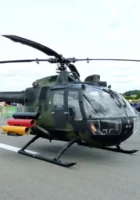
The Messerschmitt-Bölkow-Blohm Bo 105 is a light, twin-engine, multi-purpose helicopter developed by Bölkow of Ottobrunn, West Germany. It was the first light twin-engine helicopter in the world, and the first rotorcraft that could perform aerobatic maneuvers such as inverted loops. The Bo 105 features a revolutionary hingeless rotor system, a pioneering innovation in helicopters when it was introduced into service in 1970. Production of the Bo 105 began at the then-recently merged Messerschmitt-Bölkow-Blohm (MBB). The main production facilities for producing the Bo 105 were located in Germany and Canada; due to the level of export sales encountered, additional manufacturing lines were set up in Spain, Indonesia, and the Philippines. MBB became a part of Eurocopter in 1991, who continued production of the type until 2001. The Bo 105 was formally replaced in Eurocopter’s product range by the newer Eurocopter EC135.

Source: MBB Bo 105 on Wikipedia

Continue reading

Views : 1298

Grumman F9F Panther war

Grumman F9F Panther

CountryUSA
RoleFighter-bomber
First flight21 November 1947
Built1382

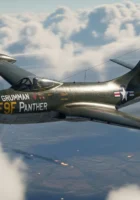
The Grumman F9F Panther was the manufacturer’s first jet fighter and one of the United States Navy’s first successful carrier-based jet fighters. A single-engined, straight-winged day fighter, it was armed with four 20 mm (0.79 in) cannon and could carry a wide assortment of air-to-ground munitions. The Panther was used extensively by the U.S. Navy and Marine Corps in the Korean War. It was also the first jet aircraft used by the Blue Angels flight team, used by them from 1949 through late 1954. The aircraft was exported to Argentina and was the first jet used by the Argentine Naval Aviation. Total F9F production was 1,382. The design evolved into the swept wing Grumman F-9 Cougar.

Source: Grumman F9F Panther on Wikipedia

Continue reading

Views : 5401

Mitsubishi J8M1 Shusui

Mitsubishi J8M1 Shusui

CountryJapan
RoleRocket-powered interceptor aircraft
First flight7 July 1945
Built7

The Mitsubishi J8M Shūsui was a Japanese World War II rocket-powered interceptor aircraft closely based on the German Messerschmitt Me 163 Komet. Built as a joint project for both the Navy and the Army Air Services, it was designated J8M (Navy) and Ki-200 (Army).

Source: Mitsubishi J8M1 Shusui on Wikipedia

Continue reading

Views : 3270