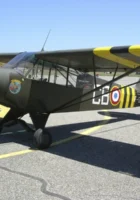
Piper PA-18 Super Cub

Piper PA-18

Country USA
Role Light utility aircraft
First flight 1949
Built 10326
 
The Piper PA-18 Super Cub is a two-seat, single-engine monoplane. Introduced in 1949 by Piper Aircraft, it was developed from the Piper PA-11, and traces its lineage back through the J-3 to the Taylor E-2 Cub of the 1930s. In close to 40 years of production, over 10,000 were built. Super Cubs are commonly found in roles such as bush flying, banner towing and glider towing.
Source: Piper PA-18 on Wikipedia
Continue reading

Views : 1738

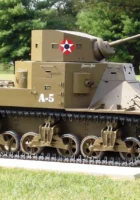
M2A1 Light Tank

M2 light tank

CountryUSA
RoleLight tank
Produced1935–42
Built698

The M2 light tank, officially Light Tank, M2, was an American pre–World War II light tank which saw limited use during World War II. The most common model, the M2A4, was equipped with one 37 mm (1.5 in) M5 gun and five .30 cal M1919 Browning machine guns. It was originally developed from the prototype T2 light tank built by Rock Island Arsenal, which had a Vickers-type leaf spring suspension. The suspension was replaced by the superior vertical volute system in the T2E1 series of 1935. This was put into production with minor modifications as the M2A1 in 1936, with ten produced. The main pre-war version was the M2A2, with 239 produced, becoming the main tank in the US Army infantry units in the interwar period. The Spanish Civil War showed that tanks armed only with machine guns were ineffective. This led to the M2A4 with a 37 mm gun as the main armament. A total of 375 were delivered, the last ten as late as April 1942.

Source: M2 light tank on Wikipedia
Continue reading

Views : 1845

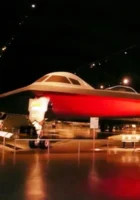
Northrop B-2 Spirit

Northrop Grumman B-2 Spirit

CountryUSA
RoleStealth strategic heavy bomber
First flight17 July 1989
Built21

The Northrop (later Northrop Grumman) B-2 Spirit, also known as the Stealth Bomber, is an American heavy strategic bomber, featuring low observable stealth technology designed for penetrating dense anti-aircraft defenses. Designed during the Cold War, it is a flying wing design with a crew of two. The bomber is subsonic and can deploy both conventional and thermonuclear weapons, such as up to eighty 500-pound class (230 kg) Mk 82 JDAM GPS-guided bombs, or sixteen 2,400-pound (1,100 kg) B83 nuclear bombs. The B-2 is the only acknowledged aircraft that can carry large air-to-surface standoff weapons in a stealth configuration.

Source: Northrop Grumman B-2 Spirit on Wikipedia

Continue reading

Views : 1345

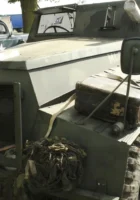
Morris Armoured Car

Morris CS9

CountryUK
RoleLight Armoured Car
Period1936+
BuiltUnknow

The vehicle was based on a Morris Commercial C9 4×2 15 long cwt (760 kg) truck chassis. On this chassis, a riveted hull was mounted with an open-topped two-man turret. The armament consisted of either Boys anti-tank rifle and Bren light machine gun or Vickers machine gun. The vehicle carried a No. 19 radio set. The prototype was tested in 1936. A further 99 cars were ordered and were delivered in 1938. Thirty-eight of these cars were used by the 12th Royal Lancers in the Battle of France, where all of them were destroyed or abandoned. Another 30 served with the 11th Hussars in the North African Campaign. It was found that, when fitted with desert tyres, the vehicle had good performance on soft sand. However, its armour and armament were insufficient. The vehicle was retired halfway through the North African Campaign.

Source: Morris CS9 on Wikipedia

Continue reading

Views : 1534

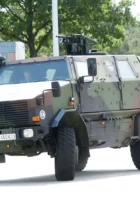
ATF Dingo 2A2-A2.3

ATF Dingo

CountryGermany
RoleInfantry mobility vehicle
In service2000 – Present
BuiltUnknow

The ATF Dingo is a German heavily armored military MRAP infantry mobility vehicle based on a Unimog chassis with a V-hull design, produced by the company Krauss-Maffei Wegmann (KMW). The first prototype of the Dingo 1 was completed in 1995 and the first production Dingo 1 entered service in 2000 with the German Army. It is designed to withstand land mines, rifle fire, artillery fragments and NBC-threats. ATF stands for Allschutz-Transport-Fahrzeug, meaning all-protected transport vehicle in German. It is named after the Australian native dog, the dingo. The Dingo 2 entered service in late 2004 after undergoing trials from November 2003-May 2004. Currently KMW is developing the Dingo 2 GFF for the German Army with increased internal volume. Textron signed an exclusive deal to produce and market KMW’s Dingo in the United States. However, Textron chose its own more expensive and heavier M1117 Armored Security Vehicle for the MRAP competition, which did not receive a contract.

Source: ATF Dingo on Wikipedia

Continue reading

Views : 1752

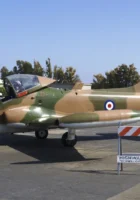
British Aircraft Jet Provost T.Mk.5A

BAC Jet Provost

CountryUK
RoleMilitary trainer aircraft
First flight26 June 1954
Built734

The BAC Jet Provost is a British jet trainer aircraft that was in use with the Royal Air Force (RAF) from 1955 to 1993. It was originally developed by Hunting Percival from the earlier piston engine-powered Percival Provost basic trainer, and later produced by the British Aircraft Corporation (BAC). In addition to the multiple RAF orders, the Jet Provost, sometimes with light armament, was exported to many air forces worldwide. The design was also further developed into a more heavily armed ground attack variant under the name BAC Strikemaster.

Source: BAC Jet Provost on Wikipedia

Continue reading

Views : 1284

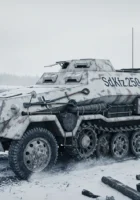
Sd.Kfz. 250 war

Sd.Kfz. 250

CountryGermany
TypeHalf-track armoured personnel carrier
In Service1941–1945
Built6600+

The Sd.Kfz. 250 (German: Sonderkraftfahrzeug 250; ‘special motor vehicle’) was a light armoured half-track, very similar in appearance to the larger Hanomag-designed Sd.Kfz. 251, and built by the DEMAG firm, for use by Nazi Germany in World War II. Most variants were open-topped and had a single access door in the rear. The Sd. Kfz 250 was adopted in 1939 to supplement the standard half-track. Production delays meant that the first vehicle did not appear until mid-1941.

Source: Sd.Kfz. 250 on Wikipedia

Continue reading

Views : 4487

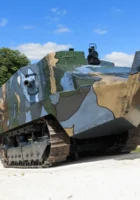
Schneider CA1

Schneider CA1

CountryFrance
TypeHeavy tank
In service1916–1918 (France) / 1921–1936 (Spain)
Built400

The Schneider CA 1 (originally named the Schneider CA) was the first French tank, developed during the First World War. The Schneider was inspired by the need to overcome the stalemate of trench warfare which on the Western Front prevailed during most of the Great War. It was designed specifically to open passages for the infantry through barbed wire and then to suppress German machine gun nests. After a first concept by Jacques Quellennec devised in November 1914, the type was developed from May 1915 onwards by engineer Eugène Brillié, paralleling British development of tanks the same year. Colonel Jean Baptiste Eugène Estienne in December 1915 began to urge for the formation of French armoured units, leading to an order in February 1916 for four hundred Schneider CA tanks, which were manufactured by SOMUA, a subsidiary of Schneider located in a suburb of Paris, between September 1916 and August 1918.

Source: Schneider CA1 on Wkipedia

Continue reading

Views : 2515

Opel Olympia

Opel Olympia

CountryGermany
TypeCar
Production1935–1970
BuiltUnknow

The Opel Olympia is a compact car produced by the German automaker Opel from 1935 to 1940, from 1947 to 1953 and again from 1967 to 1970. The 1935 Olympia was Germany’s first mass-produced car with an all-steel unitized body (monocoque). This revolutionary technology reduced the weight of the car by 180 kilograms (400 lb.) compared to its predecessor. Production of the unibody design required new production methods and materials. Spot welding, advanced types of steel, and a new production line layout were among the many advances introduced by the Olympia.

Source: Opel Olympia on Wikipedia

Continue reading

Views : 2150

Bartini Beriev VVA-14

Bartini Beriev VVA-14

CountrySoviet Union
TypeAmphibious ASW aircraft
First flight4 September 1972
Built2

The Bartini Beriev VVA-14 Vertikaľno-Vzletayushchaya Amfibiya (vertical take-off amphibious aircraft) was a wing-in-ground-effect aircraft developed in the Soviet Union during the early 1970s. Designed to be able to take off from the water and fly at high speed over long distances, it was to make true flights at high altitude, but also have the capability of flying efficiently just above the sea surface, using aerodynamic ground effect. The VVA-14 was designed by Italian-born designer Robert Bartini in answer to a perceived requirement to destroy United States Navy Polaris missile submarines. The final aircraft was retired in 1987.

Source: Bartini Beriev VVA-14 on Wiki

Continue reading

Views : 4052