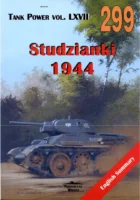
Wydawnictwo Militaria 299 Studzianki 1944

Wydawnictwo Militaria

SerieTank Power
Subject

La bataille de Studzianki

Ref29

A book from Wydawnictwo Militaria «Studzianki battle 1944 – Wydawnictwo 299» .

The Battle of Studzianki, was a tactical engagement between the elements of the Red Army’s 2nd Tank Army employed as the Cavalry mechanized group of the 1st Belorussian Front and elements of the German 9th Army of Army Group North Ukraine defending south of Warsaw. The battle was part of the Soviet Lublin-Brest Offensive Operation. The 2nd Tank Army was launched through the breach in the German 4th Panzer Army’s front between Parczew and Chełm, and bypassing Lublin attempted to find a crossing over the Visla.

In this it was supported by the Polish First Army, including the Polish 1st Armoured Brigade. In a hasty encounter battle during which the Polish 1st Armoured Brigade was located in the first echelon of the 2nd Tank Army. At the point where the Army was able to occupy the Magnuszew brideghead, the Polish brigade engaged advance elements of the counter-attacking German Fallschirm-Panzer Division 1 Hermann Göring with the express orders to deny Vistula crossings to the Red Army. The German counter-attack tried to dislodge the Soviet engineers, and the Polish troops providing support for them, behind Vistula off the bridgehead. The Soviet and Polish forces held the bridgehead, and German forces suffered heavy casualties before withdrawing. To commemorate the battle, in 1969 the name of the village Studzianki was changed to include the word Pancerne, meaning Armoured in Polish language. The episodes 3-5 of Polish TV series Czterej pancerni i pies (Four Tankmen and the Dog) depict the crew of Polish tank during the battle of Studzianki.

Source: Wikipedia

Continue reading

Views : 1201

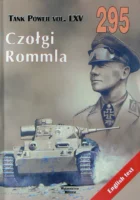
Wydawnictwo Militaria 295 Rommel's Tanks

Wydawnictwo Militaria

SerieTank Power
Sujet

The Tanks of Rommel

Ref295

The book “Wydawnictwo Militaria 295: The Tanks of Rommel” focuses on the tanks used by the Deutsches Afrikakorps (DAK) under General Erwin Rommel’s command during World War II. It provides detailed documentation on the various armored units and their operations in the deserts of Libya, western Egypt, and Tunisia. The author, Janusz Ledwoch, presents information on military tactics, equipment, and the engagements of these tank divisions in the context of the North African campaigns. The book is rich in illustrations and photographs, making it a valuable resource for military history enthusiasts and modelers.

Source: Wikipedia

Continue reading

Views : 730

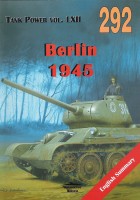
Wydawnictwo Militaria 292 - Berlin 1945

Wydawnictwo Militaria

SérieTank Power
Sujet

Bataille de Berlin 1945

Réf292

Une documentation signée Wydawnictwo Militaria le livre «Bataille de Berlin 1945 – Wydawnictwo 292» .

La bataille de Berlin se déroula de fin avril 1945 au 2 mai 1945. Elle opposa ce qui restait des forces du Troisième Reich à l’Armée rouge. Staline donna une portée symbolique à ce dernier coup porté au régime nazi, après les lourdes pertes subies par les Soviétiques pour inverser le flux de l’invasion.

Source: Wikipedia

Continue reading

Views : 1063

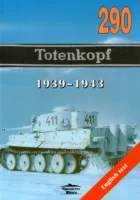
Wydawnictwo Militaria 290 Totenkopf 1939-1943

Wydawnictwo Militaria

SérieTank Power
Sujet

3e Panzerdivision – SS-Totenkopf

Réf290

Une documentation signée Wydawnictwo Militaria le livre «3e Panzerdivision SS Totenkopf – Wydawnictwo 290» .

La 3e Panzerdivision SS Totenkopf était l’une des 38 divisions de Waffen-SS durant la Seconde Guerre mondiale. La division Totenkopf avait pour origine les unités de garde des camps de concentrations, les SS-Totenkopfverbände (« unités SS à tête de mort »). Celles-ci étaient dirigées par Theodor Eicke à partir du 4 juillet 1934, lors de sa nomination comme inspecteur des camps de concentration. Rejoignant la Leibstandarte Adolf Hitler (« régiment de garde d’Adolf Hitler ») et la SS-Verfügunsgstruppe (littéralement « troupe SS à disposition »), les unités Totenkopf constituent l’un des trois piliers de la future Waffen SS. Après la réorganisation de la dénomination et de la numérotation des divisions SS en 1943, elle reçoit la dénomination officielle de 3e panzerdivision SS Totenkopf, aux côtés, entre autres, de la 1re division SS Leibstandarte Adolf Hitler et de la 2e panzerdivision SS Das Reich, issue de la Verfügunsgstruppe. Le 16 octobre 1939, Adolf Hitler autorise le regroupement des régiments Totenkopf pour former une division Waffen-SS. Cette division est intégrée à la 2e Armée pendant les opérations de la campagne de France en mai 1940.

Source: 3e Panzerdivision SS Totenkopf sur Wikipedia

Continue reading

Views : 1446

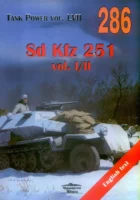
Wydawnictwo Militaria 286 Sd Kfz 251 vol. I-II

Wydawnictwo Militaria

SérieTank Power
Sujet

Sdkfz.251 – Sonderkraftfahrzeug 251

Réf286>

Une documentation signée Wydawnictwo Militaria le livre «Sdkfz.251 – Wydawnictwo 286» .

Le Sonderkraftfahrzeug 251 (SdKfz 251) (littéralement : véhicule de combat spécial) était un véhicule blindé allemand semi-chenillé de combat construit durant la Seconde Guerre mondiale, qui fut produit tout au long du conflit. Il était essentiellement destiné à équiper les Panzerdivisions et les unités de Panzergrenadieren et partageait de nombreux éléments mécaniques avec le SdKfz 7.

Source: Wikipedia

Continue reading

Views : 788

M7 Priest

M7 Priest

PaysUSA
TypeSelf-propelled gun
ManufacturerAmerican Locomotive Company
ProducedApril 1942-July 1945

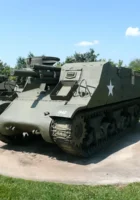
Photo Gallery on an M7 Priest, officially named 105mm Howitzer Motor Carriage M7, the M7 Priest is a self-propelled gun produced during World War II by the United States. Priest is the nickname given by the British, due to the fact that the machine gun placed on a rail gave the impression that the tank was equipped with a pulpit. It followed the English Bishop and they officially called it 105mm SP Priest. (The British liked to give names related to religion to their self-propelled guns (Priest - priest, Bishop , bishop, Sexton - sacristan), a tradition that lasted until the 1960s with the Abbot (abbot).)

Source: M7 Priest on Wikipedia

Continue reading

Views : 7393

Wydawnictwo-Militaria-285-Flammpanzer

Wydawnictwo Militaria

EditeurWydawnictwo Militaria
SérieTank Power
Sujet

Char Flammpanzer

Réf285

Une documentation signée Wydawnictwo Militaria le livre «Flammpanzer – Wydawnictwo 285» .

Le Flammpanzer est un char allemand équipé d’un lance-flamme. Avec le souvenir des combats de rues de Stalingrad à l’esprit, une centaine de Panzer III modèle M furent reconvertis en char lance-flammes. Le canon était remplacé par la nouvelle arme et l’équipage fût réduit à trois. Le blindage frontal était renforcé. Ils furent engagés à Koursk, mais la conversion ne fut pas un succès. La plupart des véhicules furent reconvertis par la suite en chars standards ou en véhicules de dépannage. Production 100 unités de février 1943 à avril 1943.

Source: Wikipedia

Continue reading

Views : 441

Wydawnictwo Militaria 281 Gerat 040-041 ''Karl Morser''

Wydawnictwo Militaria

SérieTank Power
Sujet

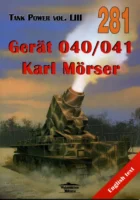
Gerät 040/041 – Karl Mörser

Réf281

Une documentation signée Wydawnictwo Militaria le livre «Gerät 040/041 – Karl Mörser – Wydawnictwo 281» .

Le mortier Karl est la plus grosse pièce d’artillerie automotrice jamais construite. En 1939, une commande fut passée par la Wehrmacht pour créer une arme capable de venir à bout des places fortes. Le résultat fut le mortier “Karlgerät” qui vit le jour à six exemplaires. Ce monstre de 132 tonnes, chargé et nécessitant 107 hommes pour sa mise en opération dont 4 pour le déplacer, allait être capable de démolir 2.5 mètres d’épaisseur de ciment et 45 cm de blindage d’acier. Ne pouvant voyager qu’à 5 km/h, il devra être monté sur deux chariots ferroviaires, un à l’avant et l’autre à l’arrière tout comme le canon “Léopold” pour franchir les grandes distances. Ce n’est qu’à destination qu’il pourra se déplacer par ses propres moyens. Dans ses manœuvres de tirs, il doit être accompagné par un transporteur de munitions munis d’un cric capable de charger les projectiles de 2,2 tonnes qu’il utilise. Ce travail sera confié à un châssis de Panzer IV modifié pour cette fonction.

Source: Mortier Karl sur Wikipedia

Continue reading

Views : 694

Wydawnictwo Militaria 275 T34-85

Wydawnictwo Militaria

SeriesTank Power
Sujet

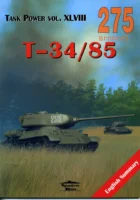
Tank T-34/85

Réf265

Signed documentation Wydawnictwo Militaria the book "Char T-34/85 - Wydawnictwo 275" .

The T-34 was a medium tank that entered service in 1940 with the Red Army. At the time, it was a remarkable balance between the three major factors that defined the quality of an armoured vehicle: firepower, protection and mobility. This success made it one of the Soviet Union's strengths in the face of the invasion of the Wehrmacht. In order to counter it, it will have to revise its armoured design policy by developing, for example, the Panzer-V 'Panther', which borrowed some of its technical features from the T-34. Although quickly surpassed by foreign production, the T-34 remained in production from 1940 to 1958, with a total of units produced estimated at 84,070, making it the second most produced tank of all time, just behind its successors, the T-54 and T-55.

Descended from the BT fast tanks designed by I. Kochkin's team in Kharkov, the T-34 introduced many technological innovations, such as the use of an aluminum alloy diesel engine, wide tracks, and sloping armour plates around the edge. It was not free of defects, moreover, with for example its two-seat turret and its lack of transmission equipment, which made its tactical use quite primary, and caused many losses, but also a questionable mechanical reliability. But like its American counterpart, the Sherman M4, it showed a certain capacity for evolution, and above all a ease of construction that made it available in very large numbers, which ensured an exceptional longevity, 27 countries still using it in 1996. His influence on the development of battle tanks was also certain, as he is often considered one of the tanks used to define the concept of the main battle tank.

Source: Wikipedia

Continue reading

Views : 1096

Wydawnictwo Militaria 274 - Petlyakov Pe-8 TB-7

Wydawnictwo Militaria

SeriesAircraft
Sujet

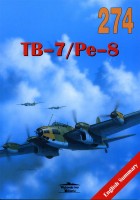
Bombardier TB-7 – Petliakov Pe-8

Réf274

Signed documentation Wydawnictwo Militaria the book "TB-7 – Petliakov Pe-8 – Wydawnictwo 274".

The Petliakov Pe-8 (ANT-42, also TB-7) is a Soviet four-engine heavy bomber designed in 1934 by the design bureau of V.M. Petlyakov led by A. N. Tupolev. The first unit was born in the autumn of 1936, making its first flight on December 27 of that year. The tests carried out revealed that at high altitudes the Pe-8 surpassed all known heavy bombers in speed, and that its flight performance corresponded to that of the best fighters of the time.

Le premier prototype fut appelé « TB-7 » et ce n’est qu’en 1941 ou 1942 que, Vladimir Petliakov prenant la direction du projet, l’on décida d’appeler le bombardier « Petliakov Pe-8 ». « ANT-42 » était la désignation interne du bureau d’études, en référence à Andreï Nikolaïevitch Tupolev. Cependant, l’un des défauts du bombardier résidait dans l’installation d’origine des moteurs AM-34FRN qui ne parvenaient pas à fournir une puissance suffisante. C’est la raison pur laquelle l’appareil fut équipé dès 1940 de moteurs AM-35A avec lesquels il fut produit en série. Au cours de la production en série, les dimensions et la conception de l’appareil ne subirent pratiquement aucun changement, a l’exception de l’installation de différents types de moteurs et de modifications dans l’armement. La production dura jusqu’en 19445. Au total, 93 appareils furent produits6.

Source: Petliakov Pe-8 sur Wikipedia

Continue reading

Views : 538