CAC Boomerang CA-12

CAC Boomerang CA-12

KrajinyAustrália
TypStíhacie lietadlá
FotografVladimír Jakubov
Tému

Album 76 fotografie prechádzky «CAC Boomerang CA-12»

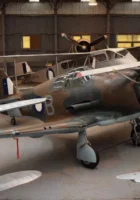
Fotogaléria CAC Boomerang CA-12, The CAC Boomerang was a World War II fighter aircraft designed and manufactured in Australia between 1942 and 1945. The Commonwealth Aircraft Corporation produced Boomerangs under the production contract numbers CA-12, CA-13, CA-14 and CA-19, with aircraft supplied under each subsequent contract incorporating modifications and improvements. The Boomerang is significant as the first combat aircraft designed and built in Australia.

Zdrojový: CAC Boomerang CA-12 na Wikipédii

Pokračovať v čítaní

Prezretí: 5338

Pz87

Pz87

KrajinyŠvajčiarsko
TypHlavný bojový tank
FotografieGunther Neumahr
Tému

Album 50 fotografie nádrže Pz87

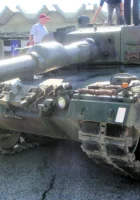
Komisia Leopard 2 (Leopard) is a main battle tank developed by Krauss-Maffei in the 1970s for the West German Army. The tank first entered service in 1979 and succeeded the earlier Leopard 1 as the main battle tank of the German Army. Various versions have served in the armed forces of Germany and 12 other European countries, as well as several non-European nations. More than 3,480 Leopard 2s have been manufactured.[citation needed] The Leopard 2 was used in Kosovo with the German Army and has also seen action in Afghanistan with the Danish and Canadian contributions to the International Security Assistance Force. The 2A4 was also license manufactured in Switzerland as the Panzer 87 (Panzer) "Leopard" alebo Pz 87. Táto verzia obsahovala švajčiarske 7,5 mm Mg 87 guľomety a komunikačné zariadenia a obsahovala vylepšený systém ochrany NBC. Švajčiarsko prevádzkovali 380 tankov Pz 87.

Zdrojový: Pz87 na Wikipédii

Pokračovať v čítaní

Zobrazenia : 3391

Pansarvärnskanonvagn m/43

Pvkv m/43

KrajinyŠvédsko
TypTorpédoborec nádrží
FotografieThord Wedman
Tému

Album 44 fotografie nádrže Pvkv m/43

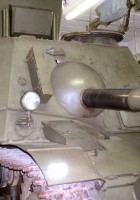
Tank destroyer m / 43 (Pvkv m / 43) was a Swedish combat vehicles that were manufactured in 1947-48. The carriages were built on the same chassis as Strv m / 42 with the superstructure of a lvkanon m / 36. They were originally built to open up but Armétygförvaltningen upgraded them in the 1950s with the roof. 1963 was fitted wagons with sexcylidriga Scania engines from decommissioned Strv m / 41 and m / 40. The carriages were used until the late 1970s. The gearbox was a Volvo VL 420 or Landsverk S-8082.

Zdrojový: Pvkv m/43 na Wikipédii

Pokračovať v čítaní

Zobrazenia : 3399

Pz68 Flakpanzer

Pz68 Flakpanzer

KrajinyŠvajčiarsko
TypFlakpanzer
FotografieGunther Neumahr
Tému

Album 18 fotografie nádrže Pz68 Flakpanzer

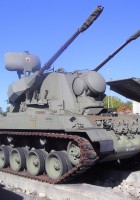
The Panzer 68 was a Swiss main battle tank developed by the Eidgenoessische Konstruktionswerkstaette in Thun in the late 1960s. Fliegerabwehrpanzer 68 : Anti-aircraft Tank 68 – variant fitted with Flakpanzer Gepard turret, mounting two Oerlikon 35mm anti-aircraft guns, on Panzer 68 hull widened by 180 millimetres (7 in); two tanks modified and tested in 1979-1980, not placed into production

Zdrojový: Pz68 Flakpanzer na Wikipédii

Pokračovať v čítaní

Zobrazenia : 2464

PTS-M Obojživelná preprava

PTS-M Obojživelná preprava

KrajinySovietsky zväz
TypTracked Amphibious Transport
Výrobybegun 1965
Body styleWaterproofed hull

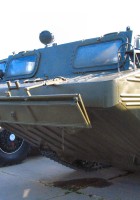
Komisia PTS is a Soviet tracked amphibious transport. PTS stands for Plavayushchij Transportyer – Sryednyj or medium amphibious transport vehicle. Its industrial index was Ob’yekt 65. Introduced in 1965, it is large, with a substantial payload of 10 tons, two to four times the capacity of the BAV 485, and better cross-country performance, at the cost of greater somewhat higher purchase costs because it is tracked. The most common model is the improved PTS-M that is powered by a 350 hp diesel engine. It has a boxy, open watertight hull, with six road wheels per side, front drive sprocket, rear idler sprocket, and no return rollers. Like the BAV 485, and unlike the DUKW, it has a rear loading ramp. The crew is seated at the front, leaving the rear of the vehicle open for a vehicle, which can be driven (or backed) in, rather than lifted over the side. To aid in facilitating this, the engine is under the floor. Propulsion in water is by means of twin propellers, in tunnels to protect them from damage during land operations.

Zdrojový: PTS-M Tracked Amphibious Transport on Wikipedia

Pokračovať v čítaní

Pohľady: 2600

Holandské PRTL

Holandské PRTL

Krajinyholandčina
ÚlohuProtilietadlová delová nádrž

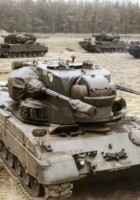
Flugabwehrkanonenpanzer Gepard ("protilietadlový delový tank Geetah", známejší ako Flakpanzer Gepard) je autonómna nemecká samohybná protilietadlová zbraň (SPAAG). Bol vyvinutý v šesťdesiatych rokoch a v 70. rokoch 20.t a bol niekoľkokrát modernizovaný najnovšou elektronikou. Predstavovala základný kameň protivzdušnej obrany nemeckej armády (Bundeswehr) a mnohých ďalších krajín NATO. V Nemecku bol Gepard koncom roka 2010 postupne vyradený a nahradený "SysFla", mobilným a stacionárnym systémom protivzdušnej obrany, ktorý používa raketu LFK NG a nový zbraňový systém MANTIS. Mobilná platforma SysFla bude pravdepodobne založená na GTK Boxer.

Holandský variant : Search radar: X band, 15 km range Tracking radar: X/Ka band, 13 km range The Dutch version was officially called the PRTL (PantserRupsTegenLuchtdoelen translating to “ArmourTrackAgainstAirtargets”), pronounced as “pruttel” (meaning ‘to sputter’) by the soldiers. The Dutch series version was made public through a photograph of a vehicle from a C-Company, the first to be equipped with the new weapon. Traditionally all Dutch vehicles in a company have names beginning with the company designation letter and this vehicle happened to have the individual name Cheetah painted in bold type on its turret. Inevitably the international press assumed “Cheetah” was the Dutch name for their Gepard version and this mistake found its way into most armour publications on the subject. In 2000 the Dutch military authorities, tired of constantly having to explain all this and considering “pruttle” was hardly a martial name anyway, conformed themselves to common error and made “Cheetah” the official designation, when the system was upgraded.

Zdrojový: Holandský PRTL na Wikipédii

Pokračovať v čítaní

Prezretí: 5126

RM-70 MLRS

RM-70 MLRS

KrajinyVýchodné Nemecko
TypViacnásobný raketomet
FotografieRobert De Craeck
Tému

Album 151 fotografie nádrže RM-70 MLRS

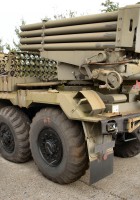
The RM-70 (raketomet vzor 1970) multiple rocket launcher is a Czechoslovakian army version and the heavier variant of the BM-21 Grad multiple rocket launcher, providing enhanced performance over its parent area-saturation artillery system that was introduced in 1971 (but the NATO designation is M1972). RM-70 was developed in Czechoslovakia as a successor for the RM-51, achieving initial operational capability with its Army in 1972. The launcher was being produced in Dubnica nad Váhom (Slovakia). Originally, it was sold to East Germany. After the Soviet Union collapse and the split of Czechoslovakia into the Czech Republic and Slovak Republic, it was sold to several states in Africa, America, Asia and Europe.

Zdrojový: RM-70 MLRS na Wikipédii

Pokračovať v čítaní

Zobrazenia : 3658

Grumman F-11 Tiger

Grumman F-11A Tiger

KrajinySpojené štáty americké
TypNadzvuková stíhačka
Prvý let30. júla 1954
Postavený200

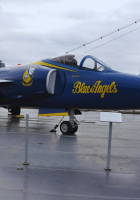
Fotogaléria Grumman F-11A Tiger, The Grumman F11F/F-11 Tiger was the first supersonic, single-seat carrier-based United States Navy fighter aircraft in operation during the 1950s and 1960s. Originally designated the F11F Tiger in April 1955 under the pre-1962 Navy designation system, it was redesignated as F-11 Tiger under the 1962 United States Tri-Service aircraft designation system. The F11F/F-11 was used by the Blue Angels flight team from 1957–1969. Grumman Aircraft Corporation made 200 Tigers, with the last aircraft being delivered to the U.S. Navy on 23 January 1959.

Zdrojový: Grumman F-11A Tiger na Wikipédii

Pokračovať v čítaní

Views : 3452

Mowag Piranha

Piranha 10×10

KrajinyŠvajčiarsko
ÚlohuObrnené bojové vozidlo
Vyrobené1972 – súčasnosť
PostavenýNeznáme

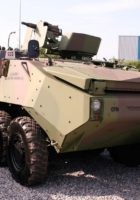
The MOWAG Piranha is a family of armoured fighting vehicles designed by the Swiss company MOWAG (since April 2010 the name has changed to General Dynamics European Land Systems – Mowag GmbH). Five generations of vehicles have been produced, manufactured by Mowag or under licence by other companies, and variants are in service with military forces throughout the world. Piranhas are available in 4×4, 6×6, 8×8, and 10×10 wheel versions. There are several variants within these versions, giving different degrees of armour protection and several kinds of turret, for use in a variety of roles. Piranha derivatives have been assigned roles as troop transports, command vehicles, fire support vehicles, tank trainers, and police vehicles.

Zdrojový: Piranha 10×10 na Wikipédii

Pokračovať v čítaní

Views : 2628

Pansarbandvagn 401

Pansarbandvagn 401

KrajinyŠvédsko
TypViacúčelové pancierové vozidlo
FotografieThord Wedman
Tému

Album 182 fotografie nádrže Pansarbandvagn 401

The MT-LB (Russian: Многоцелевой Тягач Легкий Бронированный, Mnogotselevoy Tyagach Logkiy Bronirovannyi / light multi-purpose armoured towing vehicle) is a Soviet multi-purpose fully amphibious auxiliary armoured tracked vehicle, which was first introduced in the late 1960s. Initially, the vehicle was known as the M 1970 in the west. Swedish MT-LB converted into Pbv 401 Pbv 401 (pansarbandvagn) – modified former East-German vehicle with 7.62 mm machine guns Ksp 95 and Ksp 58. Stripbv 4011 (stridsledningbandvagn) – battalion-level command post. Bgbv 4012 (bärgningsbandvagn) – Swedish designator for the MTP-LB. Rlpbv 4014/T (radiolänkbandvagn) – signals vehicle. Stripbv 4021 (stridsledningbandvagn) – company-level command post. Sjvpbv 4024 (sjukvårdspansarbandvagn) – Military ambulance. Lvrbpbv 4016 (luftvärnsrobotbandvagn) – unconfirmed designator for vehicles, equipped with RBS 70. Pvrbbv 452 (pansarvärnrobotbandvagn) – with RBS 56 BILL 1 Anti-tank guided weapon.

Zdrojový: Pansarbandvagn 401 na Wikipédii

Pokračovať v čítaní

Prezretí: 3609