SKP M-42

SKP M-42

ŠaliesŠvedija
TipasŠarvuotas personalo vežėjas
NuotraukaThordas Wedmanas
Tema

16 nuotraukų albumas "SKP M-42"

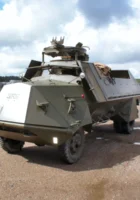
Nuotraukų galerija SKP M-42, Terrängbil m/42 KP (Tgbil m/42 SKP/VKP), meaning “Off-road vehicle 42” with a secondary designation of “Scania, Bodywork: Armoured” or “Volvo, Bodywork: Armoured”, was the Swedish army’s first armoured personnel carrier, developed as a stop-gap measure during World War II. In 1941, when tanks were organized into a unit of their own, it was clear there was a desperate need for a troop carrier able to both keep up with the tanks and provide protection against artillery shrapnel and small-arms fire. Due to the war there were no international suppliers to buy from, so the only option was to develop a domestic solution. AB Landsverk designed an APC consisting of a chassis from a regular army lorry equipped with an armoured shell.

Šaltinis: SKP M-42 Vikipedijoje

Tęsti svarstymą

Views : 2639

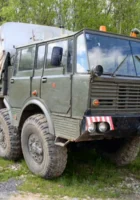
Tatra 813 Kolosas

Tatra 813 Kolosas

ŠaliesČekoslovakija
TipasSunkusis sunkvežimis
Gamybos laikotarpis1967-1982
ĮpėdinisTatra T815

Nuotraukų galerija Tatra 813 Kolosas, Tatra T813 was a truck produced in Czechoslovakia by the Tatra company. The first prototype already built in 1960 utilized existing Tatra T138 assemblies in 4×4 full-time all-wheel drive, which was also another first for Tatra. After the initial trials however the designers decided to develop and expand the concepts onto 8×8 all-wheel-drive all-terrain vehicle. The basis of the design thus became the modular chassis of T813. Successor is the Tatra T815 model.

Šaltinis: Tatra 813 Kolos Vikipedijoje

Tęsti svarstymą

Views : 4051

Sjvpbv 4024

MT-LB Sjvpbv 4024

ŠaliesŠvedija
TipasKarinė greitoji pagalba
FotografasThordas Wedmanas
Tema

Albumas 28 nuotraukos MT-LB Sjvpbv 4024

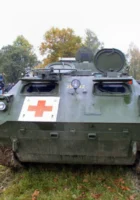
Fotokategorija MT-LB Sjvpbv 4024 , The MT-LB (Russian: Многоцелевой Тягач Легкий Бронированный, Mnogotselevoy Tyagach Logkiy Bronirovannyi / light multi-purpose armoured towing vehicle) is a Soviet multi-purpose fully amphibious auxiliary armoured tracked vehicle, which was first introduced in the late 1960s. Initially, the vehicle was known as the M 1970 in the west. Švedija :Sjvpbv 4024 (sjukvårdspansarbandvagn) – Karinė greitoji pagalba.

Šaltinis: MT-LB Sjvpbv 4024 Vikipedijoje

Tęsti svarstymą

Views : 3216

Merkavoje įsikūrusi Sholef

Merkavos haubica Sholef

ŠaliesIzraelis
TipasSavaeigė artilerija
NuotraukosSasha Levas
Tema

Albumas 23 nuotraukos pasivaikščiojimas po «Merkava Howitzer Sholef»

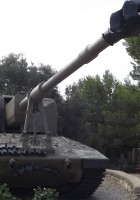
Nuotraukų galerija Merkavos haubica Sholef, Two prototypes of Sholef (“Slammer”, Hebrew slang for “Gunslinger”) 155 mm self-propelled howitzer with automatic loading system were built by Soltam in 1984–1986. The 45-ton vehicle had a long 155 mm gun barrel giving a range of 45+ km. Using GPS, inertial navigation, and an internal fire control computer, it was also capable of direct fire while on the move. It never entered production. The Slammer is a heavily armored artillery gun mounted on a modified Merkava Mk 1 chassis. Many of these vehicles are Merkava Mk 1 that were retired after the Merkava Mk 2 and Merkava Mk 3 came into service. The Slammer has a long 52-caliber gun barrel that allows +10% range. Reload speed may be decreased to 1 for one minute every 10 minutes through use of an automatic loader. Ammunition racks are large. The Slammer is ready for autonomous operation (without an FDC) if the target’s location is known within 15 seconds of a halt, using GPS, inertial navigation, and an internal fire control computer. The Slammer 155 mm self-propelled howitzer is based on a modified Merkava MBT chassis fitted with a new welded steel turret, designed by Soltam Systems. Development commenced in the 1970s. The project was considered of high national priority and incorporated the newest technological developments. Instead the Israeli Defense Forces selected an upgraded version of American M109 howitzer.

Šaltinis: Merkava haubica Sholef Vikipedijoje

Tęsti svarstymą

Views : 3825

Self-propelled 25pdr Sexton

Sexton savaeigis pistoletas

ŠaliesKanada
TipasSavaeigė artilerija
Tarnyboje1943–1956
Pastatytas2150

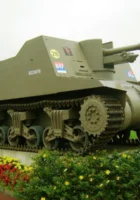
25pdr SP, stebimas, Sekstonas buvo Antrojo pasaulinio karo savaeigė artilerijos transporto priemonė. Jis buvo pagrįstas Kanadoje pagamintomis amerikietiškų "M3 Lee" ir "M4 Sherman" tankų važiuoklės versijomis, kurios Kanadoje buvo pradėtos gaminti kaip "Ram" ir "Grizzly". Kai "Sherman" gamyba JAV išsiplėtė ir tiekimas nebebuvo problema, 1943 m. buvo nuspręsta pakeisti Kanados gamybos linijas, kad būtų galima gaminti "Sexton", kad britų armijai būtų suteiktas mobilus artilerijos ginklas, naudojant jų "Ordnance QF 25" svarų šautuvą-haubicą, kuris galėtų iššauti 87,6 mm (3,45 colio) 11,5 kg (25 lb) HE apvalkalą arba šarvus pradurtą apvalkalą. Jis buvo naudojamas Kanados ir Didžiosios Britanijos armijoje, taip pat daugelyje kitų Britų imperijos ir susijusių pajėgų. Iškart po karo nemažai "Grizzly" ir "Sextons" buvo parduoti Portugalijai, kuri juos panaudojo iki 1980-ųjų.

Šaltinis: Sekstono savaeigis ginklas Vikipedijoje

Tęsti svarstymą

Peržiūrėta: 3798

Šiaurės Amerikos F-86F-20NH Sabre

Šiaurės Amerikos F-86 Sabre

ŠaliesJav
VaidmenįNaikintuvai
Pirmasis skrydis1947 m. spalio 1 d.
Pastatytas9860

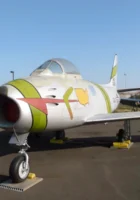
2007 Šiaurės Amerikos F-86 Sabre, kartais vadinamas "Sabrejet", buvo trangarsinis reaktyvinis naikintuvas. "North American Aviation" pagamintas "Sabre" geriausiai žinomas kaip pirmasis Jungtinių Valstijų sparnuotas sparnų naikintuvas, galintis atremti panašų sparnuotą sovietinį MiG-15 greitose šunų kautynėse virš Korėjos karo (1950–1953) dangaus. F-86, laikomas vienu geriausių ir svarbiausių naikintuvų tame kare, taip pat yra vertinamas aukštai, palyginti su kitų epochų naikintuvais. Nors jis buvo sukurtas 1940-ųjų pabaigoje ir buvo pasenęs iki 50-ųjų pabaigos, "Sabre" pasirodė universalus ir pritaikomas, ir tęsėsi kaip priekinės linijos naikintuvas daugelyje oro pajėgų, kol 1994 m. Bolivijos oro pajėgos pasitraukė iš paskutinių aktyvių operacinių pavyzdžių.

Šaltinis: Šiaurės Amerikos F-86 Sabre Vikipedijoje

Tęsti svarstymą

Views : 10737

Steyr 680M

Steyr 680M

ŠaliesAustrija
Tipassunkvežimis
NuotraukaGunther Neumahr
Gamybos laikotarpis1960-1984
Tema

Albumas 19 nuotraukos pasivaikščiojimas po «Steyr 680M»

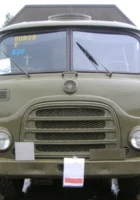
Nuotraukų galerija Steyr 680M, The Steyr 680M was a truck of the brand Steyr. It was produced from 1960 to about 1984 of the former Steyr Daimer Puch AG in Austria and in its branch in Greece. The vehicle is powered by a liquid-cooled , six-cylinder four-stroke – diesel engine series WD-609 (Vorkammereinspritzer) or WD-610 (direct injection) with 88 kW (120 hp), and from 1979 to the from the Steyr 91 derived, and 142 PS ( 104 kW) payable WD-612 operated. The design speed is 80 km / h, the range is 450 km. Overall, it can be loaded in the two-axle version with up to 4,500 kg, the maximum permissible total weight is 10,100 kg. The three-axle version 680M3 makes the largely identical engine through turbocharging 110 kW (150 hp) or the series of motors WD612 125 kW (170 hp). The payload is 5.5 tons and the maximum permissible total weight of 12 tons. The five-speed transmission of 680ers is not synchronized , it must therefore with declutching are switched and double domes. When off-road driving means of switchable are front-wheel drive , the reduction gear and the rear axle is available. Partly also vehicles were equipped with a mechanical winch fitted. In the 1990s, the Steyr 680M was combat performance increased. He was charged with double exterior mirrors, reinforced flatbed, new brakes, new roof and the dashboard of the truck Steyr 12M18 equipped.

Šaltinis: Steyr 680M Vikipedijoje

Tęsti svarstymą

Views : 4877

Respublika F-84 Perkūnkiemis

Respublika F-84 Perkūnkiemis

ŠaliesJav
VaidmenįNaikintuvas-bombonešis
Pirmasis skrydis1946 m. vasario 28 d.
Pastatytas7524

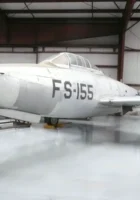
Nuotraukų galerija Respublika F-84 Perkūnkiemis, The Republic F-84 Thunderjet was an American turbojet fighter-bomber aircraft. Originating as a 1944 United States Army Air Forces (USAAF) proposal for a “day fighter”, the F-84 first flew in 1946. Although it entered service in 1947, the Thunderjet was plagued by so many structural and engine problems that a 1948 U.S. Air Force review declared it unable to execute any aspect of its intended mission and considered canceling the program. The aircraft was not considered fully operational until the 1949 F-84D model and the design matured only with the definitive F-84G introduced in 1951. In 1954, the straight-wing Thunderjet was joined by the swept-wing F-84F Thunderstreak fighter and RF-84F Thunderflash photo reconnaissance aircraft.

Šaltinis: Respublika F-84 Thunderjet Vikipedijoje

Tęsti svarstymą

Views : 7953

Saladino šarvuotas automobilis

Saladino šarvuotas automobilis

ŠaliesJungtinė Karalystė
TipasŠarvuotas automobilis
VietaYad La-Shiryon muziejus, Latrunas.
Tema

Albumas 225 nuotraukos vaikšto po «Saladino šarvuotą automobilį»

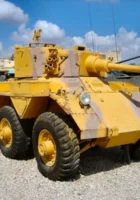
Nuotraukų galerija Saladino šarvuotas automobilis, The Saladin (FV601) is a six-wheeled armoured car built by Alvis, and fitted with a 76mm gun. Used extensively by the British Army, it replaced the AEC Armoured Car that had been in service since World War II. The Saladin was the armoured car of Alvis’ FV600 series, using similar suspension and drive train components to the Saracen armoured personnel carrier, Stalwart high mobility load carrier and Salamander fire tender. It is named after the warrior Saladin, Alvis using names beginning with an “S” for the whole range of FV600 vehicles.

Šaltinis: Saladino šarvuotas automobilis Vikipedijoje

Tęsti svarstymą

Views : 4622

SA-6 Pelningas

SA-6 Pelningas

ŠaliesSovietų Sąjunga
TipasVikšrinė vidutinio nuotolio raketų sistema "žemė-oras"

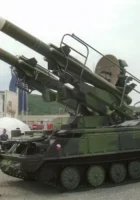
Nuotraukų galerija SA-6 Pelningas, The 2K12 “Kub” (Russian: 2К12 “Куб”; English: cube) (NATO reporting name: SA-6 “Gainful”) mobile surface-to-air missile system is a Soviet low to medium-level air defence system designed to protect ground forces from air attack. “2К12” is the GRAU designation of the system. Each 2K12 battery consists of a number of similar tracked vehicles, one of which carries the 1S91 (SURN vehicle, NATO designation “Straight Flush”) 25 kW G/H band radar (with a range of 75 km (47 mi)) equipped with a continuous wave illuminator, in addition to an optical sight. The battery usually also includes four triple-missile transporter erector launchers (TELs), and four trucks, each carrying three spare missiles and a crane. The TEL is based on a GM-578 chassis, while the 1S91 radar vehicle is based on a GM-568 chassis, all developed and produced by MMZ.

Šaltinis: SA-6 Pelnas Vikipedijoje

Tęsti svarstymą

Views : 5695