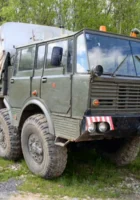
SKP M-42

SKP M-42

PaeseSvezia
digitarePortaerei corazzata
FotografiaThord Wedman
Argomento

Album di 16 foto walk-around di un «SKP M-42»

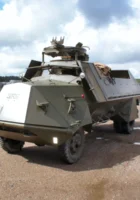
Galleria fotografica di un SKP M-42, Terrängbil m/42 KP (Tgbil m/42 SKP/VKP), meaning “Off-road vehicle 42” with a secondary designation of “Scania, Bodywork: Armoured” or “Volvo, Bodywork: Armoured”, was the Swedish army’s first armoured personnel carrier, developed as a stop-gap measure during World War II. In 1941, when tanks were organized into a unit of their own, it was clear there was a desperate need for a troop carrier able to both keep up with the tanks and provide protection against artillery shrapnel and small-arms fire. Due to the war there were no international suppliers to buy from, so the only option was to develop a domestic solution. AB Landsverk designed an APC consisting of a chassis from a regular army lorry equipped with an armoured shell.

fonte: SKP M-42 su Wikipedia

Continua a leggere

Visualizzazioni : 2638

Tatra 813 Kolos

Tatra 813 Kolos

PaeseCecoslovacchia
digitareAutocarro pesante
Periodo di produzione1967-1982
SuccessoreTatra T815

Galleria fotografica di un Tatra 813 Kolos, Tatra T813 was a truck produced in Czechoslovakia by the Tatra company. The first prototype already built in 1960 utilized existing Tatra T138 assemblies in 4×4 full-time all-wheel drive, which was also another first for Tatra. After the initial trials however the designers decided to develop and expand the concepts onto 8×8 all-wheel-drive all-terrain vehicle. The basis of the design thus became the modular chassis of T813. Successor is the Tatra T815 model.

fonte: Tatra 813 Kolos su Wikipedia

Continua a leggere

Punti di vista: 4051

Sjvpbv 4024

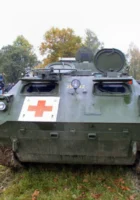
MT-LB Sjvpbv 4024

PaeseSvezia
digitareAmbulanza militare
FotografoThord Wedman
Argomento

Album di 28 foto di un MT-LB Sjvpbv 4024

Foto galeria di un MT-LB Sjvpbv 4024 , The MT-LB (Russian: Многоцелевой Тягач Легкий Бронированный, Mnogotselevoy Tyagach Logkiy Bronirovannyi / light multi-purpose armoured towing vehicle) is a Soviet multi-purpose fully amphibious auxiliary armoured tracked vehicle, which was first introduced in the late 1960s. Initially, the vehicle was known as the M 1970 in the west. Svezia : Sjvpbv 4024 (trasporto personale blindato medico) - Ambulanza militare.

fonte: MT-LB Sjvpbv 4024 su Wikipedia

Continua a leggere

Visualizzazioni : 3216

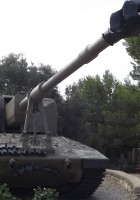
Sholef con sede a Merkava

Merkava Howitzer Sholef

PaeseIsraele
digitareArtiglieria semovente
FotografieSasha Lev
Argomento

Album di 23 foto walk-around di un «Merkava Howitzer Sholef»

Galleria fotografica di un Merkava Howitzer Sholef, Two prototypes of Sholef (“Slammer”, Hebrew slang for “Gunslinger”) 155 mm self-propelled howitzer with automatic loading system were built by Soltam in 1984–1986. The 45-ton vehicle had a long 155 mm gun barrel giving a range of 45+ km. Using GPS, inertial navigation, and an internal fire control computer, it was also capable of direct fire while on the move. It never entered production. The Slammer is a heavily armored artillery gun mounted on a modified Merkava Mk 1 chassis. Many of these vehicles are Merkava Mk 1 that were retired after the Merkava Mk 2 and Merkava Mk 3 came into service. The Slammer has a long 52-caliber gun barrel that allows +10% range. Reload speed may be decreased to 1 for one minute every 10 minutes through use of an automatic loader. Ammunition racks are large. The Slammer is ready for autonomous operation (without an FDC) if the target’s location is known within 15 seconds of a halt, using GPS, inertial navigation, and an internal fire control computer. The Slammer 155 mm self-propelled howitzer is based on a modified Merkava MBT chassis fitted with a new welded steel turret, designed by Soltam Systems. Development commenced in the 1970s. The project was considered of high national priority and incorporated the newest technological developments. Instead the Israeli Defense Forces selected an upgraded version of American M109 howitzer.

fonte: Merkava Howitzer Sholef su Wikipedia

Continua a leggere

Punti di vista: 3825

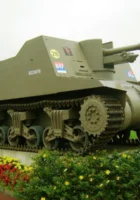
Self-propelled 25pdr Sexton

Sexton Pistola semovente

PaeseCanada
digitareArtiglieria semovente
In servizio1943–1956
Costruito2150

Il 25pdr SP, cingolato, Sagrestano era un veicolo di artiglieria semovente della seconda guerra mondiale. Era basato sulle versioni costruite in Canada del telaio dei carri armati americani M3 Lee e M4 Sherman, che entrarono in produzione in Canada come Ram e Grizzly. Quando la produzione di Sherman negli Stati Uniti si espanse e la fornitura non fu più un problema, nel 1943 fu deciso di cambiare le linee di produzione canadesi per produrre il Sexton per dare all'esercito britannico un cannone di artiglieria mobile usando il loro obice da cannone Ordnance QF da 25 libbre, che poteva sparare un proiettile HE da 87,6 mm (3,45 in) da 11,5 kg (25 libbre) o un proiettile perforante. Trovò uso nell'esercito canadese e britannico, così come in numerosi altri Impero britannico e forze associate. Subito dopo la guerra, un certo numero di Grizzly e Sextons sono stati venduti al Portogallo, che li ha utilizzati nel 1980.

fonte: Sexton Pistola semovente su Wikipedia

Continua a leggere

Visualizzazioni : 3797

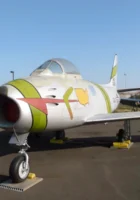
Sciabola nordamericana F-86F-20NH

Sciabola F-86 nordamericana

PaeseUsa
RuoloCaccia
Primo volo1° ottobre 1947
Costruito9860

Le Sciabola F-86 nordamericana, a volte chiamato Sabrejet, era un caccia a reazione transonico. Prodotta dalla North American Aviation, la Sabre è meglio conosciuta come il primo caccia ad ala spazzata degli Stati Uniti che potrebbe contrastare il MiG-15 sovietico ad ala simile negli scontri ad alta velocità sui cieli della guerra di Corea (1950-1953). Considerato uno dei migliori e più importanti aerei da combattimento in quella guerra, l'F-86 è anche valutato molto rispetto ai caccia di altre epoche. Sebbene sia stato sviluppato alla fine degli anni '40 ed era obsoleto alla fine degli anni '50, il Sabre si dimostrò versatile e adattabile, e continuò come caccia in prima linea in numerose forze aeree fino a quando gli ultimi esempi operativi attivi non furono ritirati dall'aeronautica boliviana nel 1994.

fonte: Sciabola F-86 nordamericana su Wikipedia

Continua a leggere

Visualizzazioni : 10737

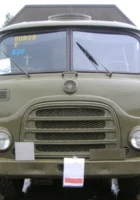
Steyr 680M

Steyr 680M

PaeseAustria
digitareCamion
FotografiaGunther Neumahr
Periodo di produzione1960-1984
Argomento

Album di 19 foto walk-around di uno «Steyr 680M»

Galleria fotografica di un Steyr 680M, The Steyr 680M was a truck of the brand Steyr. It was produced from 1960 to about 1984 of the former Steyr Daimer Puch AG in Austria and in its branch in Greece. The vehicle is powered by a liquid-cooled , six-cylinder four-stroke – diesel engine series WD-609 (Vorkammereinspritzer) or WD-610 (direct injection) with 88 kW (120 hp), and from 1979 to the from the Steyr 91 derived, and 142 PS ( 104 kW) payable WD-612 operated. The design speed is 80 km / h, the range is 450 km. Overall, it can be loaded in the two-axle version with up to 4,500 kg, the maximum permissible total weight is 10,100 kg. The three-axle version 680M3 makes the largely identical engine through turbocharging 110 kW (150 hp) or the series of motors WD612 125 kW (170 hp). The payload is 5.5 tons and the maximum permissible total weight of 12 tons. The five-speed transmission of 680ers is not synchronized , it must therefore with declutching are switched and double domes. When off-road driving means of switchable are front-wheel drive , the reduction gear and the rear axle is available. Partly also vehicles were equipped with a mechanical winch fitted. In the 1990s, the Steyr 680M was combat performance increased. He was charged with double exterior mirrors, reinforced flatbed, new brakes, new roof and the dashboard of the truck Steyr 12M18 equipped.

fonte: Steyr 680M su Wikipedia

Continua a leggere

Visualizzazioni : 4877

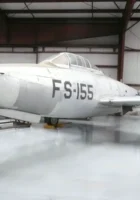
Repubblica F-84 Thunderjet

Repubblica F-84 Thunderjet

PaeseUsa
RuoloCacciabombardardo
Primo voloIl 28 febbraio 1946
Costruito7524

Galleria fotografica di un Repubblica F-84 Thunderjet, The Republic F-84 Thunderjet was an American turbojet fighter-bomber aircraft. Originating as a 1944 United States Army Air Forces (USAAF) proposal for a “day fighter”, the F-84 first flew in 1946. Although it entered service in 1947, the Thunderjet was plagued by so many structural and engine problems that a 1948 U.S. Air Force review declared it unable to execute any aspect of its intended mission and considered canceling the program. The aircraft was not considered fully operational until the 1949 F-84D model and the design matured only with the definitive F-84G introduced in 1951. In 1954, the straight-wing Thunderjet was joined by the swept-wing F-84F Thunderstreak fighter and RF-84F Thunderflash photo reconnaissance aircraft.

fonte: Repubblica F-84 Thunderjet su Wikipedia

Continua a leggere

Views : 7953

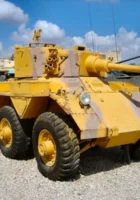
Auto blindata Saladino

Auto blindata Saladino

PaeseRegno Unito
digitareAutoblindata
LuogoMuseo Yad La-Shiryon, Latrun.
Argomento

Album di 225 foto walk-around di una «Saladin Armored Car»

Galleria fotografica di un Auto blindata Saladino, The Saladin (FV601) is a six-wheeled armoured car built by Alvis, and fitted with a 76mm gun. Used extensively by the British Army, it replaced the AEC Armoured Car that had been in service since World War II. The Saladin was the armoured car of Alvis’ FV600 series, using similar suspension and drive train components to the Saracen armoured personnel carrier, Stalwart high mobility load carrier and Salamander fire tender. It is named after the warrior Saladin, Alvis using names beginning with an “S” for the whole range of FV600 vehicles.

fonte: Auto blindata Saladino su Wikipedia

Continua a leggere

visualizzazioni : 4622

SA-6 Gainful

SA-6 Gainful

PaeseUnione Sovietica
digitareSistema missilistico terra-aria cingolato a medio raggio

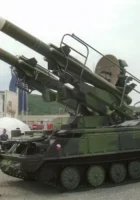
Galleria fotografica di un SA-6 Gainful, The 2K12 “Kub” (Russian: 2К12 “Куб”; English: cube) (NATO reporting name: SA-6 “Gainful”) mobile surface-to-air missile system is a Soviet low to medium-level air defence system designed to protect ground forces from air attack. “2К12” is the GRAU designation of the system. Each 2K12 battery consists of a number of similar tracked vehicles, one of which carries the 1S91 (SURN vehicle, NATO designation “Straight Flush”) 25 kW G/H band radar (with a range of 75 km (47 mi)) equipped with a continuous wave illuminator, in addition to an optical sight. The battery usually also includes four triple-missile transporter erector launchers (TELs), and four trucks, each carrying three spare missiles and a crane. The TEL is based on a GM-578 chassis, while the 1S91 radar vehicle is based on a GM-568 chassis, all developed and produced by MMZ.

fonte: SA-6 Gainful su Wikipedia

Continua a leggere

Views : 5695