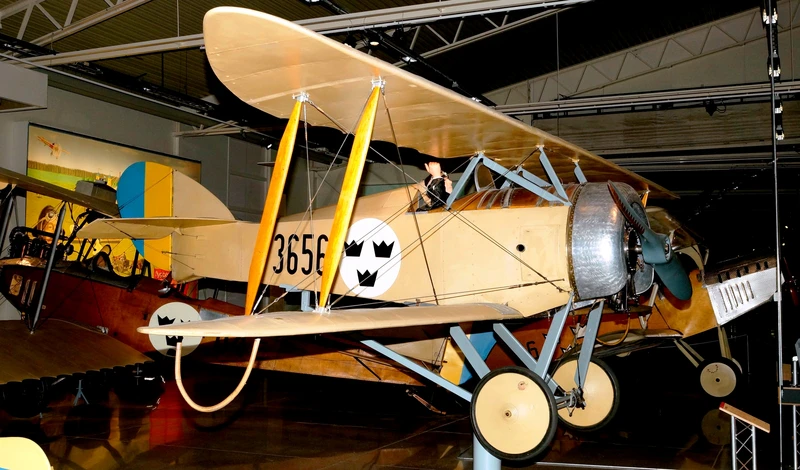
FVM Ö1 Tummelisa | |
|---|---|
| País | Suecia |
| Papel | Aviones de entrenamiento |
| Primer vuelo | Junio de 1920 |
| Construido | 28 |
el FVM Ö 1 Tummelisa (sueco para Thumbelina) es un biplano sueco monoplaza y monomotor de la década de 1920. Fue operado por la Fuerza Aérea Sueca como su entrenador avanzado hasta mediados de la década de 1930.
Fuente: FVM Ö1 Tummelisa en Wikipedia
| FVM O1 Tummelisa Paseo alrededor | |
|---|---|
| Fotógrafos | Unknow |
| Localización | Unknow |
| Fotos | 11 |


Ver también:


General Characteristics
The FVM Ö1 Tummelisa (Swedish for “Thumbelina”) is a light, single-seat biplane from the 1920s. It was the most well-known and successful aircraft designed by FVM (Flygkompaniets Tygverkstäder på Malmen), the Swedish Army Aviation’s workshop. The aircraft was developed for advanced training, particularly for prospective fighter pilots, and was praised for its agility, though it demanded skill due to the gyroscopic effect of its rotary engine. When the Swedish Air Force (Flygvapnet) was established in 1926, the type was officially designated Ö 1 (Övningsplan 1, or Advanced Trainer 1). Remarkably, it served until the mid-1930s without any fatal accidents.
| Property | Typical Value (Ö 1) |
|---|---|
| Papel | Advanced Trainer Aircraft |
| National Origin | Suecia |
| Fabricante | FVM (Flygkompaniets Tygverkstäder på Malmen) |
| First Flight | Junio de 1920 |
| Retirado | 1935 |
| No. Built | ~28–30 |
| Equipo | 1 (Pilot) |
| Longitud | 5.5 m (18 ft 1 in) |
| Envergadura | 7.8 m (25 ft 7 in) |
| Max Takeoff Weight | ~535–552 kg (1,180–1,217 lb) |
Powerplant and Performance
- Engine: 1 x Thulin A 9-cylinder rotary engine (based on the Le Rhône).
- Power Output: 67 kW (90 hp).
- Propeller: 2-bladed.
- Maximum Speed: 145–148 km/h (90–92 mph).
- Service Ceiling: 5,000 m (16,000 ft).
- Construction: Light wooden construction with wings and tail coated in linen fabric. The fuselage was covered in plywood.
- Unique Feature: The rotary engine demanded special skill to compensate for the torque effect, making it an excellent, demanding advanced trainer.
Design and Legacy
- Original Name: Initially known as “Tummeliten” (Little Tom Thumb), but pilots quickly nicknamed it “Tummelisa.”
- Designers: Gösta von Porat and Henry Kjellson.
- Operational Use: Served primarily at the Swedish Air Force Flight Academy (F 5) at Ljungbyhed.
- Survivors: One original Ö 1 is preserved and displayed at the Flygvapenmuseum (Swedish Air Force Museum) in Linköping. At least one flying replica exists, built by Mikael Carlson.
Vistas : 901
También puede ver:
 Hawker Fury – Fotos y Videos
 EKW C-35 – Fotos y Videos
 SPAD S.XI – Caminar alrededor
 Focke-Wulf Fw 44 – Fotos y Videos
 Fairey Swordfish – Fotos y Videos
 Hawker Hart – Fotos y Videos
 Fokker D.VII – Fotos y Video
 Royal Aircraft Factory S.E.5 – Fotos y Video
 SPAD S.VII Cabruna & Ruffo – Fotos y Video
 Stearman PT-13D Kaydet- Fotos y Video