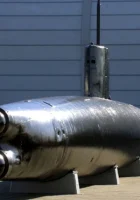
PT Boat PT-617

PT boat

CountryUSA
ClassCannon-class destroyer escort
Launched20 February 1944
IdentificationDE-766

A PT boat (short for patrol torpedo boat) was a torpedo-armed fast attack vessel (MTB) used by the United States Navy in World War II. It was small, fast, and inexpensive to build, valued for its maneuverability and speed but hampered at the beginning of the war by ineffective torpedoes, limited armament, and comparatively fragile construction that limited some of the variants to coastal waters.

Source: PT boat on Wikipedia

Continue reading

Views : 3143

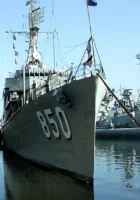
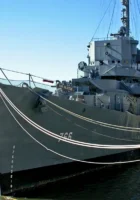
USS Slater

USS Slater

CountryUSA
ClassCannon-class destroyer escort
Launched20 February 1944
IdentificationDE-766

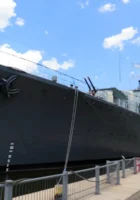
USS Slater (DE-766) is a Cannon-class destroyer escort that served in the United States Navy and later in the Hellenic (Greek) Navy. The ship was named for Frank O. Slater of Alabama, a sailor killed on the cruiser USS San Francisco during the Naval Battle of Guadalcanal. He was posthumously awarded the Navy Cross for gallantry in action and the Purple Heart. Following service during World War II, the ship was transferred to Greece and renamed Aetos. Decommissioned in 1991, the destroyer escort was returned to the United States. USS Slater is now a museum ship on the Hudson River in Albany, New York, the only one of its kind afloat in the United States. (USS Stewart (DE-238) is exhibited at Seawolf Park in Galveston, Texas, but located on dry land and USS Atherton (DE-169) is still in service in the Philippine Navy.) Slater was designated a National Historic Landmark on 2 March 2012

Source: USS Slater on Wikipedia

Continue reading

Views : 1598

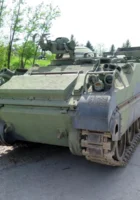
Lynx Reconnaissance Vehicle

Lynx reconnaissance vehicle

CountryUSA
RoleReconnaissance vehicle
PeriodUnknow
BuiltUnknow

The Lynx reconnaissance vehicle (manufacturer’s name: M113½ Command and Reconnaissance Vehicle, abbr. M113 C&R) is a United States-built tracked reconnaissance armoured fighting vehicle, which was employed by the armed forces of the Netherlands and Canada. Dutch vehicles were exported in the 1990s to Bahrain[1] and Chile, according to SIPRI 35 and 8 vehicles respectively. The M113½ was developed in 1963 as a private venture by FMC Corp., the manufacturer of the M113. It competed with the M114 but the US Army chose the M114 for production. The design was then offered to foreign buyers and gained the name Lynx when purchased by Canada.

Source: Lynx reconnaissance vehicle on Wikipedia

Continue reading

Views : 2421

Douglas X-3 Stiletto

Douglas X-3 Stiletto

CountryUSA
RoleExperimental
First flight15 October 1952
Built1

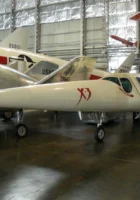
The Douglas X-3 Stiletto was a 1950s United States experimental jet aircraft with a slender fuselage and a long tapered nose, manufactured by the Douglas Aircraft Company. Its primary mission was to investigate the design features of an aircraft suitable for sustained supersonic speeds, which included the first use of titanium in major airframe components. Douglas designed the X-3 with the goal of a maximum speed of approximately 2,000 m.p.h, but it was, however, seriously underpowered for this purpose and could not even exceed Mach 1 in level flight. Although the research aircraft was a disappointment, Lockheed designers used data from the X-3 tests for the Lockheed F-104 Starfighter which used a similar trapezoidal wing design in a successful Mach 2 fighter.

Source: Douglas X-3 Stiletto on Wikipedia

Continue reading

Views : 3811

Destroyer HMCS Haida

HMCS Haida

CountryCanada
Class and typeTribal-class destroyer
Launched25 August 1942
Out of service22 February 1964

HMCS Haida is a Tribal-class destroyer that served in the Royal Canadian Navy (RCN) from 1943 to 1963, participating in World War II and the Korean War. She was named for the Haida people. The only surviving Tribal-class destroyer out of 27 vessels constructed for the RCN, Royal Navy and Royal Australian Navy between 1937 and 1945, Haida sank more enemy surface tonnage than any other Canadian warship and as such is commonly referred to as the “Fightingest Ship in the Royal Canadian Navy”

Source: HMCS Haida on Wikipedia

Continue reading

Views : 2626

B-1B Lancer

Rockwell B-1 Lancer

CountryUSA
RoleSupersonic strategic heavy bomber
First flight23 December 1974
Built104

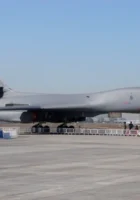
The Rockwell B-1 Lancer is a supersonic variable-sweep wing, heavy bomber used by the United States Air Force. It is commonly called the “Bone” (from “B-One”). It is one of three strategic bombers in the U.S. Air Force fleet as of 2018, the other two being the B-2 Spirit and the B-52 Stratofortress. The B-1 was first envisioned in the 1960s as a platform that would combine the Mach 2 speed of the B-58 Hustler with the range and payload of the B-52, and would ultimately replace both bombers. After a long series of studies, Rockwell International (now part of Boeing) won the design contest for what emerged as the B-1A. This version had a top speed of Mach 2.2 at high altitude and the capability of flying for long distances at Mach 0.85 at very low altitudes. The combination of the high cost of the aircraft, the introduction of the AGM-86 cruise missile that flew the same basic profile, and early work on the stealth bomber all significantly affected the need for the B-1. This led to the program being canceled in 1977, after the B-1A prototypes had been built.

Source: Rockwell B-1 Lancer on Wikipedia

Continue reading

Views : 4001

Piper Pa-48 Enforcer

Piper PA-48 Enforcer

CountryUSA
RoleCounter-insurgency aircraft
First flight29 April 1971
Built4

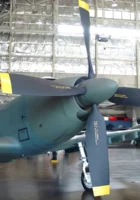
The Piper PA-48 Enforcer is an American turboprop-powered light close air support aircraft built by Piper in the 1970s. It is a development of the World War II-era North American P-51 Mustang fighter. The Enforcer concept was originally created and flown as the Cavalier Mustang by David Lindsay, owner of Cavalier Aircraft, in response to the United States Air Force PAVE COIN program, but Cavalier did not have the manufacturing abilities to mass-produce the Enforcer, so the program was sold to Piper by Lindsay in 1970.

Source: Piper PA-48 Enforcer on Wikipedia

Continue reading

Views : 4933

Boeing X-36

Boeing X-36

CountryUSA
RoleResearch aircraft
First flight17 May 1997
Built2

The McDonnell Douglas (later Boeing) X-36 Tailless Fighter Agility Research Aircraft was an American stealthy subscale prototype jet designed to fly without the traditional tail assembly found on most aircraft. This configuration was designed to reduce weight, drag and radar cross section, but increase range, maneuverability and survivability.

Source: Boeing X-36 on Wikipedia

Continue reading

Views : 1791

Junkers Ju-88R1

Junkers Ju 88

CountryNazi Germany
RoleTactical – dive – torpedo bomber – Night – heavy fighter – Reconnaissance aircraft
First flight21 December 1936
Built15183

The Junkers Ju 88 was a German World War II Luftwaffe twin-engined multirole combat aircraft. Junkers Flugzeug- und Motorenwerke (JFM) designed the plane in the mid-1930s as a so-called Schnellbomber (fast bomber) that would be too fast for fighters of its era to intercept. It suffered from a number of technical problems during its development and early operational periods but became one of the most versatile combat aircraft of the war. Like a number of other Luftwaffe bombers, it served as a bomber, dive bomber, night fighter, torpedo bomber, reconnaissance aircraft, heavy fighter and at the end of the war, as a flying bomb.

Source: Junkers Ju 88 on Wikipedia

Continue reading

Views : 7036

T-62

T-62

CountrySoviet Union
RoleMain Battle Tank
In service1961–present
Built20000+

The T-62 is a Soviet main battle tank that was first introduced 1961. As a further development of the T-55 series, the T-62 retained many similar design elements of its predecessor including low profile and thick turret armor. In contrast with previous tanks, which were armed with rifled tank guns, the T-62 was the first tank armed with a smoothbore tank gun that could fire APFSDS rounds at higher velocities. While the T-62 became the standard tank in the Soviet arsenal, it did not fully replace the T-55 in export markets due to its higher manufacturing costs and maintenance requirements compared to its predecessor. Although the T-62 was replaced in Russia and the successor states of the Soviet Union, it is still used in some countries and its design features became standardized in subsequent Soviet and Russian mass-produced tanks.

Source: T-62 on Wikipedia

Continue reading

Views : 11273