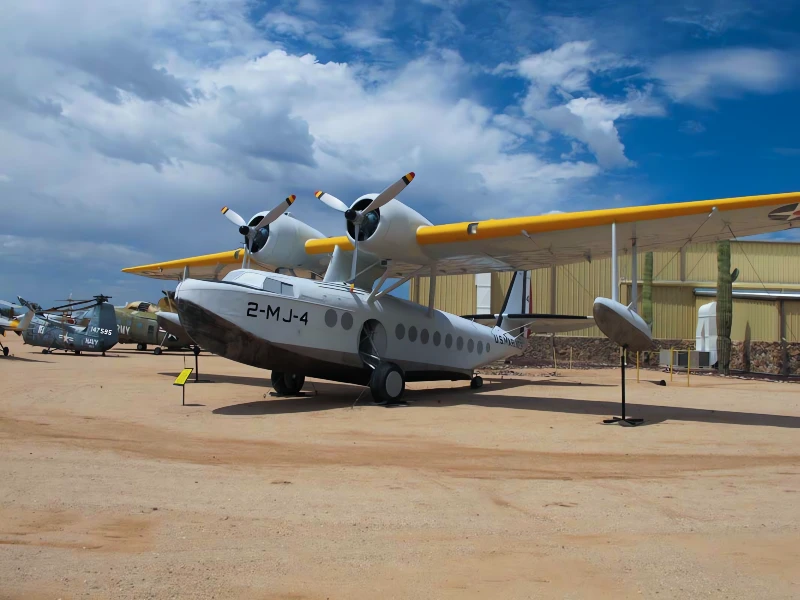
Sikorsky S-43 | |
|---|---|
| Країні | Сша |
| Роль | Авіалайнер літаючого човна |
| Перший політ | 1935 |
| Побудований | 53 |
У 201 Sikorsky S-43 — двомоторний літак-амфібія, що вироблявся в США в 1930-х роках американською фірмою Sikorsky Aircraft.
Джерело: Sikorsky S-43 у Вікіпедії
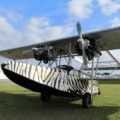
| Sikorsky S-43 (JRS-1) Baby Clipper Прогулянка | |
|---|---|
| Фотограф | Володимир Якубов |
| Локалізацією | Піма музей авіації та космонавтики, Тускон |
| Фото | 138 |

Читайте також:


The “Baby Clipper” That Bridged Land and Sea
У 201 Sikorsky S-43, affectionately known as the “Baby Clipper,” was a twin-engine amphibious aircraft designed and built by the Sikorsky Aircraft Corporation in the mid-1930s. Created as a smaller, more economical companion to the larger four-engine Sikorsky S-42 transoceanic flying boat, the S-43 was engineered specifically to pioneer regional water and land routes across Latin America, the Caribbean, and Russia. Featuring a retractable main landing gear system that allowed it to transition seamlessly between open harbor waters and paved inland runways, the aircraft offered unprecedented operational flexibility. Acquired by commercial aviation giants like Pan American Airways and military operators including the US Army Air Corps (as the Y1OA-8) and US Navy (as the ЯРС-1), the S-43 helped establish intercontinental air networks during the golden age of flying boats.
| Attribute | Technical Specification (Sikorsky S-43 Commercial Standard) |
|---|---|
| Роль | Twin-Engine Amphibious Commercial Airliner / Military Transport |
| команда | 2 to 3 (Pilot, Co-Pilot, Radio Operator) | 18 to 19 passengers |
| Силова установка | 2 × Pratt & Whitney R-1830-13 Hornet / Twin Wasp 9-cylinder air-cooled radial engines (750 to 875 hp each) |
| Максимальна швидкість | 312 km/h (190 mph / 165 knots) at 2,100 meters altitude |
| Takeoff / Gross Weight | 8,845 kg (19,500 lbs) maximum gross takeoff weight |
| Service Ceiling / Operational Range | 5,790 m (19,000 ft) ceiling | ~1,240 km (775 miles) maximum range |
| Passenger Capacity & Layout | 18 to 19 passengers in a soundproofed, single-aisle cabin compartment |
| Defensive Armament | Unarmed in standard civil/transport configuration (select utility models fitted with observation positions) |
| Hull & Wing Construction | Duralumin all-metal semi-monocoque flying boat hull with high parasol wing supported by struts and wing floats |
| Production Total | 53 units produced by Sikorsky Aircraft at Bridgeport, Connecticut between 1935 and 1941 |
Design Engineering: Parasol Wings, Retractable Amphibious Gear, and Duralumin Hulls
- True Retractable Amphibious Gear: Unlike traditional flying boats that required beaching gear to be manually attached by ground crews upon reaching shallow water, the S-43 featured fully retractable main landing gear. The wheels swung upward into deep side recesses in the metal hull, allowing the pilot to land on a water bay, lower the wheels in the water, and roll directly up a wooden ramp onto land under engine power.
- High-Mounted Parasol Wing Layout: To keep its dual engines and variable-pitch propellers clear of ocean saltwater spray during high-speed water takeoffs, Sikorsky mounted the main wing high above the hull on a central pylon and strut superstructure. This high parasol layout provided maximum aerodynamic stability and prevented engine corrosion from saltwater ingestion.
- All-Metal Duralumin Hull Geometry: The hull was constructed almost entirely from high-strength duralumin aluminum alloy sheets. It featured a flush-riveted single-step hull underside designed to cleanly break hydrodynamic surface tension during water takeoff runs, even when fully loaded with 19 passengers and fuel.
- Twin Tailfin Directional Stability: Early flight trials revealed that the high, bulky hull created significant side-slip instability. Engineers solved this by adding twin vertical tailfins and rudders mounted onto a horizontal stabilizer, providing the pilot with precise rudder control during single-engine flight maneuvers or crosswind water landings.
Operational History: Pan Am Feeder Routes, World Records, and Pearl Harbor Survivors
- Pan American Airways “Baby Clippers”: Pan Am purchased the majority of commercial S-43s, deploying them across Central and South America as “feeder” airliners. They operated along river systems like the Amazon and shallow island harbors throughout the Caribbean, transferring long-distance passengers directly to Pan Am’s larger transoceanic S-42 and Boeing 314 Clippers.
- Howard Hughes’ Aviation Records: Eccentric billionaire and aviation pioneer Howard Hughes purchased a custom S-43 in 1937. Hughes modified the aircraft to set a class altitude record, reaching 24,950 feet (7,605 meters) over Connecticut. He later used his personal S-43 to practice multi-engine flying techniques prior to his famous round-the-world flight in a Lockheed Super Electra.
- Military Utility (US Navy JRS-1 and USAAC Y1OA-8): Both the US Navy and Army Air Corps recognized the utility of an amphibious transport. The US Navy acquired 17 units under the designation JRS-1, utilizing them for utility transport, photographic mapping, and search-and-rescue duties across coastal naval air stations.
- Witness to the Attack on Pearl Harbor: On December 7, 1941, several US Navy JRS-1s were stationed at Naval Air Station Ford Island in Pearl Harbor. When the Japanese air attack began, unarmed JRS-1 amphibs were quickly prepped and launched into the surrounding Pacific waters to search for the retreating Japanese aircraft carrier fleet, making the S-43 one of the few aircraft types present at the opening clash of the Pacific War.
переглядів : 2208
Ви також можете побачити:
 Bulldog T.1 RAF – Photos & Videos
 Короткий Сандерленд – фото & відео
 Grumman G-21 Goose – фото & відео
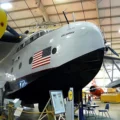 Sikorsky VS-44 – фото & відео
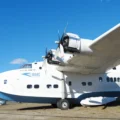 Short Solent - Фото та відео
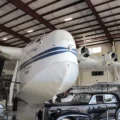 Short Sandringham – Фото & Відео
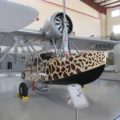 Sikorsky S-39 – Фото & Відео
 Sikorsky S-38 – фото та відео
 Dornier Do-24 – Фото & Відео
 Curtiss XF15C-1 – фото та відео