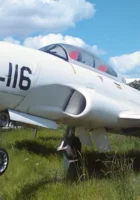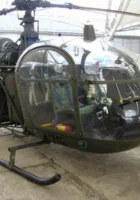
SA.318C Alouette II

SA.318C Alouette II

PaísFrança
TipoHelicóptero leve
Produzido1956-1975
Construído1300+

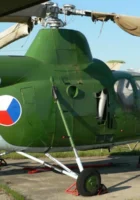
Galeria de fotos de um SA.318C Alouette II, The Aérospatiale Alouette II is a light helicopter originally manufactured by Sud Aviation and later Aérospatiale, both of France. The Alouette II was the first production helicopter to use a gas turbine engine instead of the conventional heavier piston powerplant. The Alouette II was mostly used for military purposes in observation, photography, air-sea rescue, liaison and training, but it has also carried anti-tank missiles and homing torpedoes. As a civilian helicopter it was used for casualty evacuation (with two external stretcher panniers), crop-spraying and as a flying crane, with a 500-kilogram (1,100 lb) external underslung load.

Fonte: Alouette II na Wiki

Continue lendo

Views : 6940

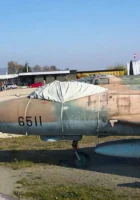
Sukhoi Su-7

Sukhoi Su-7

PaísUnião Soviética
TipoCaça supersônico
Primeiro voo7 de setembro de 1955
Construído1847

O Sukhoi Su-7 (Nome de designação da OTAN: Fitter-A) foi um caça supersônico de asa varrida desenvolvido pela União Soviética em 1955. Originalmente, foi projetado como um caça tático de baixo nível, mas não teve sucesso nessa função. Por outro lado, a série Su-7B logo introduzida tornou-se o principal caça-bombardeiro soviético e aeronave de ataque ao solo da década de 1960. O Su-7 era robusto em sua simplicidade, mas suas deficiências incluíam curto alcance e baixa carga de armas.

Fonte: Sukhoi Su-7 na Wiki

Continue lendo

Views : 12988

SPAD S.VII Cabruna & Ruffo

SPAD S.VII Cabruna & Ruffo

PaísBélgica – Itália
TipoCaça biplano
Primeiro voo6maio de 191
Construído6000

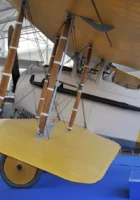
Galeria de fotos de um SPAD S.VII Cabruna & Ruffo, The SPAD S.VII was the first of a series of highly successful biplane fighter aircraft produced by Société Pour L’Aviation et ses Dérivés (SPAD) during the First World War. Like its successors, the S.VII was renowned as a sturdy and rugged aircraft with good climbing and diving characteristics. It was also a stable gun platform, although pilots used to the more manoeuvrable Nieuport fighters found it heavy on the controls. It was flown by a number of the famous aces, such as France’s Georges Guynemer, Italy’s Francesco Baracca and Australia’s Alexander Pentland.

Fonte: SPAD S.VII Cabruna & Ruffo no Wiki

Continue lendo

Visualizações : 3879

Sikorsky MH-53

Sikorsky MH-53

PaísEua
TipoHelicóptero de busca e salvamento de combate de longo alcance
Primeiro voo15 de março de 1967
Construído72

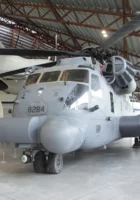
Galeria de fotos de um Sikorsky MH-53, The Sikorsky MH-53 Pave Low series is a long-range combat search and rescue (CSAR) helicopter for the United States Air Force. The series was upgraded from the HH-53B/C, variants of the Sikorsky CH-53 Sea Stallion. The HH-53 “Super Jolly Green Giant” was initially developed to replace the HH-3 “Jolly Green Giant”. The helicopters later transitioned to Special Operations missions. The U.S. Air Force’s MH-53J/M fleet was retired in September 2008.

Fonte: Sikorsky MH-53 na Wiki

Continue lendo

Visualizações : 6880

Saab J-29F Tunnan

Saab J-29F Tunnan

PaísSuécia
TipoAviões
Primeiro voo1 de Setembro de 1948
Construído661

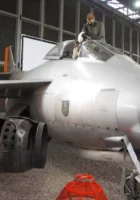
Galeria de fotos de um Saab J-29F Tunnan, The Saab 29, colloquially called Flygande tunnan (English: “The flying barrel”), was a Swedish fighter designed and manufactured by Saab in the 1940s. It was Sweden’s second turbojet-powered combat aircraft, the first being the Saab 21R; additionally, it was the first Western European fighter to be produced with a swept wing after the Second World War, the Me 262 being the first during the war. Despite its rotund appearance, from which its name derives, the J 29 was a fast and agile aircraft for its era. It served effectively in both fighter and fighter-bomber roles into the 1970s.

Fonte: Saab J-29F Tunnan na Wiki

Continue lendo

Views : 7997

76mm field gun

Canhão divisionário de 76 mm M1939

PaísUnião Soviética
TipoArma divisional
FotografiaYuri Pasholok
LocalizarDesconhecido
DescriçãoÁlbum de 21 fotos walk-around de «76 mm canhão divisional M1939»

Galeria de fotos de um Canhão divisionário de 76 mm M1939, The 76-mm divisional gun M1939 (F-22 USV or USV) (Russian: 76-мм дивизионная пушка обр. 1939 г. (Ф-22 УСВ or УСВ)) was a 76.2 mm cannon produced in the Soviet Union. It was adopted for Red Army service in 1939 and used extensively in World War II. The gun was designated as “divisional” – issued to batteries under the direct control of division headquarters. The F-22 USV was an intermediate model, coming between the F-22, which had limited anti-aircraft capability, and the simpler and cheaper ZiS-3, which eventually replaced it in production and service.

Fonte: Canhão divisional de 76 mm M1939 na Wiki

Continue lendo

Visualizações : 2483

Lebre Mi-1

Mil Mi-1 Lebre

PaísUnião Soviética
PapelHelicóptero utilitário leve
Primeiro voo20 de setembro de 1948
Construído2594+

Galeria de fotos de um Mil Mi-1 Lebre, The Mil Mi-1 (USAF/DoD reporting name “Type 32”, NATO reporting name “Hare”) was a Soviet three- or four-seat light utility helicopter. It was the first Soviet helicopter to enter serial production. It is powered by one 575 hp Ivchenko AI-26V radial. It entered service in 1950 and was first seen on the 1951 Soviet Aviation Day, Tushino and was produced for 16 years. More than 1,000 were built in the USSR and 1,594 in Poland, as SM-1.

Fonte: Mil Mi-1 Lebre na Wiki

Continue lendo

Views : 5541

BTR-60

BTR-60

PaísUnião Soviética
TipoBlindado anfíbio de rodas
Em serviço1959–presente
Construído25000+

Galeria de fotos de um BTR-60, The BTR-60 is the first vehicle in a series of Soviet eight-wheeled armoured personnel carriers (APCs). It was developed in the late 1950s as a replacement for the BTR-152 and was seen in public for the first time in 1961. BTR stands for Bronetransporter (БТР, Бронетранспортер, literally “armoured transporter”)

Fonte: BTR-60 no Wiki

Continue lendo

Visualizações : 4587

VT-34

VT-34

PaísChecoslováquia
TipoTanque de recuperação
FotografiaDesconhecido
LocalizarDesconhecido
DescriçãoÁlbum de 42 fotos walk-around de «VT-34»

Galeria de fotos de um VT-34, The T-34 medium tank is one of the most-produced and longest-lived tanks of all time. Identification of T-34 variants can be complicated. Turret castings, superficial details, and equipment differed between factories; new features were added in the middle of production runs, or retrofitted to older tanks; damaged tanks were rebuilt, sometimes with the addition of newer-model equipment and even new turrets. Some tanks had appliqué armor made of scrap steel of varying thickness welded onto the hull and turret; these tanks are called s ekranami (“with screens”), although this was never an official designation for any T-34 variant. T-34 model 1941 s ekranami, manufactured at STZ, with appliqué armour welded to the hull.

VT-34 (VT significa vyprošťovací tank "tanque de recuperação") - Esta variação foi um veículo de recuperação construído especificamente na Tchecoslováquia.

Fonte: VT-34 na Wiki

Continue lendo

Visualizações : 3176

Lockheed T-33

Lockheed T-33

PaísEua
TipoAvião jet trainer
Produzido1948–1959
Construído6557

Galeria de fotos de um Lockheed T-33, The Lockheed T-33 Shooting Star (or T-Bird) is an American jet trainer aircraft. It was produced by Lockheed and made its first flight in 1948 piloted by Tony LeVier. The T-33 was developed from the Lockheed P-80/F-80 starting as TP-80C/TF-80C in development, then designated T-33A. It was used by the U.S. Navy initially as TO-2 then TV-2, and after 1962, T-33B. As of 2015, Canadian-built examples were still in-service with the Bolivian Air Force.

Fonte: Lockheed T-33 na Wiki

Continue lendo

Views : 8494