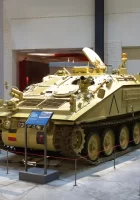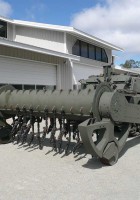
FV3902 Churchill Flail rupūžė

FV3902 Churchill Flail rupūžė

ŠaliesJk
TipasTransporto priemonėje sumontuotas įtaisas
NuotraukaVladimiras Yakubovas
SuraskiteJacques Littlefield kolekcija
Aprašymas / kontrolėAlbumas 206 nuotraukos pasivaikščiojimas po «FV3902 Churchill Flail Toad»

Nuotraukų galerija FV3902 Churchill Flail rupūžė, A mine flail is a vehicle-mounted device that makes a safe path through a mine-field by deliberately detonating land mines in front of the vehicle that carries it. They were first used by the British during World War II. The mine flail consists of a number of heavy chains, ending in fist-sized steel balls, (flails) that are attached to a horizontal, rapidly rotating rotor mounted on two arms in front of the vehicle. The rotor’s rotation makes the flails spin wildly and violently pound the ground. The force of a flail strike above a buried mine mimics the weight of a person or vehicle and causes the mine to detonate, but in a safe manner that does little damage to the flails or the vehicle.

Šaltinis: FV3902 Churchill Flail Rupūžė Wiki

Tęsti svarstymą

Views : 2236

Prancūzų VAB

Prancūzų VAB

ŠaliesPrancūzija
TipasŠarvuota atkūrimo transporto priemonė
NuotraukaLaurentas Tabibas
Aprašymas / kontrolėAlbumas 53 nuotraukos vaikšto po «prancūzišką VAB»

Nuotraukų galerija Prancūzų VAB, The Véhicule de l’avant blindé or VAB (“Armoured vanguard vehicle” in French) is an armoured personnel carrier and support vehicle designed by the Euro Mobilité Division of GIAT Industries of France. It entered service in 1976; around 5,000 were produced.

Šaltinis: Prancūzų VAB "Wiki"

Tęsti svarstymą

Peržiūrėta: 4516

FV106 Samsonas CVRT ARV

FV106 Samsonas

ŠaliesJk
TipasŠarvuota atkūrimo transporto priemonė
NuotraukaVladimiras Yakubovas
SuraskiteKarinių transporto priemonių technologijų fondas
Aprašymas / kontrolėAlbumas 57 nuotraukos vaikšto po «FV106 Samsoną»

Nuotraukų galerija FV106 Samsonas, FV106 Samson is a British Army armoured recovery vehicle, one of the CVR(T) family. The main role of this vehicle is to recover the CVR(T) family of vehicles, but can recover other light tracked vehicles such as the FV430 series.

Šaltinis: FV106 Samsonas "Wiki"

Tęsti svarstymą

Peržiūrėta: 2463

FV180 Kovos inžinierius traktorius

FV180 Kovos inžinierius traktorius

ŠaliesJk
TipasAmfibijos specialisto šarvuota transporto priemonė
NuotraukaVladimiras Yakubovas
SuraskiteKarinių transporto priemonių technologijų fondas
Aprašymas / kontrolėAlbumas 122 nuotraukos "FV180 kovinio inžinieriaus traktoriaus"

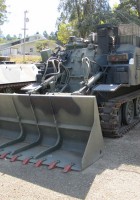
Nuotraukų galerija FV180 Kovos inžinierius traktorius, The FV180 Combat Engineer Tractor or C.E.T. is an amphibious specialist armoured vehicle of the British Army and has been in general service since 1976. A tracked, lightly armoured vehicle, with amphibious capability, the CET is used by Royal Engineers in ground preparation for bridge construction and towing activities in the front line of battle, such as digging vehicle fighting pits, constructing earthen barriers, repairing roads, recovery of disabled vehicles from water and other obstacles, preparing riverbanks for vehicle crossings and clearing obstacles.

Šaltinis: FV180 kovos inžinieriaus traktorius Wiki

Tęsti svarstymą

Views : 2901

BAC 167 Strikemaster Mk80A

BAC 167 Strikemaster Mk80A

ŠaliesJk
TipasReaktyvinis mokymas
Pagamintas1967-1984
Pastatytas146

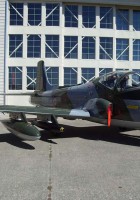
Nuotraukų galerija BAC 167 Strikemaster Mk80A, The BAC 167 Strikemaster is a British jet-powered training and light attack aircraft. It was a development of the Hunting Jet Provost trainer, itself a jet engined version of the Percival Provost, which originally flew in 1950 with a radial piston engine.

Šaltinis: BAC 167 Strikemaster Mk80A on Wiki

Tęsti svarstymą

Views : 3494

Curtiss F9C-2 Žvirblis

Curtiss F9C-2 Žvirblis

ŠaliesJav
TipasBiplane naikintuvai
Pirmasis skrydis1931 m. vasario 12 d.
Pastatytas7+

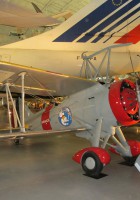
"Curtiss F9C Sparrowhawk" yra lengvas 1930-ųjų dvipusis naikintuvas, kurį gabeno Jungtinių Valstijų karinio jūrų laivyno dirižabliai "USS Akron" ir "Macon". Tai yra parazitų kovotojo, mažo lėktuvo, skirto dislokuoti iš didesnio orlaivio, pavyzdžiui, dirižablio ar bombonešio, pavyzdys.

Šaltinis: Curtiss F9C-2 Žvirblis apie Wiki

Tęsti svarstymą

Views : 3419

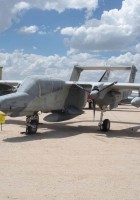
Šiaurės Amerikos Rockwell OV-10 Bronco

Šiaurės Amerikos Rockwell OV-10 Bronco

ŠaliesJav
TipasŠviesos atakos ir stebėjimo orlaiviai
Pagamintas1965–86
Sukurtas skaičius360

2007 Šiaurės Amerikos Rockwell OV-10 Bronco Yra amerikiečių turbopropelerinis šviesos atakos ir stebėjimo lėktuvas. Jis buvo sukurtas 1960-aisiais kaip specialus orlaivis kovai su sukilėliais (COIN), o viena iš pagrindinių jo misijų buvo priešakinių oro kontrolės (FAC) orlaivių. Jis gali gabenti iki trijų tonų išorinių šaudmenų, vidinių apkrovų, tokių kaip desantininkai ar neštuvai, ir gali loiter tris ar daugiau valandų.

Šaltinis: Šiaurės Amerikos Rockwell OV-10 Bronco dėl Wiki

Tęsti svarstymą

Views : 2625

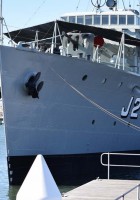
HMAS pilis (J244)

HMAS pilis (J244)

ŠaliesAustralija
TipasKorvetė
NuotraukaVladimiras Yakubovas
SuraskiteMelburnas, Australija
Aprašymas / kontrolėAlbumas 89 nuotraukos pasivaikščiojimas po «HMAS Castlemaine (J244)»

Nuotraukų galerija HMAS pilis (J244), HMAS Castlemaine (J244/M244/A248), named for the city of Castlemaine, Victoria, was one of 60 Bathurst-class corvettes constructed during World War II, and one of 36 initially manned and commissioned solely by the Royal Australian Navy (RAN). Launched in 1941 and commissioned in 1942, Castlemaine operated during World War II in the waters of Australia, New Guinea, and Timor. She remained in service until 1945, when she was decommissioned into reserve and converted into an immobilised training ship. In 1973, Castlemaine was presented to the Maritime Trust of Australia for conversion of a museum ship. She is one of two surviving examples of the Bathurst class, the other being HMAS Whyalla.

Šaltinis: HMAS Castlemaine (J244) on Wiki

Tęsti svarstymą

Views : 2624

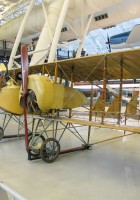
Caudron G.4

Caudron G.4

ŠaliesPrancūzija
TipasBiplanas
NuotraukaVladimiras Yakubovas
SuraskiteNacionalinis oro ir kosmoso muziejus – Udvar-Hazy centras, Chantilly
Aprašymas / kontrolėAlbumas 84 nuotraukos vaikšto po «Caudron G.4»

Nuotraukų galerija Caudron G.4, The Caudron G.4 was a French biplane with twin engines, widely used during World War I as a bomber aircraft. It was designed by René and Gaston Caudron as an improvement over their single engined Caudron G.3. The aircraft employed wing warping for banking. The first G.4 was built in 1915, and it was manufactured in France, England and Italy. The Caudron G.4 was used as a reconnaissance bomber into the heart of Germany. Later, when Germany developed a fighter force, the aircraft had to be used for night bombings.

Šaltinis: Caudron G.4 apie Wiki

Tęsti svarstymą

Views : 5171

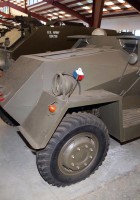
M53/59 Praga

M53/59 Praga

ŠaliesČekoslovakija
TipasSavaeigis priešgaisrinis ginklas
Pagamintas1950-ieji
Pastatytas900+

2007 M53/59 Praga is a Czechoslovak self-propelled anti-aircraft gun developed in the late 1950s. It consists of a heavily modified Praga V3S six-wheel drive truck chassis, armed with a twin 30 mm AA autocannon mounted on the rear for which the vehicle typically carries 900 rounds of ammunition, each gun being gravity fed from distinctive 50 round magazines. The vehicle has an armoured cabin. In Czechoslovakia it was known as Praga PLDvK vz. 53/59 – “Ještěrka” (PLDvK Model 53/59 – “Lizard”[2]). PLDvK stands for Protiletadlový dvojkanón = Anti-aircraft twin-gun.

Šaltinis: M53/59 Praga apie Wiki

Tęsti svarstymą

Peržiūrų kiekis : 3743