BAC 167 Strikemaster Mk80A

BAC 167 Strikemaster Mk80A

LandGroßbritannien
TypJet-powered Training
Produziert1967-1984
Gebaut146

Fotogalerie eines BAC 167 Strikemaster Mk80A, The BAC 167 Strikemaster is a British jet-powered training and light attack aircraft. It was a development of the Hunting Jet Provost trainer, itself a jet engined version of the Percival Provost, which originally flew in 1950 with a radial piston engine.

Quelle: BAC 167 Strikemaster Mk80A auf Wiki

Weiterlesen

Aufrufe : 3492

Curtiss F9C-2 Sparrowhawk

Curtiss F9C-2 Sparrowhawk

LandUsa
TypDoppeldecker
Erstflug12. Februar 1931
Gebaut7+

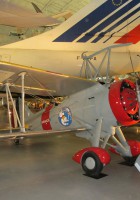
Die Curtiss F9C Sparrowhawk ist ein leichtes Doppeldecker-Jagdflugzeug aus den 1930er Jahren, das von den Luftschiffen USS Akron und Macon der United States Navy getragen wurde. Es ist ein Beispiel für einen parasitären Jäger, ein kleines Flugzeug, das von einem größeren Flugzeug wie einem Luftschiff oder Bomber aus eingesetzt werden kann.

Quelle: Curtiss F9C-2 Sparrowhawk auf Wiki

Weiterlesen

Aufrufe : 3419

North American Rockwell OV-10 Bronco

North American Rockwell OV-10 Bronco

LandUsa
TypLeichtes Angriffs- und Beobachtungsflugzeug
Produziert1965–86
Anzahl gebaut360

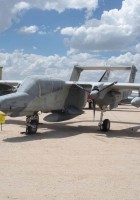
das North American Rockwell OV-10 Bronco ist ein amerikanisches Turboprop-Leichtangriffs- und Beobachtungsflugzeug. Es wurde in den 1960er Jahren als Spezialflugzeug für die Bekämpfung von Aufstandsbekämpfung (COIN) entwickelt, und eine seiner Hauptaufgaben war als Vorwärts-Luftkontrollflugzeug (FAC). Es kann bis zu drei Tonnen externe Munition, interne Ladungen wie Fallschirmjäger oder Tragen transportieren und kann für drei oder mehr Stunden lauern.

Quelle: North American Rockwell OV-10 Bronco auf Wiki

Weiterlesen

Ansichten : 2458

HMAS Castlemaine (J244)

HMAS Castlemaine (J244)

LandAustralien
TypKorvette
FotoWladimir Nikolajewitsch Jakubow
SuchenMelbourne, Australien
BeschreibungAlbum von 89 Fotos Rundgang durch eine «HMAS Castlemaine (J244)»

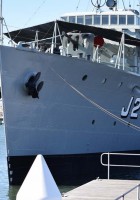
Fotogalerie eines HMAS Castlemaine (J244), HMAS Castlemaine (J244/M244/A248), named for the city of Castlemaine, Victoria, was one of 60 Bathurst-class corvettes constructed during World War II, and one of 36 initially manned and commissioned solely by the Royal Australian Navy (RAN). Launched in 1941 and commissioned in 1942, Castlemaine operated during World War II in the waters of Australia, New Guinea, and Timor. She remained in service until 1945, when she was decommissioned into reserve and converted into an immobilised training ship. In 1973, Castlemaine was presented to the Maritime Trust of Australia for conversion of a museum ship. She is one of two surviving examples of the Bathurst class, the other being HMAS Whyalla.

Quelle: HMAS Castlemaine (J244) auf Wiki

Weiterlesen

Ansichten : 2616

Caudron G.4

Caudron G.4

LandFrankreich
TypDoppeldecker
FotoWladimir Nikolajewitsch Jakubow
SuchenNational Air & Space Museum – Udvar-Hazy Center, Chantilly
BeschreibungAlbum von 84 Fotos walk-around von einem »Caudron G.4»

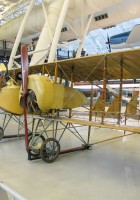
Fotogalerie eines Caudron G.4, The Caudron G.4 was a French biplane with twin engines, widely used during World War I as a bomber aircraft. It was designed by René and Gaston Caudron as an improvement over their single engined Caudron G.3. The aircraft employed wing warping for banking. The first G.4 was built in 1915, and it was manufactured in France, England and Italy. The Caudron G.4 was used as a reconnaissance bomber into the heart of Germany. Later, when Germany developed a fighter force, the aircraft had to be used for night bombings.

Quelle: Caudron G.4 auf Wiki

Weiterlesen

Aufrufe : 5165

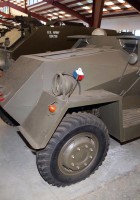
M53/59 Praga

M53/59 Praga

LandTschechoslowakei
TypSelbstfahrende Flugabwehrkanone
Produziert1950er Jahre
Gebaut900+

das M53/59 Praga is a Czechoslovak self-propelled anti-aircraft gun developed in the late 1950s. It consists of a heavily modified Praga V3S six-wheel drive truck chassis, armed with a twin 30 mm AA autocannon mounted on the rear for which the vehicle typically carries 900 rounds of ammunition, each gun being gravity fed from distinctive 50 round magazines. The vehicle has an armoured cabin. In Czechoslovakia it was known as Praga PLDvK vz. 53/59 – “Ještěrka” (PLDvK Model 53/59 – “Lizard”[2]). PLDvK stands for Protiletadlový dvojkanón = Anti-aircraft twin-gun.

Quelle: M53/59 Praga auf Wiki

Weiterlesen

Aufrufe : 3739

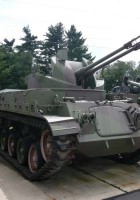
M42A1 Duster

M42A1 Duster

LandUsa
TypSelbstfahrende Flugabwehrkanone
FotoWladimir Nikolajewitsch Jakubow
SuchenMilitärmuseum Motts
BeschreibungAlbum von 152 Fotos Rundgang eines «M42A1 Duster»

Fotogalerie eines M42A1 Duster, The M42 40 mm Self-Propelled Anti-Aircraft Gun, or “Duster,” is an American armored light air-defense gun built for the United States Army from 1952 until December 1959, in service until 1988. Production of this vehicle was performed by the tank division of the General Motors Corporation. It used components from the M41 light tank and was constructed of all-welded steel.

Quelle: M42A1 Duster im Wiki

Weiterlesen

Aufrufe : 3957

Mig-27K

Mig-27K

LandURSS
TypBodenangriffsflugzeug
FotoWladimir Nikolajewitsch Jakubow
SuchenMinsk-Borovaya Luftmuseum
BeschreibungAlbum von 175 Fotos walk-around von einem "Mig-27K"

Fotogalerie eines Mig-27K, The Mikoyan MiG-27 (Russian: Микоян МиГ-27; NATO reporting name “Flogger-D/J”) is a variable-geometry ground-attack aircraft, originally built by the Mikoyan design bureau in the Soviet Union and later license-produced in India by Hindustan Aeronautics as the Bahadur (“Valiant”). It is based on the Mikoyan-Gurevich MiG-23 fighter aircraft, but optimized for air-to-ground attack. Unlike the MiG-23, the MiG-27 did not see widespread use outside Russia, as most countries opted for the MiG-23BN and Sukhoi Su-22 instead. It currently only remains in service with the Indian, Kazakh and Sri Lankan Air Forces in the ground attack role. All Russian and Ukrainian MiG-27s have been retired.

Quelle: Mig-27K auf Wiki

Weiterlesen

Aufrufe : 5673

Kugisho-Yokosuka K-1 Ohka

Kugisho/Yokosuka K-1 Ohka

LandJapan
TypRaketenbetriebene Menschen
ErstflugJanuar 1944
Gebaut852

Fotogalerie eines Kugisho/Yokosuka K-1 Ohka, The Yokosuka MXY-7 Ohka was a purpose-built, rocket powered human-guided anti-shipping kamikaze attack plane employed by Japan towards the end of World War II. Ohka K-1: eine nicht angetriebene Trainerversion mit Wasserballast anstelle von Sprengkopf und Motoren, um piloten Handling-Erfahrung zu bieten. 45 wurden von Dai-Ichi Kaigun Koku Gijitsusho gebaut

Quelle: Kugisho/Yokosuka K-1 Ohka auf Wiki

Weiterlesen

Views : 2354

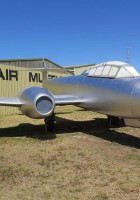
Gloster Meteor T.7

Gloster Meteor T.7

LandGroßbritannien
TypKampfflugzeuge
FotoWladimir Nikolajewitsch Jakubow
SuchenAustralisches Nationales Luftfahrtmuseum
BeschreibungAlbum von 71 Fotos Rundgang eines «Gloster Meteor T.7»

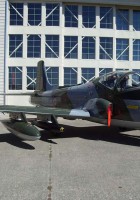
Fotogalerie eines Gloster Meteor T.7, The Gloster Meteor was the first British jet fighter and the Allies’ only operational jet aircraft during the Second World War. The Meteor’s development was heavily reliant on its ground-breaking turbojet engines, pioneered by Sir Frank Whittle and his company, Power Jets Ltd. Development of the aircraft itself began in 1940, although work on the engines had been under way since 1936. The Meteor first flew in 1943 and commenced operations on 27 July 1944 with No. 616 Squadron RAF. Nicknamed the “Meatbox”, the Meteor was not a sophisticated aircraft in its aerodynamics, but proved to be a successful combat fighter. Gloster’s 1946 civil Meteor F.4 demonstrator G-AIDC was the first civilian-registered jet aircraft in the world. Meteor T.7: Two-seat trainer variant of the F.4, company prototype first flew 19 March 1948, 640 production aircraft for the Royal Air Force and the Royal Navy (43) and 72 for export (Belgium, Brazil, Denmark, Egypt, France, Israel, Netherlands). Avions Fairey modified 20 Belgian Air Force F.4s to T.7 standard.

Quelle: Gloster Meteor T.7 auf Wikipedia
Weiterlesen

Aufrufe : 3433