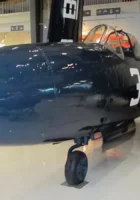
McDonnell Douglas FH-1 Phantom

McDonnell FH Phantom

Country USA
Role Carrier-based fighter aircraft
First flight 26 January 1945
Built 62

The McDonnell FH Phantom was a twin-engined jet fighter aircraft designed and first flown during World War II for the United States Navy. The Phantom was the first purely jet-powered aircraft to land on an American aircraft carrier and the first jet deployed by the United States Marine Corps. Although with the end of the war, only 62 FH-1s were built, it helped prove the viability of carrier-based jet fighters. As McDonnell’s first successful fighter, leading to the development of the follow-on F2H Banshee, which was one of the two most important naval jet fighters of the Korean War, it would also establish McDonnell as an important supplier of Navy aircraft. When McDonnell chose to bring the name back with the Mach 2–class McDonnell Douglas F-4 Phantom II, it launched what would become the most versatile and widely used western combat aircraft of the Vietnam War era, adopted by the USAF and the US Navy

Source: McDonnell FH Phantom on Wikipedia
Continue reading

Views : 2502

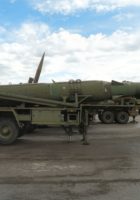
Pershing II Erector Launcher

Pershing II

Country USA
Role Medium-range ballistic missile
In service 1983–1991
Built 276

The Pershing II Weapon System was a solid-fueled two-stage ballistic missile designed and built by Martin Marietta to replace the Pershing 1a Field Artillery Missile System as the United States Army’s primary nuclear-capable theater-level weapon. The U.S. Army replaced the Pershing 1a with the Pershing II Weapon System in 1983 while the German Air Force retained Pershing 1a until all Pershings were eliminated in 1991. The U.S. Army Missile Command (MICOM) managed the development and improvements while the Field Artillery Branch deployed the systems and developed tactical doctrine.

Source: Pershing II on Wikipedia
Continue reading

Views : 4350

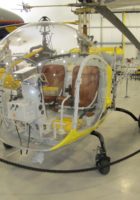
Bell 47D

Bell 47

Country USA
Role Multipurpose light helicopter
First flight 8 December 1945
Built 5600

The Bell 47 is a single rotor single engine light helicopter manufactured by Bell Helicopter. Based on the third Bell 30 prototype, the company’s first helicopter designed by Arthur M. Young, the 47 became the first helicopter certified for civilian use on 8 March 1946. More than 5,600 Bell 47s were produced, including those under license by Agusta in Italy, Kawasaki Heavy Industries in Japan, and Westland Aircraft in the United Kingdom. The Bell 47J Ranger is a modified version with a fully enclosed cabin and fuselage.

Source: Bell 47 on Wikipedia
Continue reading

Views : 5679

M65 280 mm Atomic Cannon

M65 atomic cannon

Country USA
Role Towed artillery
Caliber 280 mm
Built 20+

The M65 atomic cannon, often called “Atomic Annie”, was a towed artillery piece built by the United States and capable of firing a nuclear device. It was developed in the early 1950s, at the beginning of the Cold War, and fielded, by 1953, in Europe and South Korea.

Source: M65 atomic cannon on Wikipedia
Continue reading

Views : 3459

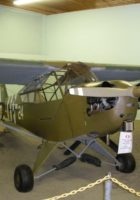
Piper L-4B Grasshopper

Piper L-4 Grasshopper

Country USA
Role Trainer
First flight 1938
Built 19800+

Piper developed a military variant (“All we had to do,” Bill Jr. is quoted as saying, “was paint the Cub olive drab to produce a military airplane”), variously designated as the O-59 (1941), L-4 (after April 1942) and NE (U.S. Navy). The L-4 Grasshopper was mechanically identical to the J-3 civilian Cub, but was distinguishable by the use of a Plexiglas greenhouse skylight and rear windows for improved visibility, much like the Taylorcraft L-2 and Aeronca L-3 also in use with the US armed forces. Carrying a single pilot and no passenger, the L-4 had a top speed of 85 mph (137 km/h), a cruise speed of 75 mph (121 km/h), a service ceiling of 12,000 ft (3,658 m), a stall speed of 38 mph (61 km/h), an endurance of three hours, and a range of 225 mi (362 km). Some 5,413 L-4s were produced for U.S. forces, including 250 built for the U.S. Navy under contract as the NE-1 and NE-2.

Source: Piper L-4 Grasshopper on Wikipedia
Continue reading

Views : 6484

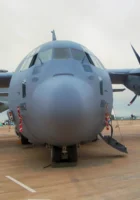
Lockheed Martin C-130J Super Hercules

C-130J Hercules

Country USA
Role Military transport, aerial refuelling
First flight 5 April 1996
Built 300+

The Lockheed Martin C-130J Super Hercules is a four-engine turboprop military transport aircraft. The C-130J is a comprehensive update of the Lockheed C-130 Hercules, with new engines, flight deck, and other systems. The Hercules family has the longest continuous production run of any military aircraft in history. During more than 60 years of service, the family has participated in military, civilian, and humanitarian aid operations. The Hercules has outlived several planned successor designs, most notably the Advanced Medium STOL Transport contestants. Fifteen nations have placed orders for a total of 300 C-130Js, of which 250 aircraft have been delivered as of February 2012

Source: C-130J Hercules on Wikipedia
Continue reading

Views : 2965

Taylorcraft L-2M Grasshoper

Taylorcraft L-2

Country USA
Role Observation and Liaison
First flight 1941
Built Unknow

The Taylorcraft L-2 Grasshopper is an American observation and liaison aircraft built by Taylorcraft for the United States Army Air Forces in World War II. In 1941 the United States Army Air Forces ordered four Taylorcraft Model Ds with the designation YO-57. They were evaluated in the summer of 1941 during maneuvers in Louisiana and Texas where they were used for support purposes such as light transport and courier. General Innis P. Swift, commander of the 1st Cavalry Division, coined the ‘grasshopper’ name after witnessing a bumpy landing. This led to a production order under the designation O-57 Grasshopper. In March 1942, the designation was changed to L-2 Grasshopper.

Source: Taylorcraft L-2 on Wikipedia
Continue reading

Views : 1414

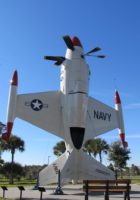
Lockheed XFV Salmon

Lockheed XFV

Country USA
Role Experimental VTOL fighter aircraft
First flight 16 June 1954
Built 1

The American Lockheed XFV (sometimes referred to as the Salmon) was an experimental tailsitter prototype aircraft built by Lockheed in the early 1950s to demonstrate the operation of a vertical takeoff and landing fighter for protecting convoys.

Source: Lockheed XFV on Wikipedia
Continue reading

Views : 1620

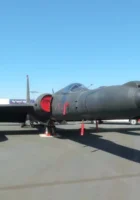
Lockheed U-2S Senior Year

Lockheed U-2

Country USA
Role High-altitude reconnaissance aircraft
First flight 1 August 1955
Built 1104

The Lockheed U-2, nicknamed “Dragon Lady”, is an American single-jet engine, ultra-high altitude reconnaissance aircraft operated by the United States Air Force (USAF) and previously flown by the Central Intelligence Agency (CIA). It provides day and night, high-altitude (70,000 feet; 21,000 m), all-weather intelligence gathering. The U-2 has also been used for electronic sensor research, satellite calibration, scientific research, and communications purposes.

Source: Lockheed U-2 on Wikipedia
Continue reading

Views : 5220

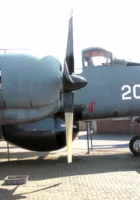
Lockheed Neptune

Lockheed P-2 Neptune

Country USA
Role Maritime Patrol and Anti-Submarine Warfare
First flight 17 May 1945
Retired 1984 From military use

The Lockheed P-2 Neptune (designated P2V by the United States Navy prior to September 1962) was a Maritime patrol and anti-submarine warfare (ASW) aircraft. It was developed for the US Navy by Lockheed to replace the Lockheed PV-1 Ventura and PV-2 Harpoon, and was replaced in turn by the Lockheed P-3 Orion. Designed as a land-based aircraft, the Neptune never made a carrier landing, although a small number of aircraft were converted and deployed as carrier-launched, stop-gap nuclear bombers which would have to ditch or recover at land bases. The type was successful in export and saw service with several armed forces.

Source: Lockheed P-2 Neptune on Wikipedia
Continue reading

Views : 8232