Wydawnictwo Militaria 007 - PzKpfw 35t

Wydawnictwo Militaria

SeriesWydawnictwo Militaria
Réf007
PeriodWorld War II
SujetPzKpfw 35(t)

Signed documentation Wydawnictwo Militaria le livre «PzKpfw 35(t) – Wydawnictwo Militaria 007» .

Les Chars LT vz 35 were employed by the Czechoslovak army from 1937 to 1939. But a total of 219 LT vz 35 tanks were captured by Germany in March 1939 and employed by the Wehrmacht during World War II. They were first used, from June 5, 1939, by the cavalry under the name LTM 35. But after January 16, 1940, they fell under the control of the Panzertruppe, the German armored units, under the name Panzer 35(t), the letter t indicating their Czechoslovak origin. The 6th Panzer Division (which at the time was still called the 1st Light Cavalry Division) was equipped with it at the beginning of the war, and the tanks served in Poland in 1939 and in France in 1940. But from 1940, there were no more spare parts and the tanks had to be completely rebuilt to remain operational; it was therefore decided that the campaign of the summer of 1941 would be their last. In addition, Panzer 35(t) proved to be totally inadequate in the face of the extreme cold encountered in the USSR. At the end of November 1941, not a single one was operational. These weaknesses, in addition to the thinness of their armor and the low caliber of their gun against Soviet tanks, meant that most were withdrawn from the front and the 26 still operating in 1942 were sold to Romania. The tank continues to serve another year in Slovakia and Romania. Some are then transformed by Germany into ammunition transporters or tractors.

Source: Wikipedia

Continue reading

Views : 665

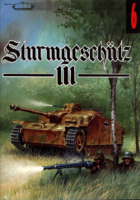
Sturmgeschutz III - Wydawnictwo Militaria 006

Wydawnictwo Militaria

SeriesWydawnictwo Militaria
Réf006
SujetSturmgeschutz III
Periodww2

Signed documentation Wydawnictwo Militaria the book "Sturmgeschutz III - Wydawnictwo Militaria 006" .

The assault cannon Sturmgeschütz III (StuG III) fut le véhicule blindé de combat produit au plus grand nombre d’exemplaires par l’Allemagne au cours de la Seconde Guerre mondiale. Il était construit sur le châssis du char Panzer III. Conçu au départ comme un canon léger blindé destiné à soutenir l’infanterie, le StuG fut continuellement modifié et fut largement employé comme chasseur de chars. La série des Sturmgeschütz est reconnue pour son excellent rapport prix/qualité. À la fin de la guerre, plus de 10 500 avaient été construits.

Source: Wikipedia

Continue reading

Views : 1208

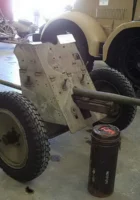
37mm Pak35-36

37mm Pak35-36

PaysGermany
TypeAnti-tank gun
PeriodWorld War II

Photo gallery on a Pak35-36 cannon, The Pak 36 (Panzerabwehrkanone 36) was a German anti-tank gun capable of firing 37 mm caliber shells. Developed in 1936 by Rheinmetall, the Pak 36 appeared the same year during the Spanish Civil War. It became the base of the anti-tank guns of many countries during the early years of The Second World War. The KwK 36 L45 was the same gun, but served as armament on several battle tanks, including early-war models such as the Panzer III.

Source: Pak35-36 Anti-Tank Gun on Wikipedia

Continue reading

Views : 5701

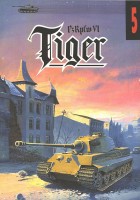
Wydawnictwo Militaria 005 - PzKpfw VI Kenig Tiger

Wydawnictwo Militaria

SeriesWydawnictwo Militaria
Réf005
SujetPanzerkampfwagen VI Tiger
Periodww2

Signed documentation Wydawnictwo Militaria le livre «Panzerkampfwagen VI Tiger – Wydawnictwo Militaria 005» .

The Tiger I (Tigre), char d’assaut lourd allemand, en service de 1942 à 1945, est l’un des chars les plus connus de la Seconde Guerre mondiale, bien qu’il n’ait été que peu produit par rapport au T-34 soviétique ou au Sherman américain. Ce sont ses dimensions, ses lignes très carrées, sa résistance au combat, sa puissance ainsi que les équipages expérimentés l’ayant mené au feu qui ont marqué les esprits, notamment du fait de la propagande allemande. Son développement a commencé en 1937 et, quand il apparaît pour la première fois sur le front, le 29 août 1942, près de Léningrad, le Tigre I est le char techniquement le plus avancé, le mieux protégé et le plus puissant aligné par l’Axe, affichant une mobilité limitée mais exceptionnelle pour un engin qui fait plus de deux fois le poids de ses prédécesseurs et de la majorité de ses adversaires chenillés. Mais le char lourd, outre de sa production faible, a pâti tout au long de sa carrière de sa mécanique très fragile réduisant considérablement sa disponibilité au feu, de sa mise en œuvre opérationnelle rendue difficile par sa faible autonomie, souffrant également de son poids excessif. Construit à seulement 1 350 exemplaires, il n’a été que rarement endivisionné mais plutôt engagé dans des unités indépendantes.

Source: Wikipedia

Continue reading

Views : 734

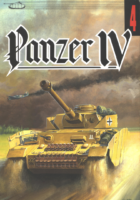
Wydawnictwo Militaria 004 - Panzer IV

Wydawnictwo Militaria

SeriesWydawnictwo Militaria
Réf004
PeriodWorld War II
SujetPanzer IV

Signed documentation Wydawnictwo Militaria the book "Panzer IV - Wydawnictwo Militaria 004" .

The Panzerkampfwagen IV (PzKpfW IV), often referred to as Panzer IV was a tank used by Nazi Germany during World War II. Originally designed as a fire support tank, with a short 75 mm gun, for the Panzerkampfwagen III, it eventually replaced the panzerkampfwagen III when allied tanks became too protected for the pan. Re-equipped with a long anti-tank gun, the PzKpfW IV was the main German tank during the second part of the war with more than 9000 copies produced and gave birth to many versions.

Source: Wikipedia

Continue reading

Views : 767

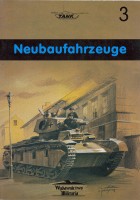
Wydawnictwo Militaria 003 - Neubaufahrzeuge

Wydawnictwo Militaria

SeriesWydawnictwo Militaria
Réf003
SujetNeubaufahrzeug
Periodww2

Signed documentation Wydawnictwo Militaria le livre «Neubaufahrzeug – Military Publishing House 003» .

The german prototype series Neubaufahrzeug was a first attempt to create a heavy tank for the Wehrmacht, after Adolf Hitler came to power. Multi-turrets, heavy and slow, these tanks did not fit with the tactics of the Blitzkrieg and were not put into production. They were mainly used for propaganda purposes, although three took part in the Norwegian campaign in 1940.

Source: Neubaufahrzeug on Wikipedia

Continue reading

Views: 830

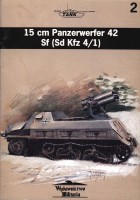
Panzerwefer 42 - sdkfz.4/1 - Wydawnictwo Militaria 002

Wydawnictwo Militaria

SeriesWydawnictwo Militaria
Réf002
SujetPanzerwefer 42 - sdkfz.4/1
Periodwwii

Signed documentation Wydawnictwo Militaria the book "Panzerwefer 42 - sdkfz.4/1 - Wydawnictwo Militaria 002" .

The massive use of multiple rocket launchers by the Wehrmacht led to the deployment of Nebelwerfer (lanceurs de brouillard) au plus près de la ligne de front. Cette arme peu onéreuse et d’une grande efficacité dans les tirs de saturation du champ de bataille avait cependant un point faible. La traînée de fumée laissée par la combustion de la poudre du propulseur de la roquette lors de son départ était un indice visible pour les tirs de contre-batterie de l’artillerie adverse. On monta donc un lance-roquettes multiple, d’abord de 110 mm puis de 150 mm, sur un Sd.Kfz. 3 Opel Maultier modifié par adjonction d’un blindage sur la superstructure. L’engin fut désigné Panzerwerfer 42 (Sd.Kfz. 4/1). Aussi, la mobilité devint un atout majeur pour la sauvegarde des « faiseurs de nuée ». Comme ils étaient grands consommateurs de projectiles, il fallut prévoir un second véhicule rapide, tout-terrain et blindé pour effectuer le ravitaillement en munitions dans des conditions de sécurité maximales. Des Opel Maultier blindés dérivés du lanceur furent ainsi transformés en véhicule de ravitaillement. Ce véhicule conservait les caractéristiques principales du véhicule lanceur.

Source: Wikipedia

Continue reading

Views : 568

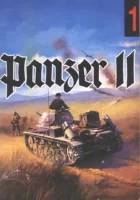
Wydawnictwo Militaria 01 Panzer II

Wydawnictwo Militaria

SeriesWydawnictwo Militaria
Réf001
SujetPanzer II
Periodwwii

Signed documentation Wydawnictwo Militaria the book "Panzer II - Wydawnictwo Militaria 001" .

The Panzerkampfwagen II ( PzKpfw II ) or Sd. Kfz. 121 was a German-made tank. Like the PzKpfw I, it was designed as a temporary model, waiting for tanks like the PzKpfw III or the PzKpfw IV. Both types of vehicles were intended to provide training gear for The Panzerwaffe crews to develop the tactics of the future Blitzkrieg. However, the delay in the production of real battle tanks forced the Germans to use them massively during the beginning of the Second World War, and it was not until 1941 that they were gradually removed from the front lines. Subsequently, however, the PzKpfw II remained for a long time an important vehicle in the Wehrmacht's arsenal, thanks to reconnaissance derivatives and as a chassis for self-propelled guns, such as the Marder II and the Wespe. It had one more crew member than the Panzer I, a radio operator, also responsible for reloading the 20 mm automatic gun.

Source: Wikipedia

Continue reading

Views: 1479

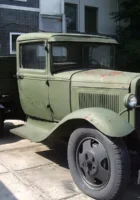
Truck Gaz AA

Truck Gaz AA

CountryUSA
TypeTruck
DescriptionAlbum of 40 photos walk-around of a truck Gaz AA

Photo gallery of a truck Gaz AA, Ford Model AA is a truck from Ford. As the Model T and TT became obsolete and needed to be replaced, Henry Ford began initial designs on the Model A and Model AA in 1926. Basic chassis layout was done rapidly and mechanical development was moved forward quickly. Body design and style was developed and then outsourced to various body manufacturers, including Briggs and Murray. The designs of the Model A shared parts and materials with the Model AA Ford, notably the body, engine and interior. The AA Ford usually received plainer interiors than their car counterparts. The Model AA Ford followed similar design changes that the Model A Ford underwent during the four year production, but often those changes followed on a delay, anywhere from three to nine months. The mechanical changes and upgrades were done during production of the vehicles. Body changes that occurred between 1929 and 1930 were also integrated into the Ford AA production, but leftover parts were used longer in the heavy commercial trucks.

Source: Gaz AA on Wikipedia

Continue reading

Views : 6795

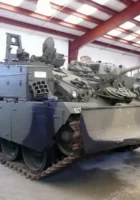
FV4204 Chieftain

FV4204 Chieftain

PaysUK
TypeChar lourd
SujetAlbum de 147 photos du «FV4204 Chieftain»

Le Char Chieftain (fv-4204) est un char d’assaut lourd britannique conçu par la Royal Ordnance Factory, dans les années 1960 qui resté en service, dans les forces britanniques, de 1966 à 1995. Des versions d’engins de génie militaire furent également construit.

Source: FV4204 Chieftain sur Wikipedia

Continue reading

Views : 3843