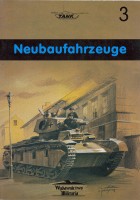
Wydawnictwo Militaria 003 - Neubaufahrzeuge

Wydawnictwo Militaria

SeriesWydawnictwo Militaria
Réf003
SujetNeubaufahrzeug
Periodww2

Signed documentation Wydawnictwo Militaria le livre «Neubaufahrzeug – Military Publishing House 003» .

The german prototype series Neubaufahrzeug was a first attempt to create a heavy tank for the Wehrmacht, after Adolf Hitler came to power. Multi-turrets, heavy and slow, these tanks did not fit with the tactics of the Blitzkrieg and were not put into production. They were mainly used for propaganda purposes, although three took part in the Norwegian campaign in 1940.

Source: Neubaufahrzeug on Wikipedia

Continue reading

Views : 943

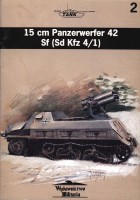
Panzerwefer 42 - sdkfz.4/1 - Wydawnictwo Militaria 002

Wydawnictwo Militaria

SeriesWydawnictwo Militaria
Réf002
SujetPanzerwefer 42 - sdkfz.4/1
Periodwwii

Signed documentation Wydawnictwo Militaria the book "Panzerwefer 42 - sdkfz.4/1 - Wydawnictwo Militaria 002" .

The massive use of multiple rocket launchers by the Wehrmacht led to the deployment of Nebelwerfer (lanceurs de brouillard) au plus près de la ligne de front. Cette arme peu onéreuse et d’une grande efficacité dans les tirs de saturation du champ de bataille avait cependant un point faible. La traînée de fumée laissée par la combustion de la poudre du propulseur de la roquette lors de son départ était un indice visible pour les tirs de contre-batterie de l’artillerie adverse. On monta donc un lance-roquettes multiple, d’abord de 110 mm puis de 150 mm, sur un Sd.Kfz. 3 Opel Maultier modifié par adjonction d’un blindage sur la superstructure. L’engin fut désigné Panzerwerfer 42 (Sd.Kfz. 4/1). Aussi, la mobilité devint un atout majeur pour la sauvegarde des « faiseurs de nuée ». Comme ils étaient grands consommateurs de projectiles, il fallut prévoir un second véhicule rapide, tout-terrain et blindé pour effectuer le ravitaillement en munitions dans des conditions de sécurité maximales. Des Opel Maultier blindés dérivés du lanceur furent ainsi transformés en véhicule de ravitaillement. Ce véhicule conservait les caractéristiques principales du véhicule lanceur.

Source: Wikipedia

Continue reading

Views: 687

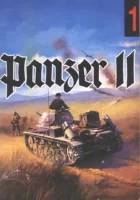
Wydawnictwo Militaria 01 Panzer II

Wydawnictwo Militaria

SeriesWydawnictwo Militaria
Réf001
SujetPanzer II
Periodwwii

Signed documentation Wydawnictwo Militaria the book "Panzer II - Wydawnictwo Militaria 001" .

The Panzerkampfwagen II ( PzKpfw II ) or Sd. Kfz. 121 was a German-made tank. Like the PzKpfw I, it was designed as a temporary model, waiting for tanks like the PzKpfw III or the PzKpfw IV. Both types of vehicles were intended to provide training gear for The Panzerwaffe crews to develop the tactics of the future Blitzkrieg. However, the delay in the production of real battle tanks forced the Germans to use them massively during the beginning of the Second World War, and it was not until 1941 that they were gradually removed from the front lines. Subsequently, however, the PzKpfw II remained for a long time an important vehicle in the Wehrmacht's arsenal, thanks to reconnaissance derivatives and as a chassis for self-propelled guns, such as the Marder II and the Wespe. It had one more crew member than the Panzer I, a radio operator, also responsible for reloading the 20 mm automatic gun.

Source: Wikipedia

Continue reading

Views : 1631

Truck Gaz AA

Truck Gaz AA

CountryUSA
TypeTruck
DescriptionAlbum of 40 photos walk-around of a truck Gaz AA

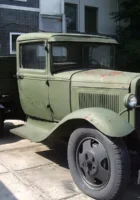
Photo gallery of a truck Gaz AA, Ford Model AA is a truck from Ford. As the Model T and TT became obsolete and needed to be replaced, Henry Ford began initial designs on the Model A and Model AA in 1926. Basic chassis layout was done rapidly and mechanical development was moved forward quickly. Body design and style was developed and then outsourced to various body manufacturers, including Briggs and Murray. The designs of the Model A shared parts and materials with the Model AA Ford, notably the body, engine and interior. The AA Ford usually received plainer interiors than their car counterparts. The Model AA Ford followed similar design changes that the Model A Ford underwent during the four year production, but often those changes followed on a delay, anywhere from three to nine months. The mechanical changes and upgrades were done during production of the vehicles. Body changes that occurred between 1929 and 1930 were also integrated into the Ford AA production, but leftover parts were used longer in the heavy commercial trucks.

Source: Gaz AA on Wikipedia

Continue reading

Views : 7139

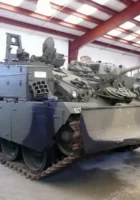
FV4204 Chieftain

FV4204 Chieftain

PaysUK
TypeChar lourd
SujetAlbum de 147 photos du «FV4204 Chieftain»

Le Char Chieftain (fv-4204) est un char d’assaut lourd britannique conçu par la Royal Ordnance Factory, dans les années 1960 qui resté en service, dans les forces britanniques, de 1966 à 1995. Des versions d’engins de génie militaire furent également construit.

Source: FV4204 Chieftain sur Wikipedia

Continue reading

Views : 4009

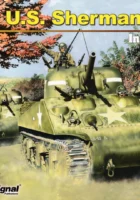
Squadron Signal 2048 WWII US Sherman Tank

Squadron Signal

SérieAmor In Action
RéfSS2048
SujetUS Sherman Tank
Périodewwii

Une documentation signée Squadron Signal le livre «WWII US Sherman Tank in Action – Squadron Signal SS2048» .

The iconic American tank of World War II, the M4 Sherman was known for its simple, reliable, and flexible design. Ten different companies contributed to the total output of 50,000 units produced in a myriad of variations. Even after it went into serial production in 1942 the Sherman was subject to almost constant change and modification, based on lessons learned and needs perceived on the battlefield. The full story of the Sherman’s exploits would fill several volumes, so this book focuses on the variants and sub-variants of the Shermans used by US forces during WWII. The Shermans that rolled off the assembly lines in 1945 bore little resemblance to the M4s produced in 1942, and this volume chronicles each major model of the Sherman everywhere the American soldier fought. Augmenting the nearly 200 period photos, many of them in rare original color, are a host of exquisitely rendered line drawings illustrating the subtle variations in hull, turret, and weapons used on these famed armored fighting vehicles. Includes color profiles; Ervin and Doyle; 80 pages.

Source: Squadron Signal

Continue reading

Views : 1764

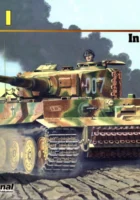
Squadron Signal 2047 Tiger I

Squadron Signal

SérieAmor In Action
RéfSS2047
SujetTiger I in Action
Périodewwii

Une documentation signée Squadron Signal le livre «Tiger I in Action – Squadron Signal SS2047» .

The Tiger is arguably the most feared tank of WWII. Billed as invincible by Nazi propaganda, the massive, heavily armed and armored vehicle’s mystique has continued to grow in the intervening years. Often forgotten were the 56-ton behemoth’s weaknesses, among which were a feeble powertrain and suspension, an unquenchable thirst for precious fuel, and perhaps most crucial, the huge drain it imposed on Germany’s manufacturing and engineering resources. Only 1,346 Tiger Is were produced; so precious a resource was the Tiger that even severely damaged vehicles were remanufactured and returned to the front, some multiple times – leading to a bewildering array of features over the tank’s many variants. Today, only a half-dozen Tigers survive, leaving period photographs as a visual record of their victories – and ultimate defeat. Illustrated with over 200 vintage photographs, plus color profiles and detailed line drawings. Doyle; 72 pages.

Source: Squadron Signal

Continue reading

Views : 1069

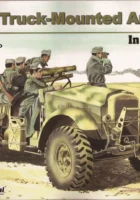
Squadron Signal 2044 Italian Truck-Mounted Artillery

Squadron Signal

SérieAmor In Action
RéfSS2044
SujetTruck-Mounted Artillery in Action
Périodewwii

Une documentation signée Squadron Signal le livre «Truck-Mounted Artillery in Action – Squadron Signal SS2042» .

Italian military planners saw the need for highly mobile artillery early in the 20th Century. Accordingly, Italy began mounting anti-aircraft weapons on truck chassis prior to WWI, giving birth to the autocannone, a weapon concept which would soldier through both World Wars. Inspired by the German half-tracks equipped with 88mm guns, the Italians reprised the autocannone with their 90/53 guns on a heavy truck chassis. Other vehicles, some captured, were mated with a wide variety of weapons, often in the field. A unique and lavishly-illustrated survey of the various weapon combinations devised by the Italian military from the inception of the autocannone until the end of WWII. Illustrated with over 200 photographs, plus color profiles and detailed line drawings. Riccio; 52 pages.

Source:Squadron Signal

Continue reading

Views : 898

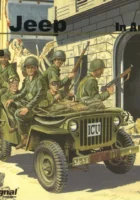
Squadron Signal 2042 WWII Jeep

Squadron Signal

TopicAmor In Action
RefSS2042
SubjectWorld War II Jeep
Periodwwii

A doc from Squadron Signal the book «World War II Jeep In Action – Squadron Signal SS2042» .

During World War II, the Jeep was enormously popular with troops and leaders. Originally designed as a reconnaissance car, Jeeps plowed through the sands of North Africa, the snows of central Europe, pulled aircraft across flight decks and ferried the wounded through jungles. Jeeps were configured for radio gear, armed with weapons, and bore stretchers. Large numbers of Jeeps were also delivered to allied nations. This book takes a detailed look at these vehicles’ service during World War II with more than 100 photographs, color profiles and detailed line drawings. Doyle; 52 pages.

Source: World War II Jeep In Action sur Squadron Signal

Continue reading

Views : 1725

Squadron Signal 2041 M551 Sheridan

Squadron Signal

SerieAmor In Action
RefSS2041
SubjectM551 Sheridan in Action
Periodwwii

Une documentation signée Squadron Signal le livre «M551 Sheridan in Action – Squadron Signal SS2041» .

Beginning in 1966, the Allison Division of General Motors built 1,562 M551s with primary armament being a 152-millimeter gun/launcher capable of firing conventional ammunition or the Ford-built Shillelagh anti-tank missile. The Sheridan was indeed a unique vehicle that served the US Army over 3 decades. While it was conceived as a light Armored Reconnaissance/Airborne Assault Vehicle that had both amphibious and airborne assault abilities, the casual observer, and most in the military, saw the M551 Sheridan as a tank. Whatever the conception, this vehicle proved an asset to the Army in Vietnam, Panama, and Operation Desert Storm. With a 4-man crew, this 6-cylinder Detroit Diesel engine-powered vehicle, though retired, has yet to be replaced by a more suitable military asset. Illustrated with 91 color photos, 8 b/w photos, 7 color profiles, 3-view drawing, vehicle development illustrations, and 2 colorized camouflage patterns. Doyle; 60 pages.

Source: Squadron Signal

Continue reading

Views : 1110